How many stars can you see with the naked eye?
About 8,600 across the whole sky, counting down to sixth magnitude. But only a fraction are visible at once, around 2,500 at best, and far fewer in a city.
8,600
We often speak of the stars as the very image of something beyond counting. But if you limit yourself to the stars visible without a telescope, there is a finite number. So how many are there?
Look it up and the answers don’t agree. Two major Japanese references, the Nihon Kokugo Daijiten dictionary and the Japanese edition of Britannica, put the number of naked-eye stars across the whole sky at about 6,000. The Nipponica encyclopedia says about 3,000. Meanwhile, a figure of 8,588 stars brighter than sixth magnitude is quoted from the Rika Nenpyo (Chronological Scientific Tables), the standard Japanese scientific data book compiled by the National Astronomical Observatory of Japan. Why the spread?
Where to draw the line
Astronomers rank brightness by “magnitude.” According to Nipponica, the system goes back to ancient Greece, where about 20 of the brightest stars were called first magnitude and the faintest stars the eye could just see were called sixth magnitude, making six classes in all.
In the 19th century, once brightness could be measured, it turned out that first-magnitude stars are about 100 times brighter than sixth-magnitude ones. In 1856 the English astronomer Norman Pogson proposed redefining the scale so that a difference of five magnitudes is exactly a factor of 100. A single magnitude is thus a factor of about 2.5. Today magnitudes are given with decimals, so a star can be magnitude 5.8.


Here lies the reason for the different counts. A “sixth-magnitude star” usually means anything from about magnitude 5.5 to 6.5. So you can count everything brighter than 6.5 as visible to the naked eye, or set the eye’s limit at 6.0, and the totals come out very differently.
Take Yale University’s Bright Star Catalogue (5th edition), a standard list of the brightest stars. Count its entries and you find about 5,000 stars brighter than magnitude 6.0, but about 8,400 brighter than 6.5. Faint stars vastly outnumber bright ones, so moving the cutoff by just half a magnitude multiplies the count by nearly 1.7. Much of the gap between 6,000 and 8,600 probably comes down to where the line is drawn.
Less than half at a time
You will never see all of them at once. For a start, half the sky is always below the horizon, so at any moment only about half of all the stars are above it.
Stars near the horizon also look dimmer. Compared with light from straight overhead, starlight from 30 degrees above the horizon passes through twice as much air, and from 5 degrees about 10 times as much, losing brightness along the way. The faintest naked-eye stars all but vanish close to the horizon.
The Nihon Kokugo Daijiten puts the number of stars visible at one time from a single spot on a clear night at around 2,500. Writing in BBC Sky at Night Magazine, the astronomy writer Peter Grego took the example of a dark rural sky in Britain, where the eye can reach magnitude 5.5. About 2,800 stars across the whole sky are that bright, he noted; about 1,400 are above the horizon at any time, and once you allow for dimming near the horizon, fewer than 1,000 are actually visible.
Stars lost to city lights
The biggest thief of stars today is artificial light. As the night sky brightens, the faintest stars are the first to disappear into the glow.
According to a world atlas of night sky brightness published in 2016, more than 80% of the world’s population lives under light-polluted skies. The Milky Way is hidden from more than a third of humanity, including 60% of Europeans and nearly 80% of North Americans.
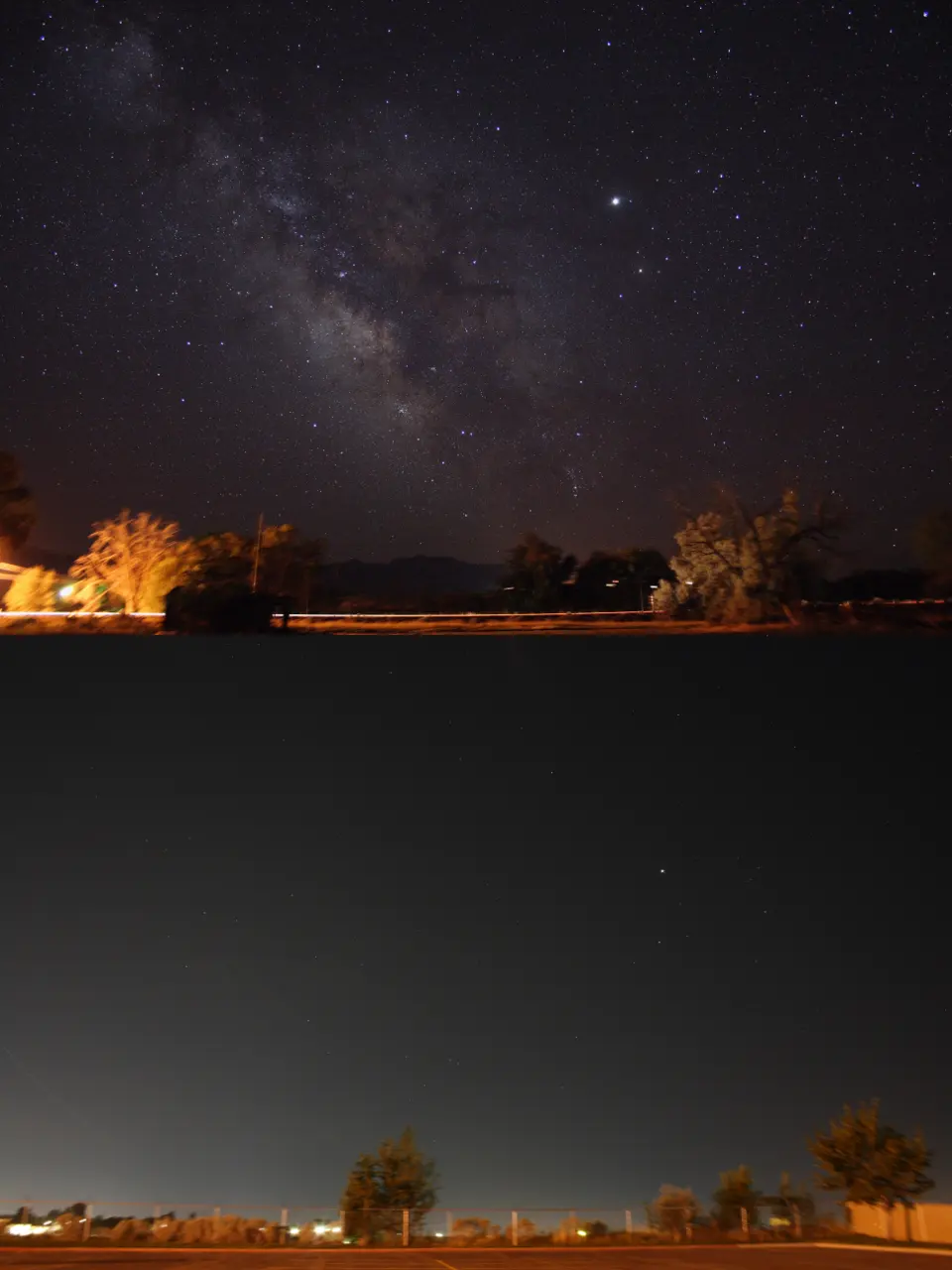

And the skies are getting brighter. In Globe at Night, a citizen-science program run by NSF NOIRLab in the United States, volunteers compare their sky with a set of star charts and report which one best matches what they see. A 2023 study of more than 50,000 reports from 2011 to 2022 concluded that the night sky over Europe and North America had been brightening by 9.6% a year. At that rate, said the lead author, Christopher Kyba of the German Research Centre for Geosciences, “a child born in a location where 250 stars were visible would be able to see only around 100 by the time they turned 18.”