Is Betelgeuse about to explode?
It will go supernova one day, but probably not for at least another 100,000 years, and it is too far away to do Earth much harm.
100,000years+
On winter nights, the constellation Orion climbs into the southern sky, and on the hunter’s right shoulder glows a red first-magnitude star: Betelgeuse. Between late 2019 and early 2020, that star grew noticeably fainter, and news reports and social media buzzed with speculation that it was about to go supernova.
It didn’t. So what was the “Great Dimming,” and will Betelgeuse really explode one day?
A red giant 750 times the Sun’s size
Betelgeuse is a red supergiant, a massive star that has swollen up near the end of its life. A 2020 study by an international team including researchers from the Australian National University and the University of Tokyo’s Kavli Institute for the Physics and Mathematics of the Universe estimated its radius at about 750 times the Sun’s and its mass at 16.5 to 19 times the Sun’s. Put in place of the Sun, it would reach well beyond the orbit of Mars. The same team put its distance at about 530 light-years, although other estimates run to around 700, and the exact figure is still uncertain.
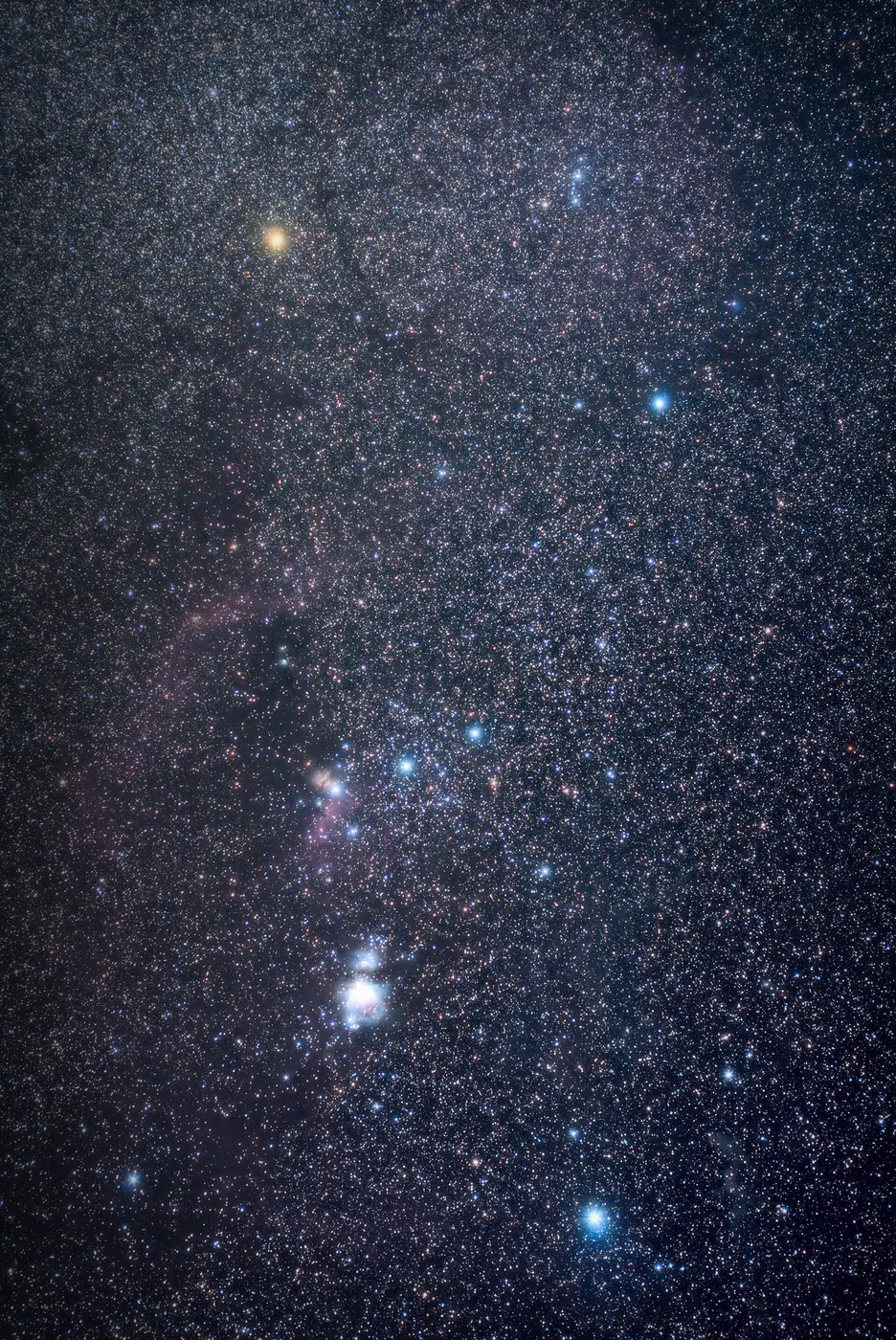

The more massive a star is, the faster it burns through its fuel and the shorter its life. Betelgeuse is thought to be only about 10 million years old, yet it is already in the final stretch of its life. It has always been a variable star, swelling and shrinking on a cycle of about 400 days.
The dimming was a veil of dust
Betelgeuse began to fade in late 2019, and by February 2020 it had lost more than two-thirds of its usual brightness, a change plain to see with the naked eye.
All the while, the European Southern Observatory’s Very Large Telescope (VLT) in Chile was taking pictures of the star’s surface. According to a study published in the journal Nature in 2021, the star had shortly beforehand puffed out a large bubble of gas. Soon afterward, a patch of its surface cooled, and the drop in temperature was enough for that gas to condense into solid dust, forming a veil over the southern part of the star.
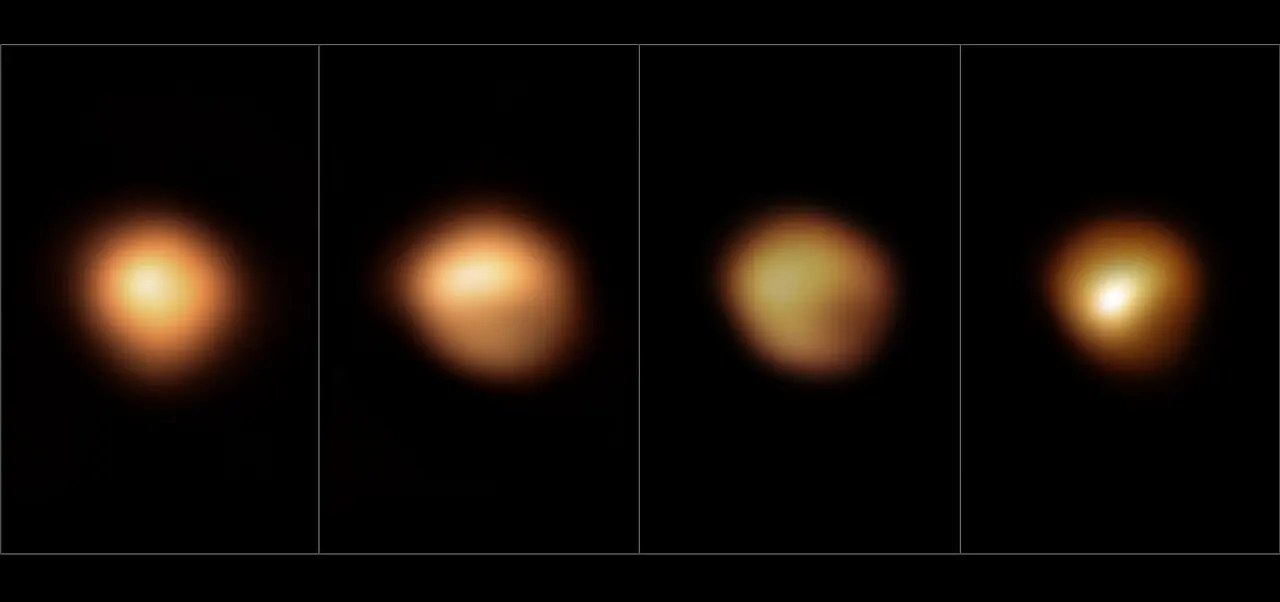

A team at the Center for Astrophysics | Harvard & Smithsonian, using the Hubble Space Telescope, reported that in 2019 the star had blasted off a large piece of its visible surface. In October and November 2019, Hubble had watched hot, dense gas moving outward through the star’s atmosphere at about 200,000 miles per hour (320,000 kilometers per hour). The material thrown off weighed several times as much as our Moon, and the upheaval stopped the star’s 400-day pulsation, at least for a while.
The explosion is a long way off
Even so, researchers stress that none of this means Betelgeuse is about to explode. According to the 2020 study, the star is now burning helium in its core, and it probably has more than 100,000 years to go before it blows.
When it does, it is expected to shine brightly enough to be visible for a while even in the daytime sky. Earth will be safe, though. The research team explains that Betelgeuse is far enough away that its eventual explosion will have no significant impact here.
A hidden companion
Betelgeuse still holds some surprises. In 2025, scientists at NASA’s Ames Research Center announced that they had used the Gemini North telescope in Hawai‘i to spot a faint companion star orbiting very close to Betelgeuse. The detection was at the very limit of what the instrument can do, but the companion has been nicknamed Siwarha, Arabic for “her bracelet.” In 2026, astronomers using Hubble also reported a wake-like trail of gas that the companion leaves in Betelgeuse’s outer atmosphere. The companion will next appear at its greatest separation from Betelgeuse in November 2027.