Who invented the windshield wiper?
Mary Anderson of Alabama is usually credited: she patented a hand-operated wiper in 1903. But others had similar ideas, and automatic and intermittent wipers came from other inventors.
1903
On a rainy day, windshield wipers sweep back and forth across the glass, keeping the road in view. No car is complete without them.
The name most often given as their inventor is Mary Anderson, a woman from Alabama in the American South. Yet her patent expired without ever being turned into a product, and the wipers we use today were shaped by a whole series of later inventors.
A streetcar in the snow
According to the Encyclopedia of Alabama, Anderson was born in 1866 on a plantation in Greene County, Alabama. In 1889 she moved to Birmingham with her mother and sister, and the family built an apartment building there. From 1893 she ran a cattle ranch and vineyard in Fresno, California, returning to Birmingham by 1900.
Early in the 20th century she visited New York City. Riding a streetcar, she noticed that whenever snow and sleet blocked the view, the motorman had to stop, get out and clean the front window by hand. The National Inventors Hall of Fame adds that drivers often opened their windows just to see. Her great-great-niece, Sara-Scott Wingo, told NPR that according to family lore, this happened in 1902.
A “window cleaning device” you could remove
Back in Birmingham, Anderson designed a device that could be worked from inside the vehicle. She filed for a patent on June 18, 1903, and on November 10 she received U.S. Patent No. 743,801 for a “Window-Cleaning Device.” It was intended for electric streetcars and other vehicles. By turning a handle inside, the motorman swung an arm across the outside of the glass, where wooden strips fitted with rubber swept away snow, rain and sleet. Springs kept the rubber pressed evenly against the glass, and a counterweight balanced the arm. In fair weather the arm could simply be removed, “thus leaving nothing to mar the usual appearance of the car.”
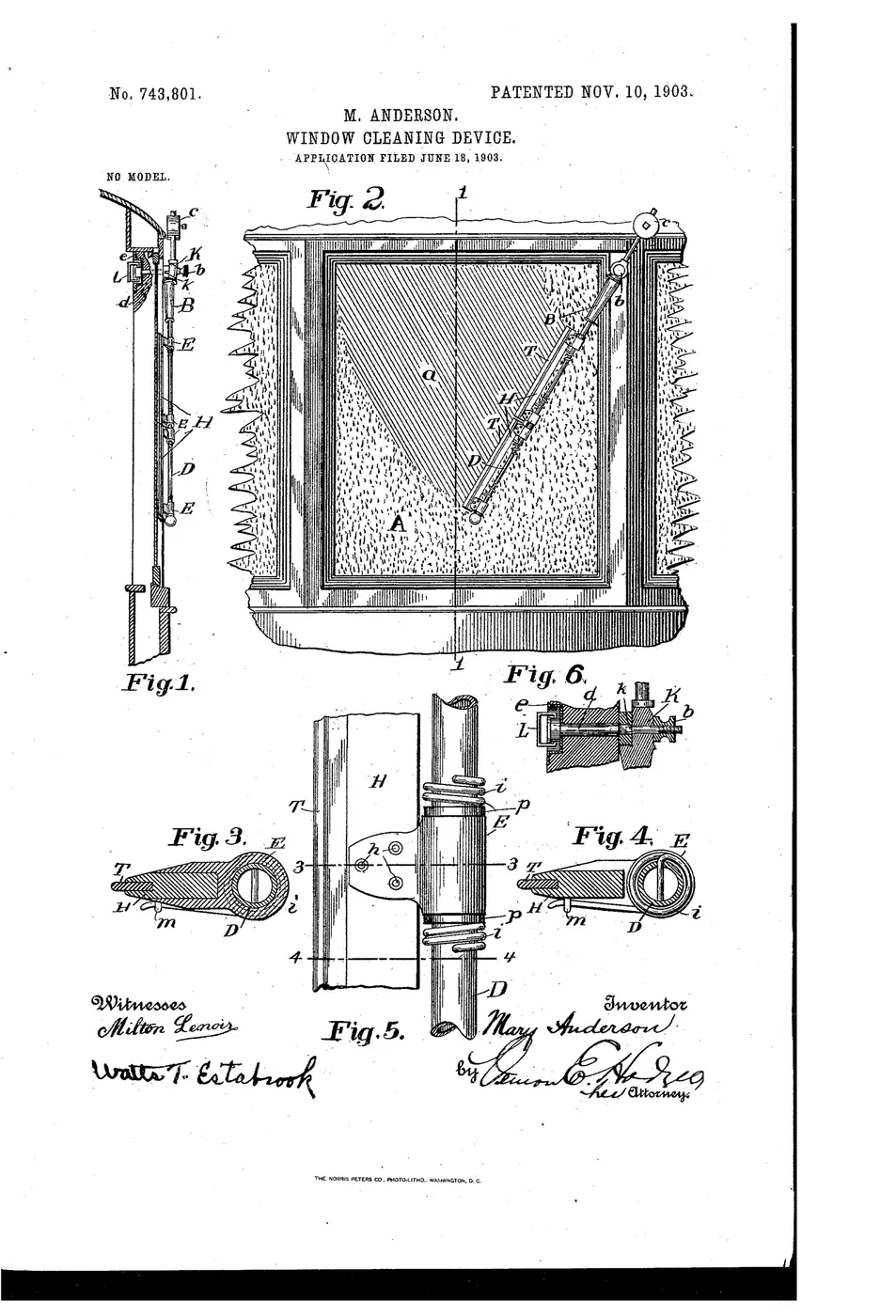

She was not the only one thinking along these lines. In March of that same year, a man named Robert A. Douglass had applied for a patent on a cleaner for locomotive cab windows. Even the National Inventors Hall of Fame describes Anderson’s device carefully, as “the first windshield-clearing device to be effective.”
“No commercial value”
Anderson tried to sell her patent. A 1905 reply from Dinning and Eckenstein, a firm in Montreal, survives in the Birmingham Public Library: “We regret to state we do not consider it to be of such commercial value as would warrant our undertaking its sale.” According to the Encyclopedia of Alabama, that seems to have been her only attempt to market the invention.
Cars were still a rarity. In 1920, at the end of its 17-year term, her patent quietly expired. According to the National Inventors Hall of Fame, Cadillac made wipers standard equipment two years later, in 1922. Anderson went on managing her apartment building in Birmingham and died in 1953, at 87. She was inducted into the National Inventors Hall of Fame in 2011.
Motors and pauses
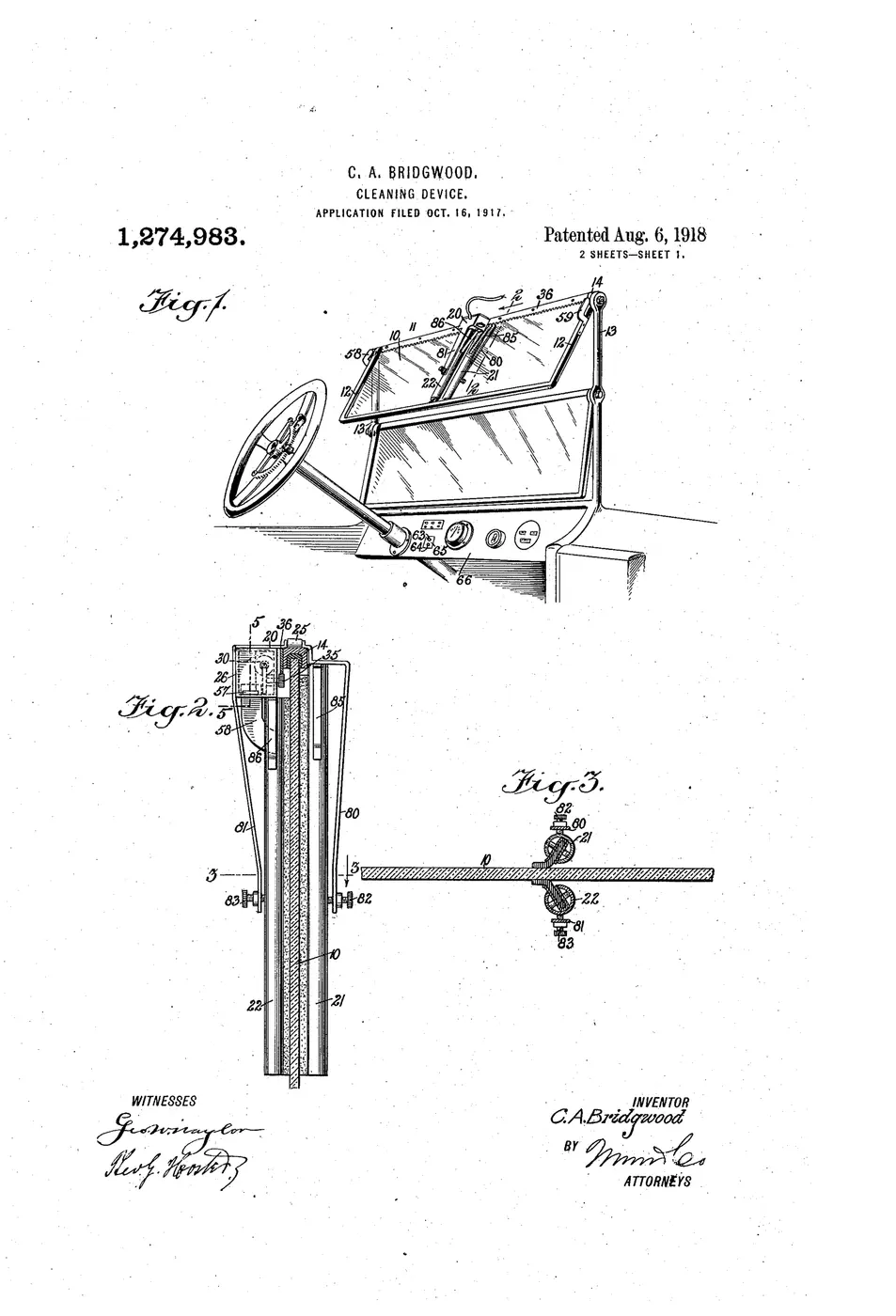
After hand-cranked wipers came wipers that worked on their own. Charlotte Bridgwood of Westwood, New Jersey, applied in October 1917 for a patent on a “Cleaning Device,” granted in 1918. In her design, a motor-driven carriage ran back and forth along the top of the windshield frame, with wipers hanging from it that cleaned the outside and inside of the glass at the same time. The driver could start it at any moment and then pay it no further attention.

Later still came the intermittent wiper, which sweeps once every few seconds in light rain. The name attached to it is Robert Kearns, an engineer who had taught at Wayne State University in Detroit. He built a prototype around 1963, applied for a patent in 1964 and received it in 1967. His prototypes are now in the Smithsonian’s National Museum of American History.
When intermittent wipers began appearing on cars, Kearns sued Ford in 1978 and Chrysler in 1982 for patent infringement. According to the New York Times, a jury found in 1990 that Ford had infringed his patent, and Ford agreed to pay $10.2 million to settle. Chrysler was ordered to pay $18.7 million plus interest, and in 1995 the Supreme Court refused to hear its appeal. Kearns, who acted as his own lawyer for parts of the fight, said: “I don’t think the goal was the magnitude of the money.” His role, he said, “was to defend the patent system.”