Was the pneumatic tire invented for a child’s tricycle?
Partly. In 1887 John Boyd Dunlop made air-filled tires for his son’s tricycle. But Robert William Thomson had patented the idea more than 40 years earlier.
43years
Bicycles, cars, even the wheels of airplanes all roll on tires full of air. The air inside acts as a cushion, soaking up the bumps of the road.
The story of how the pneumatic tire began is usually told like this: a veterinarian in Belfast made an air-filled tire for his young son’s tricycle. That story is broadly true. But behind it stands a second, half-forgotten inventor.
A rattling tricycle on cobblestones
John Boyd Dunlop was born on a farm in Scotland in 1840. He graduated from veterinary college in Edinburgh at just 19, and in 1867 he moved to Belfast, where he built up a very successful veterinary practice.
According to the Dictionary of Irish Biography, published by the Royal Irish Academy, in October 1887 Dunlop set out to spare his nine-year-old son the jolting the boy got from the solid rubber tires of his tricycle on Belfast’s cobbled streets. He improvised an air-filled rubber tube and held it on the wooden wheel with linen cloth tacked into place.
The tires turned out to make riding not just more comfortable but noticeably better all round, and local cyclists soon wanted them too. Dunlop applied for a patent in December 1888, and it was granted in 1889.
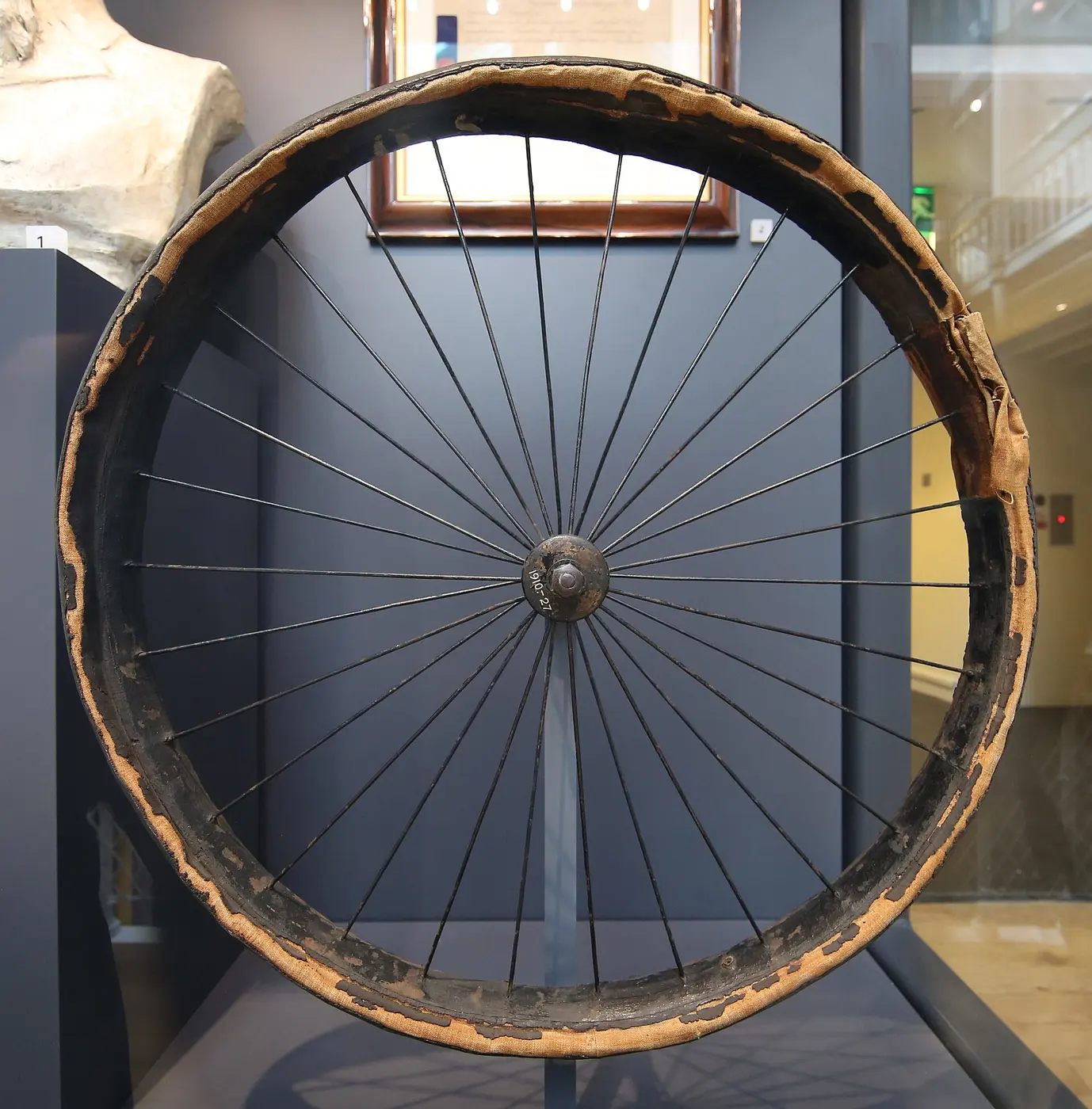

A cycling businessman
The Belfast businessmen who had teamed up with Dunlop could not build bicycles fast enough to meet demand, so they turned to William Harvey du Cros, a Dublin businessman and keen cyclist whose son was the Irish cycling champion. In 1889, a company was launched to make and sell the new tires.
Then, less than a year later, in November 1890, came unwelcome news. Dunlop’s patent was invalid. Someone had patented the same idea more than 40 years earlier.
The “aerial wheel”
That someone was Robert William Thomson (1822–1873), a Scottish engineer. He had taken out patents in Britain in 1845, in France in 1846 and in the United States in 1847.
His U.S. patent describes a hollow belt made of an airtight and watertight material, wrapped around the rim of a carriage wheel, inflated with air and protected by an outer casing of strong leather. Its purpose, the patent says, was to reduce the force needed to pull a carriage, make the ride smoother and cut down on noise.
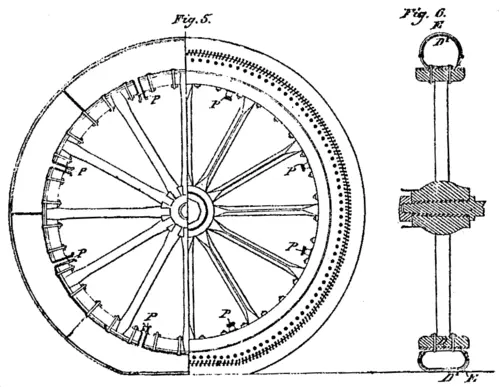

According to Grace’s Guide, an online archive of British industrial history, Thomson’s “aerial wheels” were demonstrated on horse-drawn carriages in London’s Regent’s Park in March 1847, and one set reportedly ran 1,200 miles (1,900 km) without showing signs of wear. But good, thin rubber was hard to get at the time, and the invention never caught on. Thomson later turned his attention to solid rubber tires for steam-powered road vehicles, and he died in Edinburgh in 1873, at the age of 50, long before anyone remembered his air-filled wheels.
Why the name Dunlop stuck
When Dunlop learned that his patent was invalid, he was so dejected that he would have given up making tires altogether. In return for his patent, he had received £300 and 3,000 shares in the company. Du Cros kept firm control of the business, secured other patents, and built it up on bicycle tires and then car tires. Dunlop himself left the board in 1895 and is said never to have made a great fortune from his invention.
Even so, Dunlop’s name and portrait went on being used as the company’s trademarks. Thomson came up with the pneumatic tire first, but it was the tire that started on a boy’s tricycle, arriving just as the bicycle was taking off, that put air under the world’s wheels.