When was toilet paper invented?
Wiping with paper goes back to sixth-century China. It became a product in 1857, and the roll came along in late-1800s America.
1857
A white roll hanging on the bathroom wall. Many of us only truly appreciate it when it is about to run out.
Yet in the long sweep of human history, wiping with paper is a fairly recent habit. Before paper, people used whatever was at hand: leaves, grass, straw, stones, moss, snow, water and more. The ancient Romans are said to have used a sea sponge on the end of a stick. So when did paper take over, and when did the roll appear?
The Chinese were the first to wipe with paper
China, where paper was invented, put it to use in the toilet early on. Around 589 CE, the sixth-century scholar Yan Zhitui wrote that he would not use paper bearing quotations from the classics or the names of sages “for toilet purposes.” That he felt the need to say so suggests that using paper in the toilet was already common.
In 851, an Arab traveler visiting China noted with some surprise that the Chinese did not wash with water but only wiped themselves with paper. By the Ming dynasty, records from 1393 show that 720,000 sheets of toilet paper, each roughly 60 by 90 centimeters (2 by 3 feet), were made for the imperial court. For the emperor’s family, 15,000 sheets of especially soft, perfumed paper were prepared as well.
A product at last: America, 1857
The first person to sell paper made specifically for the toilet was Joseph Gayetty of the United States. In December 1857, in New York, he launched “Gayetty’s Medicated Paper.” It came as flat sheets of Manila hemp paper treated with aloe, each one watermarked with his name. It was not a roll, but a stack of loose sheets.
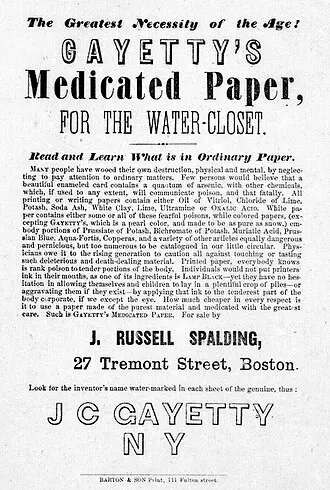

His ads proclaimed it “The Greatest Necessity of the Age!” It did not catch on overnight, though. In rural America, plenty of people were still making do with corncobs, old newspapers and pages from mail-order catalogs well into the twentieth century.
Enter the roll and the perforation
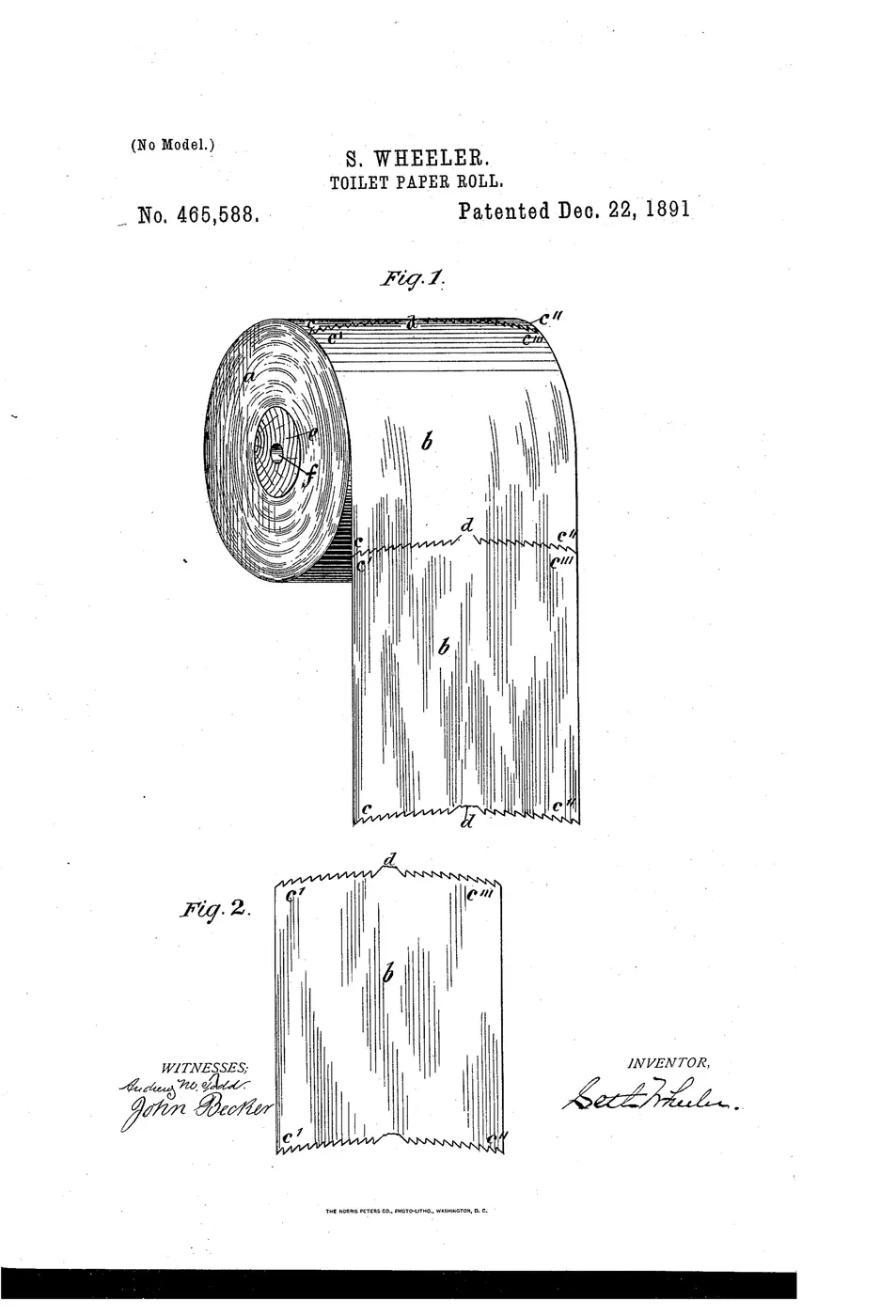
The familiar roll was the work of Seth Wheeler, a businessman from Albany, New York. In 1871 he patented a roll of wrapping paper perforated so that sheets could be torn off one at a time. He founded a company in 1877, and toilet paper soon became its most important product. In 1891 he also patented a perforated roll of toilet paper itself.
Around the same time, in 1890, the Scott Paper Company began selling toilet paper on a roll. As late as the 1930s, one paper company was still advertising its toilet paper as “splinter free,” which says a lot about how rough the earlier stuff must have been.

Japan’s story begins in the 1920s
In Japan, people in the seventh to twelfth centuries are thought to have used flat wooden sticks called chūgi. Paper came into use from roughly the Kamakura period (late twelfth to fourteenth centuries), and in the Edo period (1603–1868) ordinary people used asakusa-gami, a cheap paper made by re-pulping wastepaper.
Rolled toilet paper was first made in Japan in 1924. As far as the records show, a Kobe trading company called Shimamura Shōkai had a paper mill in Kōchi Prefecture make the base paper, then finished it into toilet rolls.
It only really took off after the Second World War. From around 1955, as pit toilets gave way to flush toilets, demand grew for rolls that would break up in water. In 1977, production of toilet rolls finally overtook that of chirigami, the square tissue sheets Japanese households had long used. Shortly before that, in November 1973, during the oil crisis, a supermarket in Senri New Town near Osaka sold out of 1,400 packs of toilet paper, a normal week’s stock, in a single hour. Panic buying spread across the country, a sign of how indispensable the roll had already become.