Is there a plant that lives for over a thousand years with only two leaves?
Yes. Welwitschia, from the Namib Desert, keeps growing the same two leaves for its whole life, and some plants are more than 1,500 years old.
2
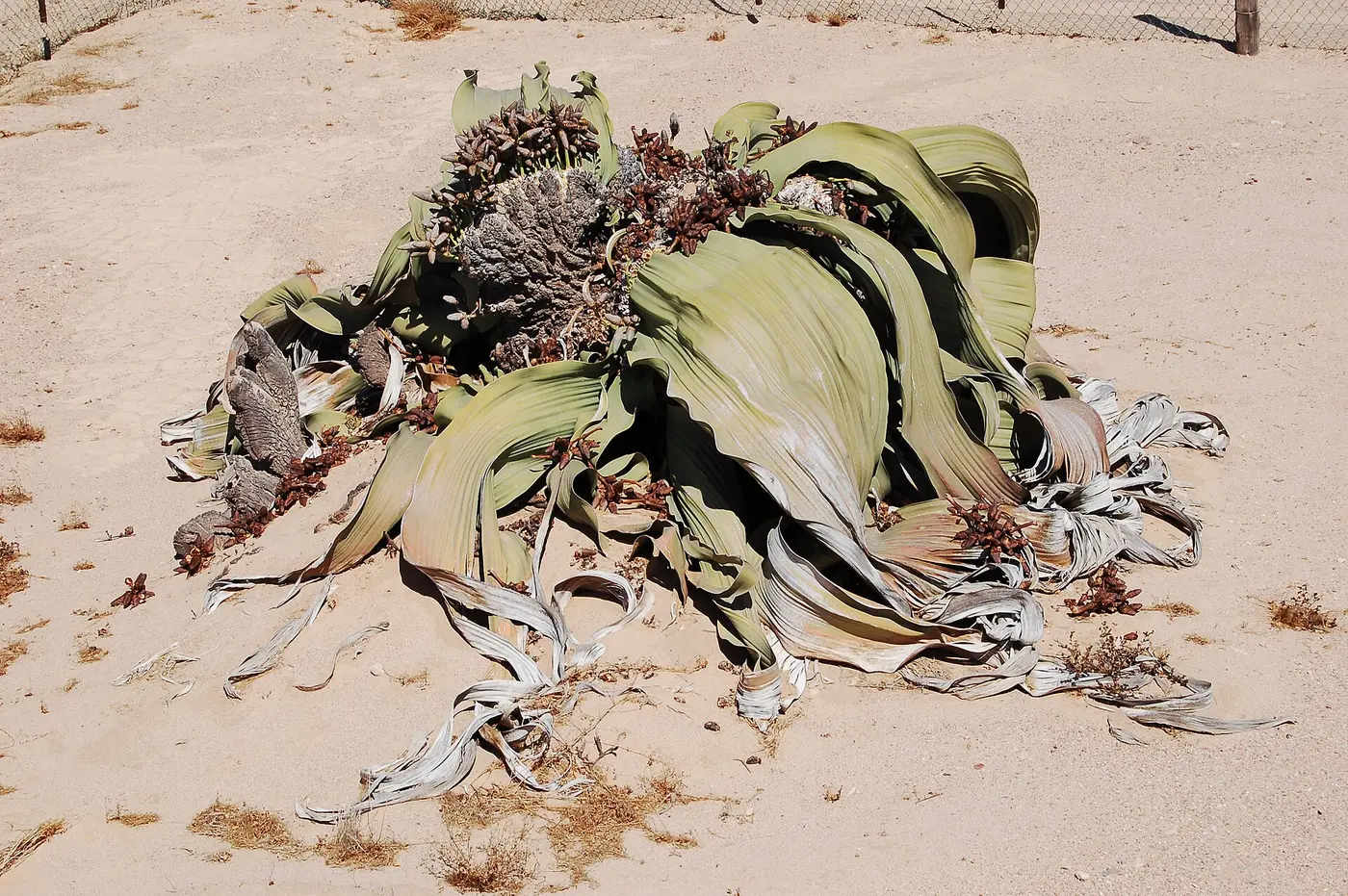
In the Namib Desert, along the Atlantic coast of southwestern Africa, grows a very odd plant. A low, woody stem barely rises above the sand, like a tree stump, and from it long, tattered leaves spread out across the ground. From a distance it looks like a heap of seaweed washed up on a beach.
This is welwitschia, and apart from its two seed leaves, it makes just two leaves in its whole life. It then keeps growing those same two leaves for more than a thousand years.
A botanist on his knees
The first scientist to bring welwitschia to the world’s attention was Friedrich Welwitsch, an Austrian-born botanist employed by the Portuguese government to study the plants of its colony of Angola. In 1859 he came across the plant on a plateau near the coast in the south of the country. According to Britain’s Dictionary of National Biography, the sight was “so overwhelming that he could do nothing but kneel down on the burning soil and gaze at it.”
Specimens were sent to the Royal Botanic Gardens, Kew, near London, where the botanist Joseph Dalton Hooker studied them in detail. Hooker presented his findings to the Linnean Society of London in 1862 and named the plant Welwitschia mirabilis, after its discoverer; mirabilis is Latin for “wonderful.” According to the University of Oxford’s herbaria, Hooker wrote in a private letter to his friend, the biologist Thomas Huxley, that it was “out of all question the most wonderful plant ever brought to this country – and the very ugliest.”

Two leaves that never stop
Most plants grow by producing one new leaf after another from the tips of their stems. Welwitschia does not. According to lecture notes by Mitsuyasu Hasebe, a professor at Japan’s National Institute for Basic Biology, a seedling first puts out its two seed leaves, then forms a single pair of true leaves, and after that no further leaves appear.
Instead, those two leaves keep adding new cells at their base and are pushed out bit by bit, like a slow conveyor belt. They grow about 10 to 13 centimeters (4 to 5 inches) a year. The older ends die back and fray into long strips, so what looks like a messy pile of many leaves is really just two leaves torn to shreds. In some plants the living part of a leaf alone reaches 2.5 meters (8 feet).
More than a thousand years
Welwitschia lives in the coastal desert of northern Namibia and southern Angola, where less than 50 millimeters (2 inches) of rain falls in a year. According to the Oxford herbaria, the plant gets by on heavy dews and on groundwater deep below the surface.
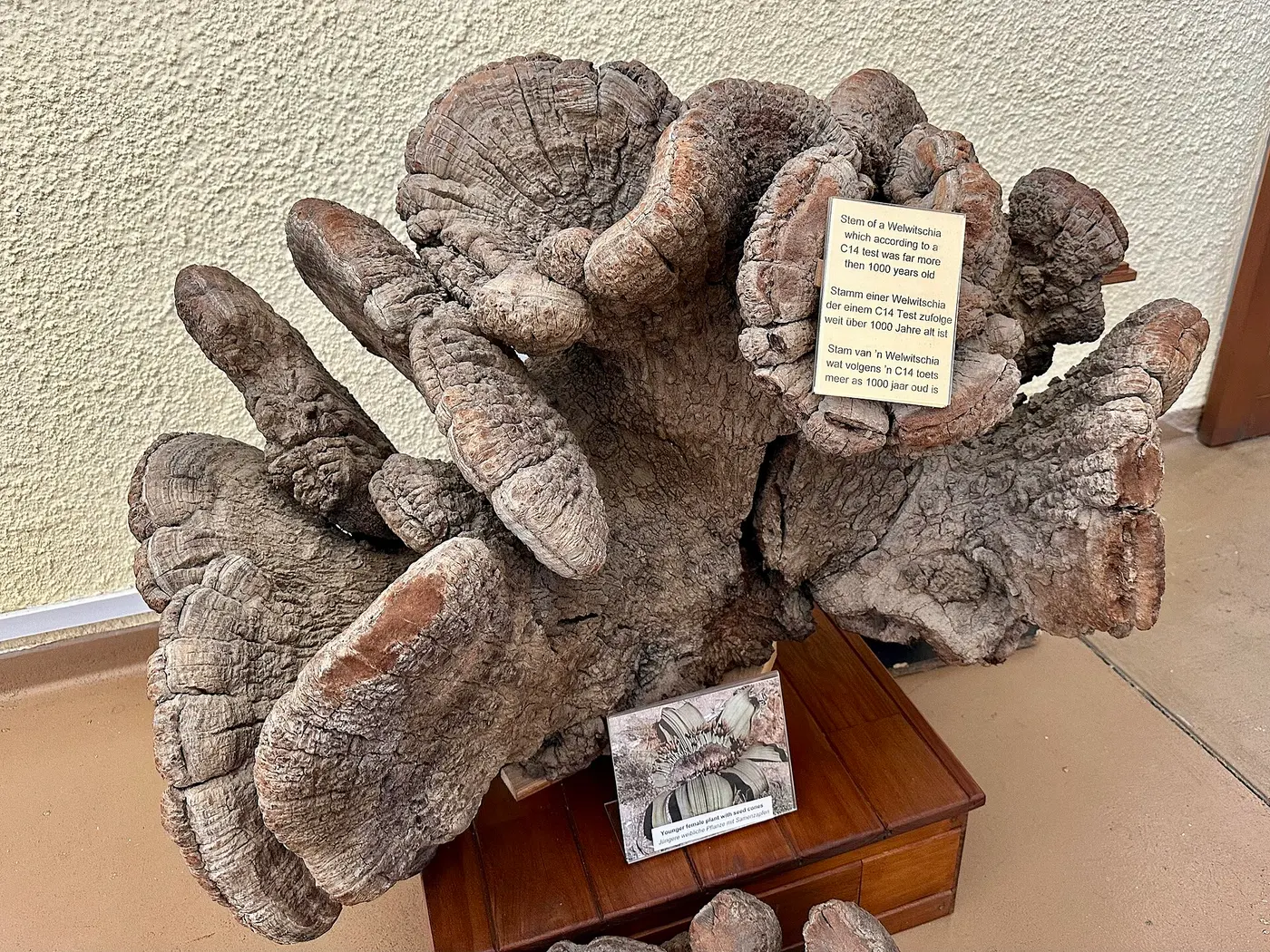
Because the leaves wear away at their tips, you cannot tell a plant’s age from their length. A 2021 study in the journal Nature Communications, by researchers from China, the United Kingdom, Namibia and elsewhere, reports that radiocarbon dating of some of the largest plants has shown them to be more than 1,500 years old. Ages of over 2,000 years are sometimes quoted too, so the estimates vary.
The study itself was a reading of welwitschia’s complete genome. The team reported that the plant’s whole genome doubled about 86 million years ago, and that genes involved in producing new cells at the base of the leaves stay switched on continuously. The paper notes that in Afrikaans, a language spoken in South Africa and Namibia, the plant is called tweeblaarkanniedood: “two leaves that cannot die.”

Welwitschia is a gymnosperm, a relative of pines and cycads, and it is the only species in its family. Each plant is either male or female and bears small cones. In Japan it is known as kiso tengai, a Japanese idiom for something wildly unexpected, and visitors can see it in the greenhouses of the Kyoto Botanical Gardens, among other places.