Why does the voice break?
At puberty, rising male hormones make the larynx grow and the vocal folds get longer and thicker. A boy’s voice drops about an octave.
Somewhere between the last years of elementary school and middle school, a boy’s voice suddenly turns husky, or cracks in the middle of a sentence. Before long it has settled into a deep, grown-up voice. Being greeted with “Your voice has changed!” by relatives you haven’t seen in a while is a rite of passage at this age.
The breaking voice is one of the changes of puberty, as the body moves from childhood to adulthood. So what is actually happening inside the throat?
Two folds that set the pitch
Our voice comes from the vocal folds, also called vocal cords, inside the larynx, or voice box, in the throat. The vocal folds are a pair of folds of tissue that open when we breathe and close when we speak. As air from the lungs squeezes through the closed folds, they vibrate rapidly and produce sound.


The pitch of the voice depends on how many times per second the vocal folds vibrate. Just as a thicker, longer guitar string plays a lower note, longer and thicker vocal folds vibrate fewer times per second, giving a lower voice. The basic pitch of an adult speaking voice is about 90 to 155 hertz for men and 165 to 255 hertz for women. In other words, a man’s vocal folds vibrate only around 100 times a second.
Male hormones grow the throat
The trigger for the change is the rise in male hormones at puberty, which surge from around age 12 to 15. Under their influence the larynx grows quickly, and the vocal folds inside it become longer and thicker.
The vocal folds are said to be about 0.9 centimeters long in children, growing to around 2 centimeters in adult men and 1.5 centimeters in adult women. A man’s vocal folds end up more than twice as long as they were in childhood. As a result, a boy’s voice drops by roughly an octave.
The thyroid cartilage that wraps around the larynx also grows and juts forward. This is the Adam’s apple that stands out on many men’s necks, and it is why the Adam’s apple suddenly becomes noticeable around the time the voice breaks.
People tend to think only boys’ voices change, but girls’ voices do too. A girl’s larynx also grows as she develops, and the bottom of her range drops by about a third, roughly the gap from C to E. The change is small, though, so often neither she nor anyone around her notices.
Why does the voice crack?
The voice change is said to begin at around 13 in boys and around 11 in girls. In most cases the voice settles into its adult form within three months to a year.
Along the way, the voice may turn hoarse or suddenly leap up into a high falsetto. Because the larynx and vocal folds grow so much in a short time, the muscles that adjust the vocal folds are thought to struggle to keep up with the change. During this period, it is generally advised not to keep straining for high notes, as that can hurt the throat.
Boys’ choirs and “the day”
No one is more sensitive to when the voice breaks than a boys’ choir, because the pure boy soprano voice is lost when it does.
For the St. Thomas Choir in Leipzig, Germany, which Johann Sebastian Bach directed in the 18th century, one researcher estimated in 1970, based on surviving records, that the choristers’ voices broke at around 17 on average. That would be far later than today, but the idea has been challenged, and nobody knows for certain.
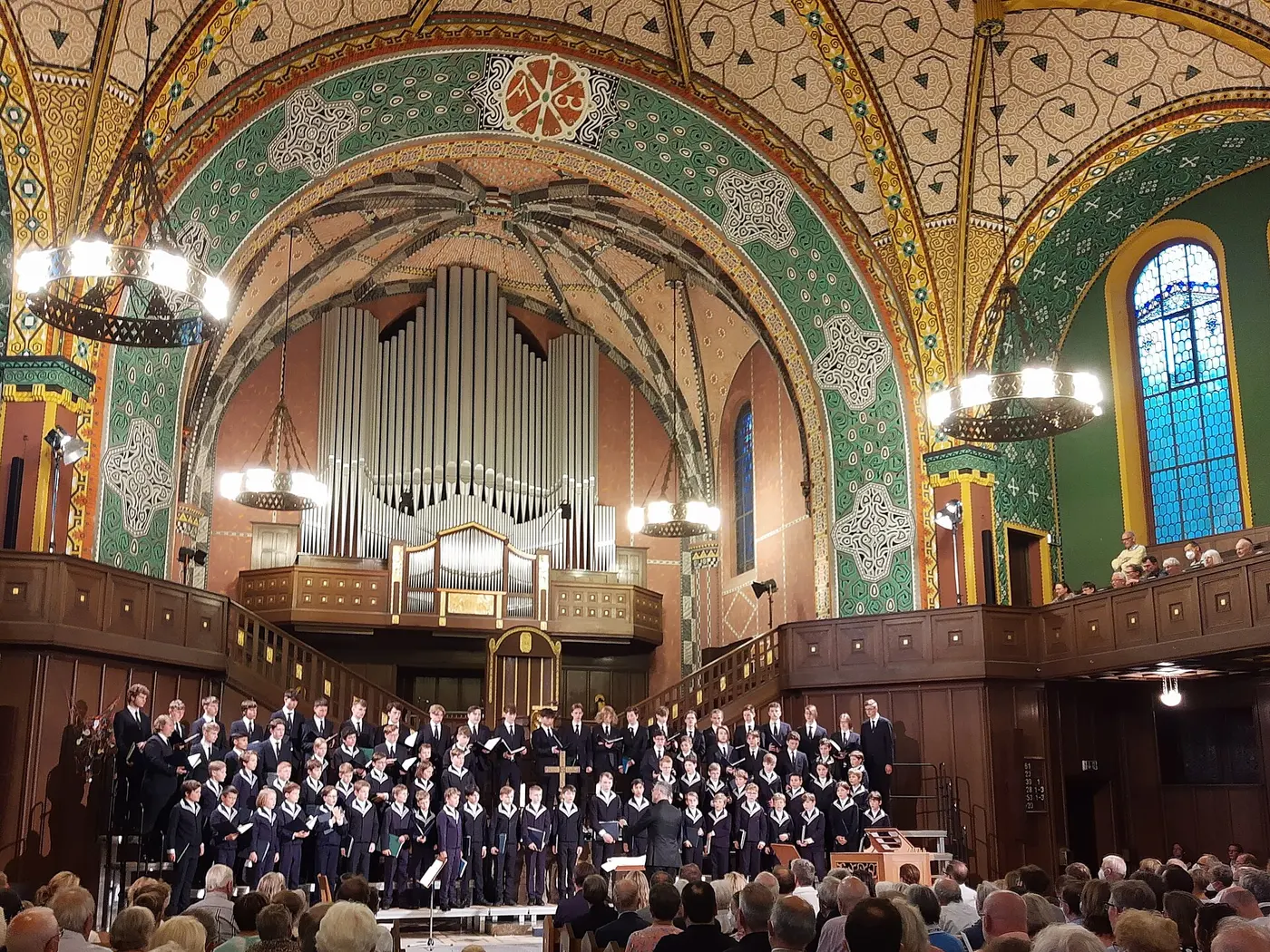

More recently, a study of records from a boys’ choir school in Copenhagen, Denmark, from 1994 to 2003 found a median age at voice break of 14.0, and the age crept downward even over that single decade. Boys who had a higher body mass index (BMI) at age 8 also tended to have their voices break earlier.