What is the largest organ in the human body?
The skin. An adult’s skin covers about 1.6 to 1.9 square meters and weighs 2 to 3 kilograms even without the fatty layer beneath it. Among the organs inside the body, the largest is the liver.
1.6 m²
Heart, lungs, stomach, intestines, liver. Say the word “organ,” and most people picture something hidden deep inside the body. So which organ is the largest?
The answer is something you see every day but rarely think of as an organ: the skin that wraps your whole body. Exactly how big it is depends on how you measure it and where you decide the skin ends. And in 2018, headlines announced that an even bigger organ might have been discovered.
One continuous organ
An organ is a part of the body in which several kinds of tissue work together to do a particular job, and the skin fits that description. From the outside in, it consists of the epidermis, the dermis and a fatty layer called the hypodermis, complete with sweat glands, hair, blood vessels and nerves. As the open textbook Anatomy and Physiology from OpenStax puts it, you may not typically think of the skin as an organ, but it is made of tissues that work together as a single structure.
Atarashii Hifukagaku (“New Dermatology”), a standard Japanese dermatology textbook by Hiroshi Shimizu (third edition, 2018), calls the skin “a single continuous organ” with the greatest weight of any in the human body. In adults, it says, the skin covers about 1.6 square meters (17 square feet), roughly the size of a single tatami, the straw mat used to measure rooms in Japan.
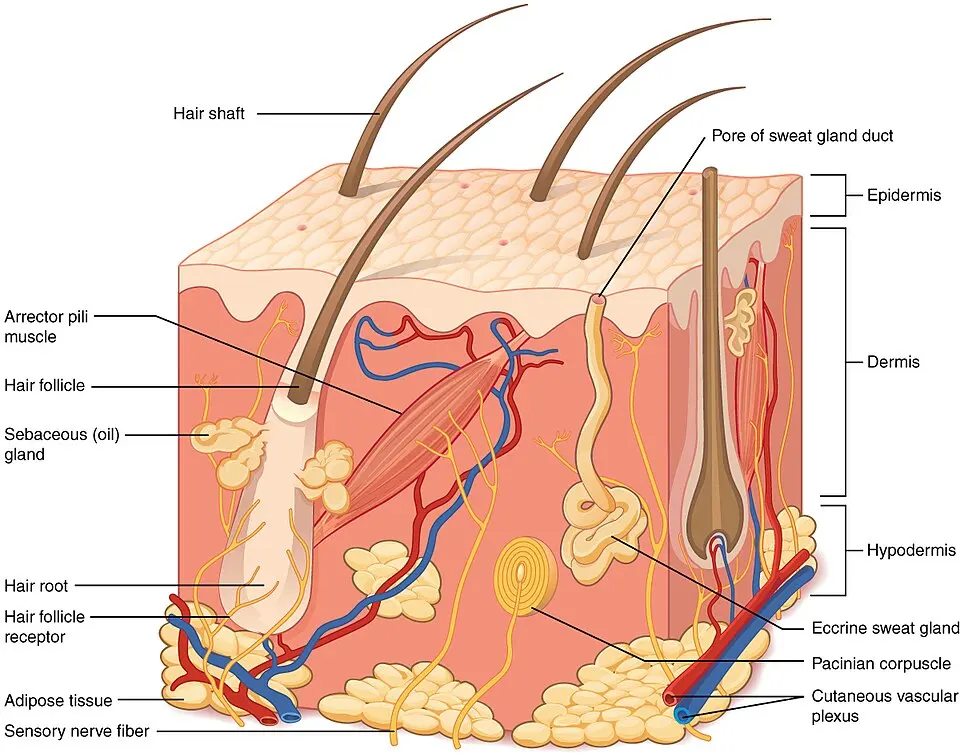

That one sheet keeps water from escaping, helps regulate body temperature, protects us from microbes and from harm such as ultraviolet light, and works as a sense organ.
It depends on what you count
According to Shimizu’s textbook, the skin accounts for about 16 percent of body weight if you include the hypodermis. Most of the hypodermis is fat, however, and the OpenStax textbook says it is not strictly part of the skin. Count only the epidermis and dermis, and the numbers shrink considerably.
The International Commission on Radiological Protection (ICRP), for example, sets out standard organ weights for calculating radiation doses. In its 2002 reference values, a man weighing 73 kg (161 pounds) has 3.3 kg of skin, and a woman weighing 60 kg has 2.3 kg, or roughly 4 percent of body weight. Their body surface areas are given as 1.9 and 1.66 square meters.
Even so, the skin stays on top: in the same reference values, the liver weighs 1.8 kg in men and 1.4 kg in women, and the brain 1.45 kg and 1.3 kg.
Some comparisons muddy the picture. All your muscles together far outweigh your skin, but as the OpenStax textbook notes, each skeletal muscle is an organ in its own right. And in 2014, two researchers in Sweden put the lining of the digestive tract at about 32 square meters: not the “tennis court” of the textbooks, but still 17 to 20 times the area of the skin. That, however, is the lining of several organs combined.
Inside the body, the liver wins
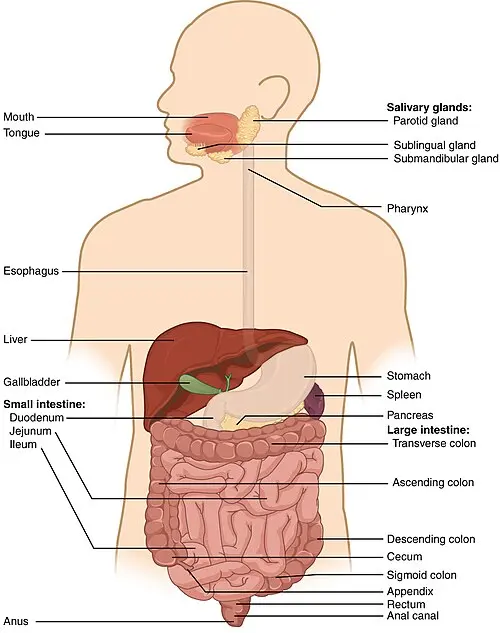
Count only the organs inside the body, and the liver comes out on top; Japan’s National Cancer Center calls it the body’s largest internal organ. It sits in the upper right of the abdomen and weighs more than 1 kg in adults. It turns the nutrients absorbed from the stomach and intestines into substances the body needs, breaks down alcohol and other harmful substances, and produces bile, which helps digest fat.

The “new organ” of 2018
In March 2018, a paper by a U.S. team in the journal Scientific Reports made a big splash. It began in 2015 at a hospital in New York City, when two endoscopists, David Carr-Locke and Petros Benias, used a special microscopic probe to check a patient’s bile duct for cancer spread. In the living tissue they saw a network of fluid-filled spaces that matched no known anatomy.
When the tissue was made into microscope slides, the spaces vanished: preparing the slides drained the fluid, and they collapsed. The pathologist Neil Theise and his colleagues then found similar spaces throughout the body, beneath the lining of the digestive tract and bladder, in the dermis, around airways and arteries, and in the fascia. The team presented this as an expansion of the concept of the interstitium, the spaces between cells.
A press release from NYU Langone Health described the interstitium as “one of the largest” organs in the body, and headlines announced that the body’s largest organ had been found.
The paper itself, however, never calls the interstitium an organ. Theise told Live Science that the label was unofficial: for a body part to become an organ officially, a consensus would have to develop as more researchers studied it, and other groups would need to confirm the findings. The skin, it seems, has not lost its crown.