Does Vivaldi’s “Four Seasons” come with poems?
Yes. Each of the four concertos was published with a 14-line sonnet, and the music paints the scenes the poems describe.
“The Four Seasons” by the Italian composer Antonio Vivaldi is everywhere: in films, in commercials, in hotel lobbies, and in Japan in school music lessons. The bright opening of “Spring” in particular is one of the most recognizable tunes in classical music.
The work is a set of four concertos for solo violin and string orchestra. There is no singing, yet the music was published with a poem for each season.
Four poems printed with the music
“The Four Seasons” was published in 1725 in Amsterdam, as the first four concertos in a collection of 12 titled Il cimento dell’armonia e dell’inventione (“The Contest Between Harmony and Invention”). The collection was dedicated to Count Wenzel von Morzin, a Bohemian nobleman, and Vivaldi’s dedication thanks the count for having enjoyed these concertos for some time. In other words, the music itself seems to have been written well before it was printed.
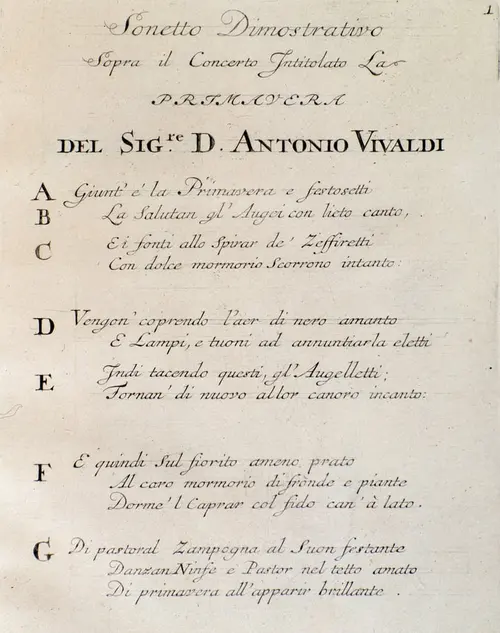
Each of the four concertos came with a sonnet, a 14-line poem. Better still, the lines of each poem were marked with letters, and the same letters appear in the musical parts, so players could see exactly which passage matched which line.
Nobody knows who wrote the sonnets. But each one is divided into three parts that line up neatly with the three movements of its concerto, which has led to suggestions that Vivaldi wrote them himself. The score also includes other notes, such as “the barking dog” in the second movement of “Spring” (played by the violas) and “the drunkards have fallen asleep” in the second movement of “Autumn.”

“Winter” begins with chattering teeth
So what about “Winter”? The poem for the first movement describes shivering in the icy snow, buffeted by a horrid wind, running and stamping one’s feet, and then: “E pel soverchio gel batter i denti” (“and in the bitter cold, teeth chattering”).
The music opens with sharp, stabbing chords from the strings. Commentators describe the solo violin’s rapid scales as the howling wind, a passage in which the orchestra hammers out fast repeated notes as the stamping feet, and quick trills (rapid alternations between two notes) as chattering teeth.
The second movement is a complete contrast: peaceful, contented days by the fire while the rain pours down outside. The strings pluck their notes in pizzicato to suggest raindrops, while the solo violin sings a calm melody above them.
The third movement moves out onto the ice. You walk slowly and carefully for fear of falling. You turn too quickly, slip and crash to the ground. You get up and run across the ice until it cracks. From behind closed doors you hear all the winds at war. And then the sonnet ends: “Quest’è ’l verno, ma tal, che gioja apporte” (“This is winter, but it brings its own joys”).
Forgotten and found again
Vivaldi died in Vienna in 1741 and was buried in a pauper’s grave. His music then slipped into obscurity for a long time, and interest revived only in the 20th century. A recording of “The Four Seasons” survives from a French radio broadcast thought to date from early 1939, and the first proper recording was made in 1942.

In Japan, “The Four Seasons” became a craze in the 1960s and 1970s. According to a paper by researchers at Osaka University, the Italian chamber ensemble I Musici drew only modest audiences on its first tour of Japan in 1963. After the concerts, however, sales of its “Four Seasons” recording began to climb until it became a bestseller, and the work became a fixture of the group’s later Japanese tours. By 1973, a Japanese newspaper was describing the craze with a pun on the work’s Japanese title, Shiki, calling its fans shikima, roughly “Four Seasons fiends.”