Is “Jingle Bells” really a Christmas song?
Not originally. It is a winter sleigh-riding song, and the lyrics published in 1857 never once mention Christmas.
1857
Few songs say “Christmas is coming” as quickly as “Jingle Bells.” A few bars of it in a shopping mall, and the holiday season has officially begun. In Japan, too, it plays on a loop in shops and shopping streets all through December.
Yet the original lyrics never mention Christmas at all. There is no Santa Claus, no tree and no presents. So what is the song actually about?
A song about sleigh rides
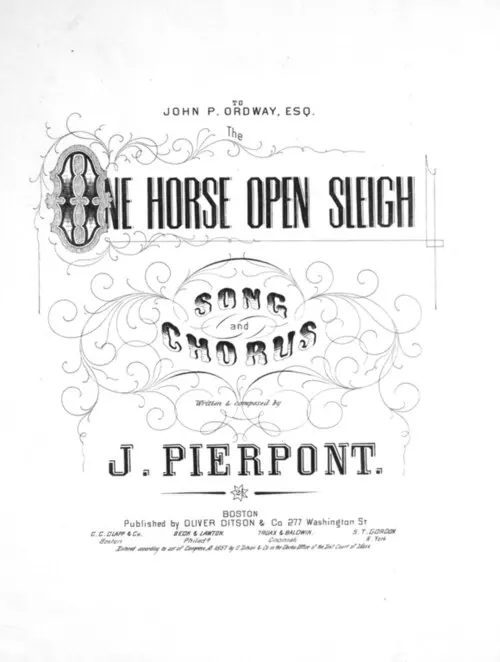
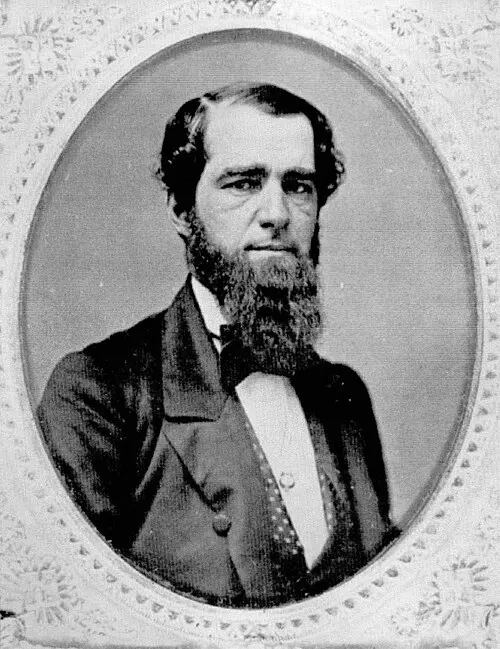
The song was published in Boston on September 16, 1857, under the title “The One Horse Open Sleigh.” It was written by James Lord Pierpont (1822–1893), a musician from New England.
It opens with the lines everyone knows: “Dashing through the snow / In a one-horse open sleigh.” In the second verse, the singer takes a ride with a Miss Fanny Bright by his side, only for their lean, lanky horse to plow into a snowdrift and tip them both out. In the third, he falls flat on his back in the snow, and a gentleman driving by in a sleigh just laughs and keeps going. A later verse urges listeners to “go it while you’re young” and take the girls out for a sleigh ride that night.
In other words, it is a cheerful song about winter fun and a bit of flirting. Songs about sleigh rides were a popular genre in America at the time, and this was one of many.

Bells for safety
The “jingle bells” of the title are usually understood as the bells on a horse’s harness. In New England before the automobile, it was common to hang bells on a horse’s harness in winter. A sleigh gliding over snow makes almost no noise, so the bells warned others of its approach and helped prevent collisions at blind intersections. The bouncy rhythm of the tune seems to imitate the bells of a trotting horse. The music historian James Fuld even pointed out that “jingle” in the title is apparently a verb: an order to make the bells ring.
The song was republished in 1859 as “Jingle Bells, or The One Horse Open Sleigh.” Choirs took it up in the 1860s and 1870s, and it gradually became associated with winter and Christmas. In 1898 it was recorded as part of a Christmas medley, and by the early 20th century it had become a Christmas favorite.
Which town was it written in?
The song’s birthplace has long been disputed.
In Medford, Massachusetts, a plaque declares that Pierpont wrote the song in 1850 at a local tavern. Savannah, Georgia, meanwhile, has long claimed that he wrote it there in late 1857. Pierpont had moved to Savannah that year to become organist at the church where his brother was minister. That August he married the daughter of the city’s mayor, and he never returned north.
Kyna Hamill, a researcher at Boston University, looked into the question and found that Pierpont was in California in 1850, not Medford. A playbill showed that the song’s first known performance took place on September 15, 1857, at a theater in Boston. Hamill concluded that Pierpont most likely wrote it in Boston before he moved south.

That first performance, however, was part of a blackface minstrel show, a form of entertainment in which performers darkened their faces to mock Black people. A song that sounds like pure winter fun also carries a trace of 19th-century America’s racist entertainment. As a footnote, Pierpont was the uncle of the financier J. P. Morgan.