Was the first tune for Japan’s national anthem written by a British bandmaster?
Yes. The first melody for “Kimigayo” was written around 1869 by John William Fenton, a British army bandmaster in Yokohama. The tune sung today replaced it in 1880.
11bars
“May your reign continue for a thousand, eight thousand generations, until the pebbles grow into boulders lush with moss.” The words of “Kimigayo,” Japan’s national anthem, come from a poem in the Kokin Wakashū, an anthology compiled in the early 10th century.
The music sung today, on the other hand, dates from 1880, in the Meiji period (1868–1912). And it was the second tune. The first person to set these words to music was a British army bandmaster stationed in Yokohama.
A poem of celebration
The source is an anonymous poem that opens the “Celebrations” section of the Kokin Wakashū. In that version the first line reads “Waga kimi wa,” or “My lord’s.” According to the Japanese encyclopedia Nipponica, the word kimi in that era could refer to a master, the head of a household, a friend or a lover, a much wider range of people than the emperor alone.
The poem later appeared in another anthology, the Wakan Rōeishū, with the opening “Kimi ga yo wa,” and by the Edo period (1603–1868) it had found its way into music for the koto and the shamisen, as a song for festive occasions.
The bandmaster in Yokohama
When the Meiji era began, Japan had no national anthem. According to Japan’s Ministry of Foreign Affairs, in 1869 John William Fenton, a British military band instructor in Yokohama, learned that the country lacked one. He told the members of a Japanese band about “God Save the King,” stressed that Japan needed an anthem of its own, and offered to compose the music if someone would supply the words.
Fenton came from Kinsale, in Ireland, then part of the United Kingdom, and was bandmaster of a British army regiment stationed in Yokohama to protect the foreign community. At the time, the Satsuma domain in southern Japan had sent young men to Yokohama to learn Western band music from him. Myōkōji, the temple where they lodged and practiced, still has monuments marking it as the birthplace of both Japanese wind band music and “Kimigayo.”
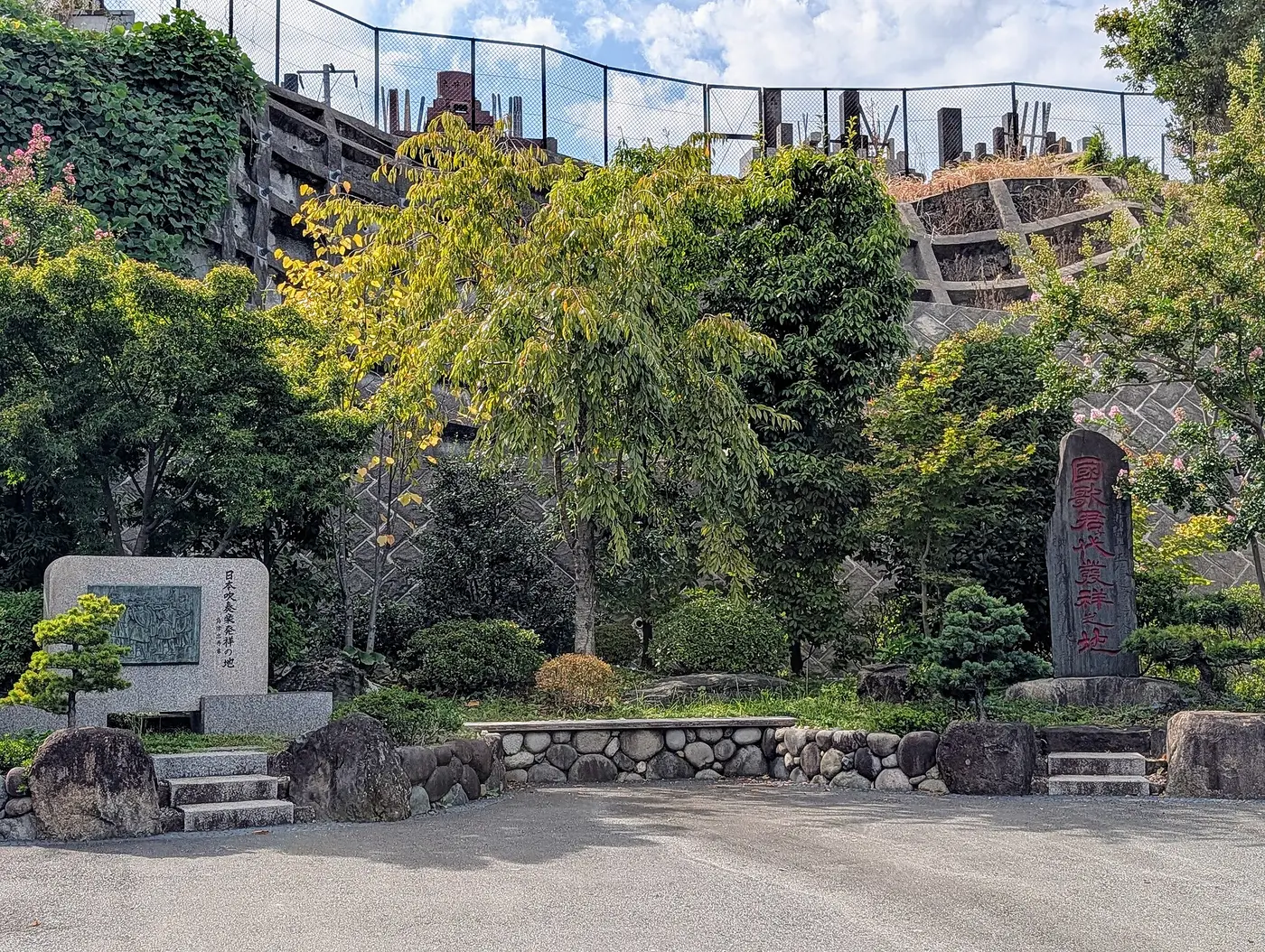

The words are said to have been chosen by Ōyama Yasuke, an artillery officer from Satsuma who later became Field Marshal Ōyama Iwao, though other accounts name different people. Ōyama took the lines from a Satsuma biwa ballad called “Hōraisan,” and Fenton set them to music.
An unpopular first tune
According to the Tokyo Band of the Japan Maritime Self-Defense Force, Fenton’s “Kimigayo” is thought to have been performed for the first time in 1870 by the Satsuma band, at a military review held for the emperor at Etchūjima in Tokyo.
The tune did not go down well. The Ministry of Foreign Affairs says it was later judged to lack solemnity, and the Tokyo Band says it did not suit Japanese sensibilities. Some have also pointed out that its melody clashed with the natural rise and fall of the Japanese words.
In 1876 Nakamura Suketsune, the leader of the navy band, proposed to the Navy Ministry that the music be revised. According to the Ministry of Foreign Affairs, it was decided that the new melody should draw on the style of the chants performed at the imperial court. Fenton left Japan the following year, and later died in the United States.
The 1880 version
In July 1880, four men were appointed to a committee to revise the music: Nakamura of the navy band, Yotsumoto Yoshitoyo of the army band, Hayashi Hiromori, head of the court musicians who performed gagaku, Japan’s ancient court music, and Franz Eckert, a German musician employed by the navy. They chose a melody based on a traditional gagaku scale. Eckert harmonized it in the Western style, and it was first performed at the imperial palace on November 3, 1880, the emperor’s birthday.
Officially, the composer is Hayashi Hiromori. But some accounts say the melody was really written by Oku Yoshiisa, another court musician, together with Hayashi’s eldest son, Hayashi Hirosue, and others credit the court musician Tōgi Sueyoshi. The question has never been settled.
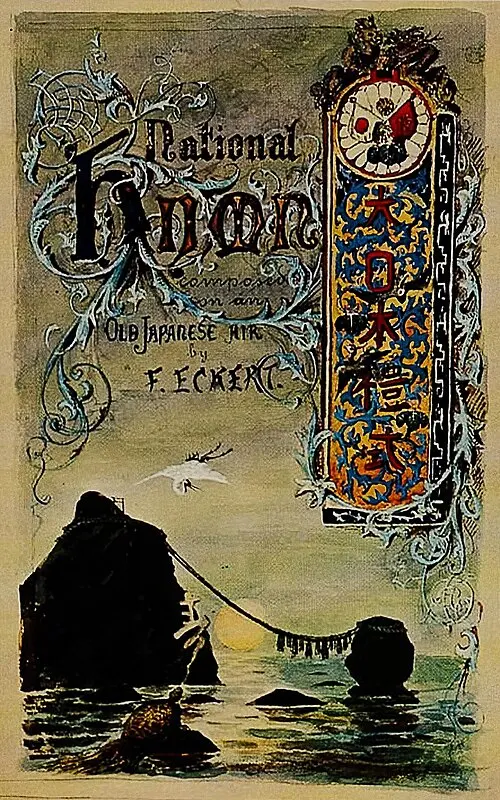

In 1888 the Navy Ministry sent copies of the score, titled “Dai Nippon Reishiki,” to the countries with which Japan had treaties, and in 1893 the Ministry of Education made it one of the songs to be sung at school ceremonies on national holidays. It became Japan’s national anthem by law only in 1999, under the Act on National Flag and Anthem.