What is the piano’s full name?
Its longer name is “pianoforte”: an instrument that can play both soft (piano) and loud (forte).
Look at a piece of sheet music and you will find little letters such as “p” and “f.” As music teachers explain, p stands for piano, soft, and f for forte, loud. Both are Italian words.
You may already have spotted something odd. The instrument is a piano, and “piano” also means soft. That is no coincidence. The name we use today is just the first half of a longer one that survived.
A keyboard that couldn’t play soft or loud
Before the piano, the keyboard instrument of choice at European courts was the harpsichord. Press a key and a small plectrum plucks a string. The sound is bright and glittering, but whether you strike the key hard or press it gently, the volume barely changes.
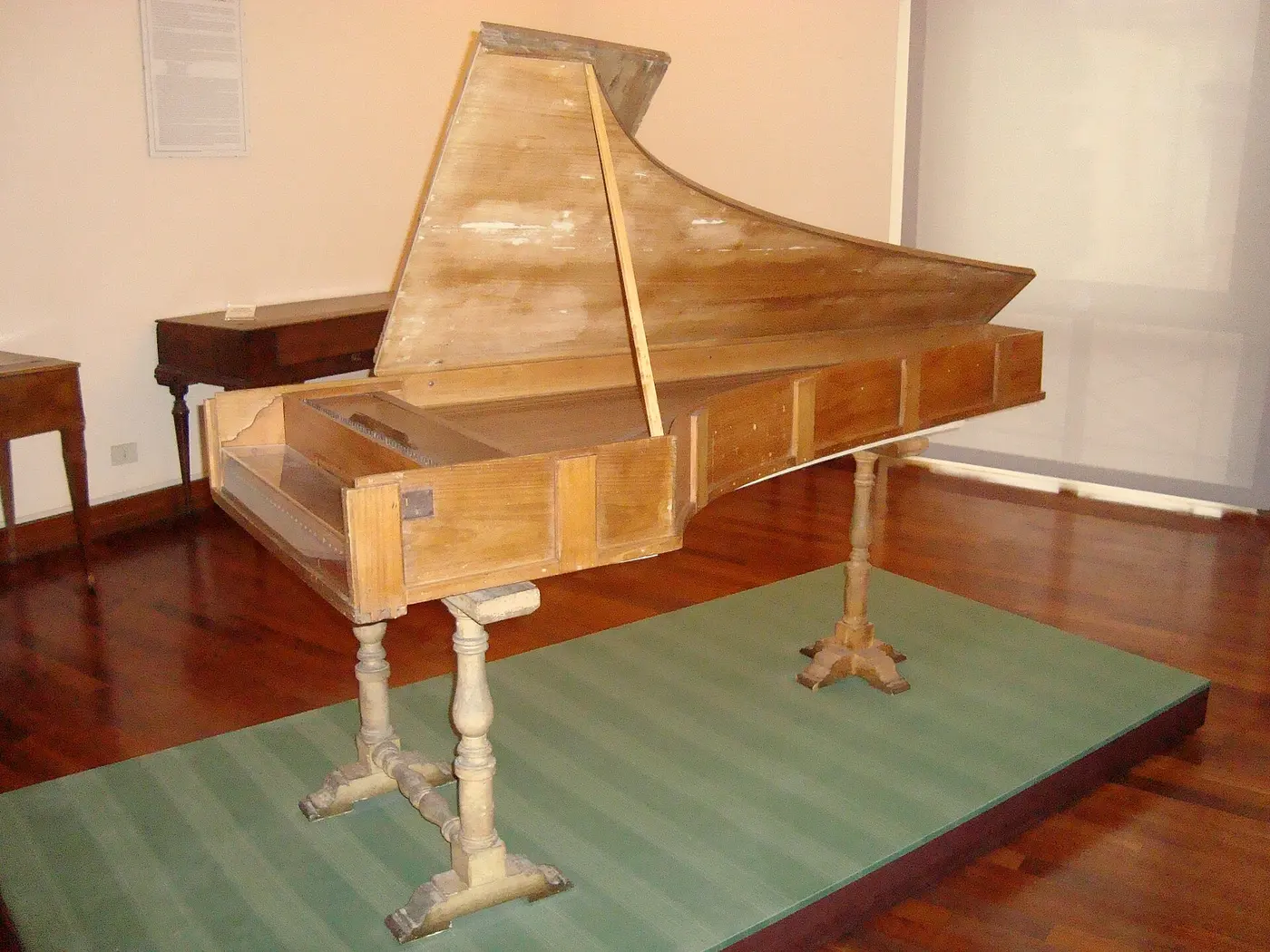
The man who solved this problem was the Italian instrument maker Bartolomeo Cristofori. From 1688 he worked in Florence for Prince Ferdinando de’ Medici, heir to the Grand Duke of Tuscany, looking after the prince’s instruments. Instead of plucking the strings, Cristofori had small hammers strike them and then spring away the instant they made contact. The force of the player’s finger passed straight into the hammer, so loudness could be controlled note by note.
A Medici inventory of instruments drawn up in 1700 already lists the new invention. It describes an arpicembalo “of new invention, that makes soft and loud.”

A writer spread the word
The person who introduced the instrument to the wider world was Scipione Maffei, a writer from Verona. In 1711 he described it, with a diagram of its mechanism, in a scholarly journal published in Venice. The name he used was gravicembalo col piano e forte. Since gravicembalo is another word for harpsichord, that means “harpsichord with soft and loud.”
The article was translated into German and read widely, and German builders such as Gottfried Silbermann went on to make pianos whose actions copied Cristofori’s almost exactly. Over time the long name was trimmed to “pianoforte” or “fortepiano,” and in the end only “piano” was left.
So if you want the piano’s longer name, “pianoforte” is the answer. There is, however, no legally fixed “official name.” The long name often credited to Cristofori himself is first documented in Maffei’s article, and some scholars think Cristofori called his instrument an arpicembalo. Some popular accounts also date the invention to 1709, but the 1700 inventory shows it was already finished by then.
Beethoven wanted a German word
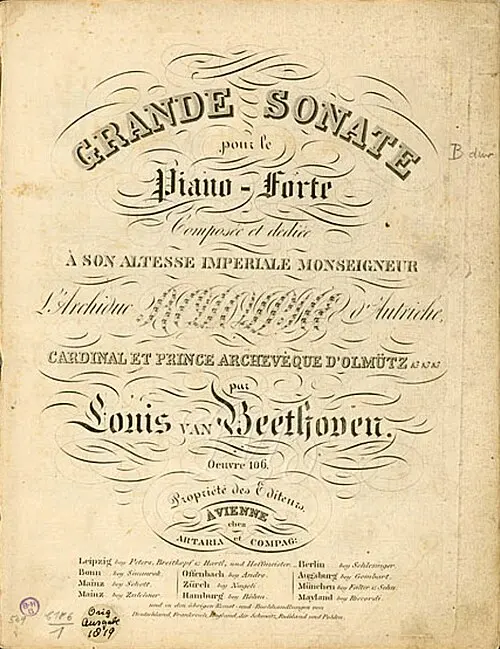
In the 19th century, national feeling added another twist. In a letter of 1817, Beethoven announced that from then on his works would use the German word Hammerklavier, “hammer keyboard,” instead of “pianoforte.”
His Piano Sonata No. 29, published by Artaria in Vienna in September 1819, was printed from the same plates with two different title pages: one in French, “Grand Sonata for the Piano-Forte,” and one in German, “Grand Sonata for the Hammerklavier.” That is why the piece is still known as the “Hammerklavier” Sonata.

Today the word “fortepiano” is used for the early pianos of Mozart’s and Beethoven’s time, to tell them apart from the modern instrument.
Japan had its own name, too. Around the 19th century the piano was called yōkin, written with characters meaning “Western zither,” and prewar Japanese texts sometimes spelled the borrowed word as “piyano.”