Is Mercury the hottest planet in the solar system?
No, Venus is. Its surface averages about 460°C (860°F), hotter than Mercury’s daytime high of about 430°C (800°F), and it stays that hot through the night.
460°C
The closer you sit to a campfire, the hotter it gets. It seems natural to assume the same of planets: the nearer the Sun, the hotter the planet. By that logic, the hottest planet in the solar system should be Mercury, the innermost one.
Yet NASA’s Space Place website for children puts it plainly: “Even though Venus isn’t the closest planet to the Sun, it is still the hottest.” The surface of Venus, the next planet out from Mercury, averages about 460°C (860°F). That is hot enough to melt lead.
Nearly twice as far from the Sun
According to NASA, Mercury orbits the Sun at an average distance of about 58 million kilometers (36 million miles), and Venus at about 108 million kilometers (67 million miles). Because sunlight weakens with the square of distance, Venus receives only about 30 percent as much sunlight as Mercury.
Mercury’s daytime surface, NASA says, reaches 430°C (800°F). But Mercury has almost no atmosphere to hold on to that heat, so at night the temperature can plunge to −180°C (−290°F). NASA’s own Mercury page notes that the title of hottest planet belongs to its neighbor Venus, thanks to its dense atmosphere.
Venus, by contrast, stays hot day and night. According to the German Aerospace Center (DLR), Venus rotates so slowly that its days and nights each last for weeks on end, yet its thick atmosphere stores and stirs the heat so well that the temperature hardly differs between the day side and the night side.
A thick blanket of carbon dioxide
What makes this even stranger is that little sunlight actually reaches the surface of Venus. The planet is wrapped in dense clouds of sulfuric acid, and according to the European Space Agency (ESA), the clouds reflect about 80 percent of the incoming sunlight back into space. Only about 10 percent gets through to heat the ground.
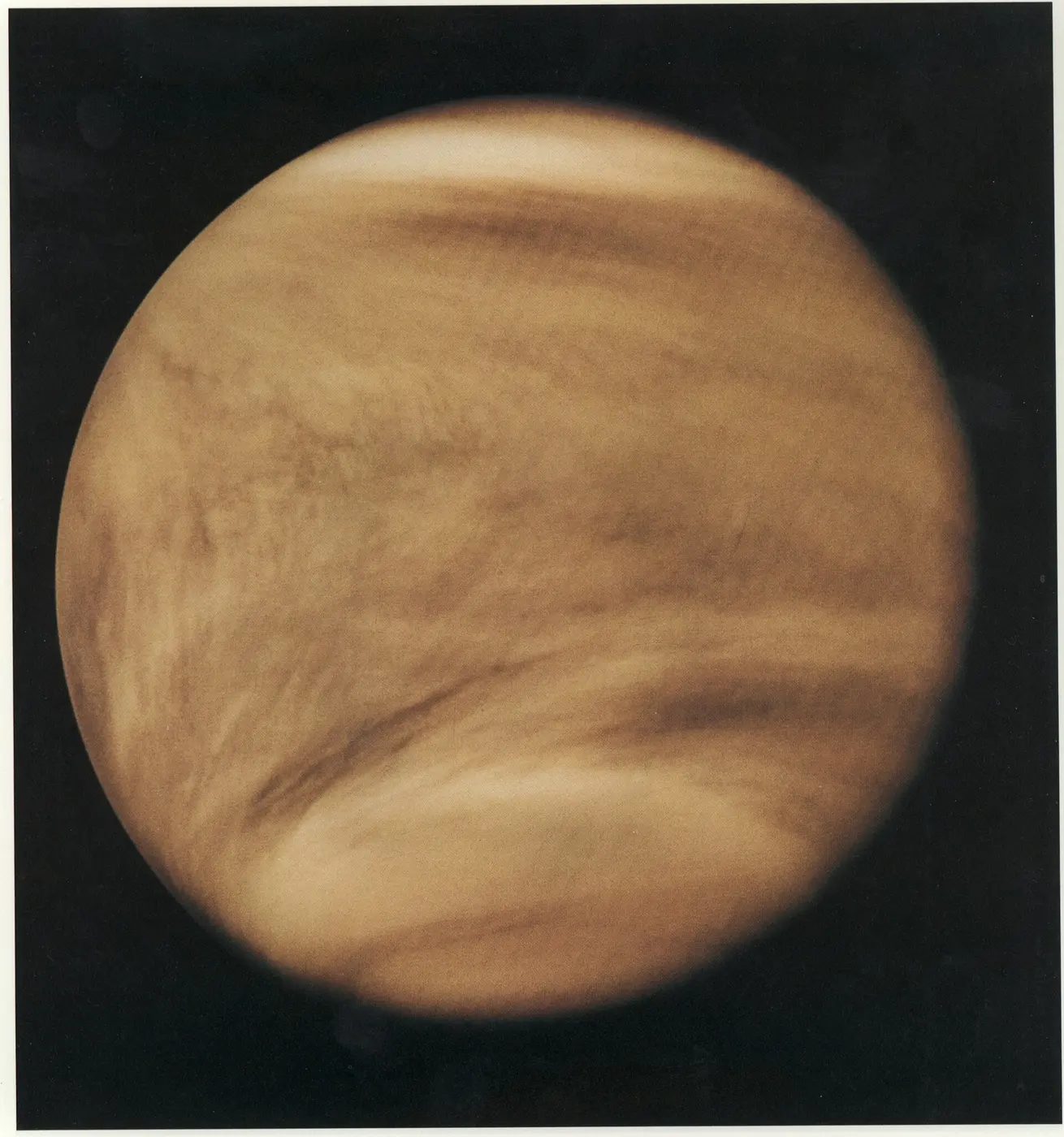

Venus is hot anyway because its atmosphere won’t let the heat out. The air is mostly carbon dioxide. The ground, warmed by what little sunlight gets through, gives off heat as infrared radiation, and the thick atmosphere traps it: the greenhouse effect. NASA describes what happens on Venus as a runaway greenhouse effect. According to ESA, the temperature difference between the surface and the cloud tops is a staggering 500°C (900°F).
There is also an enormous amount of air. The pressure at the surface is about 92 times Earth’s at sea level. NASA compares it to being more than 900 meters (3,000 feet) underwater on Earth.
What the probes found
Venus revealed its true face only in the space age. According to the Japanese edition of the Britannica International Encyclopaedia, while its surface was hidden by clouds, conditions there were thought to be much like those on Earth.
On December 14, 1962, NASA’s Mariner 2 flew past Venus, becoming the first spacecraft to successfully explore another planet. According to the Japanese encyclopedia Nipponica, measurements of the radio waves coming from the planet showed that the surface was around 500°C. In 1967 the Soviet probe Venera 4 plunged into the atmosphere and found that its main ingredient was carbon dioxide. In 1970, Venera 7 reached the surface and sent back readings of 475°C and 92 atmospheres.

Venera 13, which landed on March 1, 1982, kept transmitting from the surface for 127 minutes, according to NASA, and returned the first color pictures of the Venusian surface. That was a little over two hours, in heat that melts lead and pressure like the deep sea.
Did Venus once have oceans?
Venus is often called Earth’s twin, because the two planets are so similar in size and mass. So how did they end up so different? One clue lies in the hydrogen in Venus’s atmosphere.
In 1978, the large probe of NASA’s Pioneer Venus mission plunged into the atmosphere and measured the ratio of ordinary hydrogen to deuterium, a heavier form of hydrogen. According to a paper published in Science in 1982, deuterium on Venus is about 100 times more abundant, relative to hydrogen, than on Earth. Light hydrogen escapes into space more easily than deuterium, so as a planet loses water, the proportion of deuterium goes up. The paper’s title says it all: “Venus Was Wet.” Venus seems to have once held far more water than it does now.
NASA, too, notes that in their youth, Venus and Earth may both have had oceans. One idea is that as the greenhouse effect heated the planet, the water rose high into the atmosphere, where ultraviolet sunlight broke it apart and the hydrogen drifted off into space. What set the two twins on such different paths is a question scientists are still trying to answer.