Does it rain diamonds on Neptune?
Probably, deep inside. Carbon from methane is thought to turn into diamonds that sink through the planet’s interior. Lab experiments support the idea, but no one has observed it directly.
1.5 millionatm
Neptune, the outermost planet in the solar system, orbits more than 30 times farther from the Sun than Earth does. It is about four times as wide as Earth, and it looks blue because methane in its atmosphere absorbs reddish light.
Deep inside this planet, the story goes, it rains diamonds. The idea pops up in science news from time to time, but nobody has been there to look. So which parts have actually been tested, and which are still educated guesses?
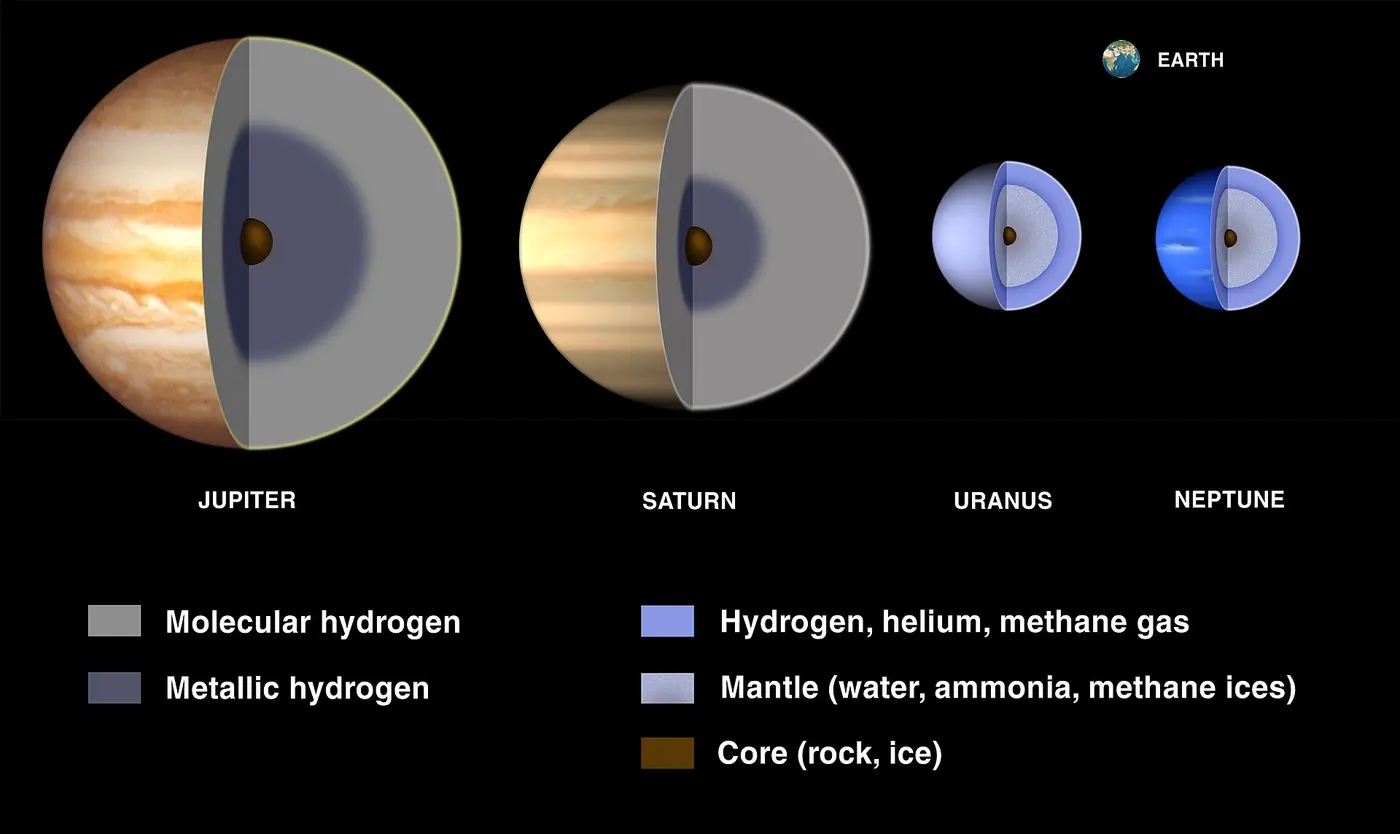
Inside an “ice giant”
NASA describes Neptune, like Uranus, as an “ice giant.” Its outer layer is an atmosphere of mostly hydrogen and helium, with about 1.5% methane by volume. Below that lies a hot, dense fluid of “icy” materials (water, methane and ammonia), and at the center a rocky core with roughly the mass of Earth.
These ices are neither cold nor solid. Planetary scientists simply use the word “ice” for compounds such as water, methane and ammonia, in which hydrogen is bonded to carbon, oxygen or nitrogen.

A prediction from 1981
The suggestion that diamonds might form in this layer came from Marvin Ross of Lawrence Livermore National Laboratory in California. In 1981 he published a paper in Nature titled “The ice layer in Uranus and Neptune—diamonds in the sky?”
Models at the time put the pressure in the ice layer at about 0.2 megabar (some 200,000 times atmospheric pressure) at its outer edge and about 6 megabars at the boundary with the core, with temperatures from roughly 2,200 to 7,000 kelvin (about 1,900–6,700°C, or 3,500–12,100°F). Drawing on earlier experiments and theory, Ross argued that under such conditions methane would break down, and its carbon might take the form of diamond.
In 1999 a team at the University of California, Berkeley, squeezed methane between two diamonds and heated it with a laser. At pressures of 10 to 50 gigapascals (about 100,000 to 500,000 atmospheres) and temperatures of about 2,000 to 3,000 kelvin, they reported, the methane broke down and formed diamond. But other materials in such setups can interfere with the chemistry, so the result was not conclusive.
A snapshot taken with an X-ray laser
In August 2017 a team led by Dominik Kraus of the Helmholtz-Zentrum Dresden-Rossendorf in Germany, with partners including Osaka University in Japan, reported new results in Nature Astronomy.
Working at SLAC National Accelerator Laboratory in California, the team fired a powerful laser at polystyrene, a plastic made of carbon and hydrogen. The shock waves briefly created a pressure of about 150 gigapascals (1.5 million atmospheres) and a temperature of about 5,000 kelvin, conditions like those about 10,000 kilometers (6,200 miles) beneath the surfaces of Neptune and Uranus. Probing the sample with X-ray pulses just 50 femtoseconds (50 quadrillionths of a second) long, they found that nearly all of the plastic’s carbon atoms had formed tiny diamonds a few nanometers across.
“Previously, researchers could only assume that the diamonds had formed,” Kraus said in SLAC’s announcement, calling the moment he saw the results “one of the best moments of my scientific career.” The researchers think the diamonds inside the planets would be far bigger, perhaps millions of carats, and might sink through the icy layers over thousands of years to build up a thick layer around the core.
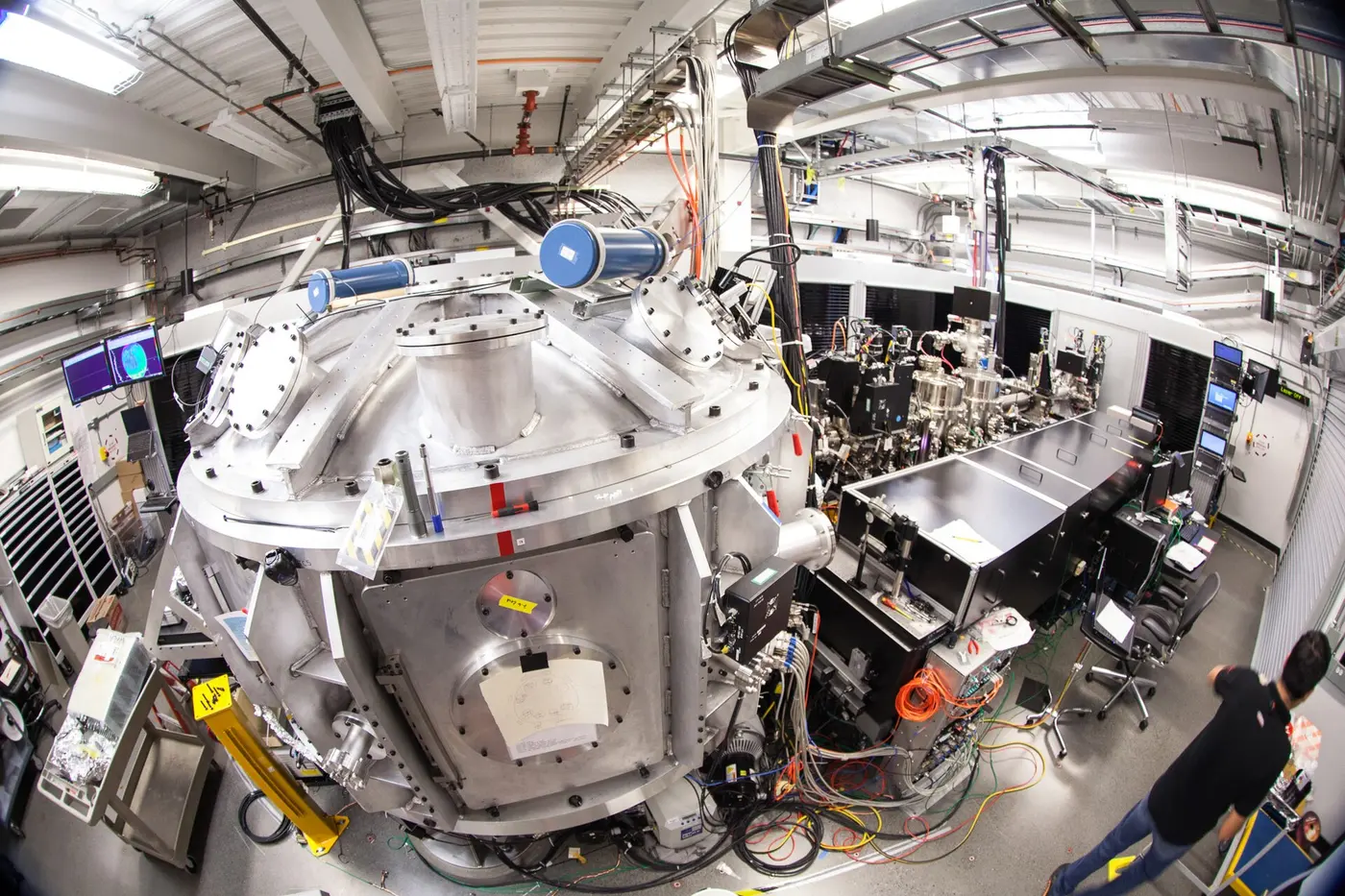

In 2022 the same group repeated the experiment with PET, the plastic used in drink bottles, which contains oxygen as well as carbon and hydrogen. The oxygen, they found, made diamonds form more readily. That matters, because the planets’ icy layers should hold plenty of oxygen in the form of water.
No one has seen the rain
Still, these are experiments on Earth. The only spacecraft ever to visit Neptune, NASA’s Voyager 2, flew past in August 1989, and nothing has ever looked deep inside. The lab can create these extreme conditions only for an instant, which is not the same as conditions that have lasted billions of years inside a planet.
Even so, the diamond “rain” matters for understanding these worlds. Heavy diamonds sinking toward the core would release heat and could change how heat moves through the interior. Researchers are using the findings to refine their models of what Neptune and Uranus are like inside.