Is Venus the closest planet to Earth?
Venus comes closest of all. But averaged over time, the planet nearest to Earth is actually Mercury.
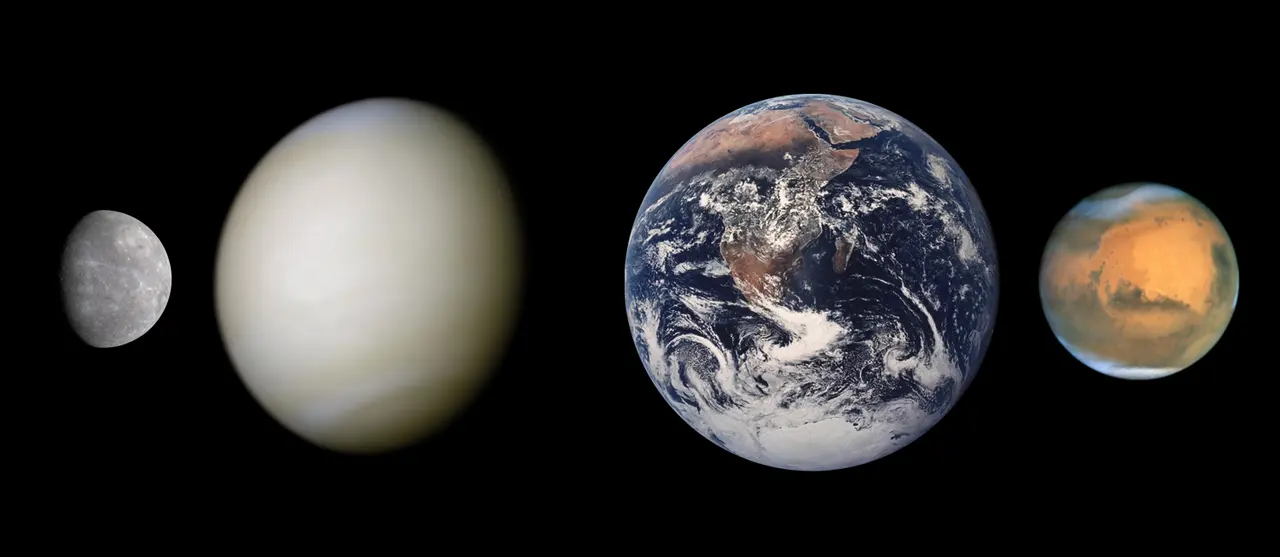
List the planets in order from the Sun and you get Mercury, Venus, Earth, Mars and so on. Venus orbits just inside Earth, Mars just outside. So if someone asks which planet is closest to Earth, Venus seems the natural answer.
That answer may be only half right. It depends on what you mean by “closest.”
Venus comes nearest
Venus orbits the Sun at an average distance of about 108 million kilometers (67 million miles). Earth is about 150 million kilometers (93 million miles) from the Sun, so the gap between the two orbits is a little over 40 million kilometers. Sure enough, at its closest Venus comes within about 38 million kilometers (24 million miles) of Earth.
Our other neighbor, Mars, made its closest approach in nearly 60,000 years in August 2003, and even then it was about 55.76 million kilometers (34.6 million miles) away. In terms of how near a planet can get, Venus is without doubt the closest. It is also almost exactly Earth’s size, which is why it is sometimes called Earth’s twin.

It doesn’t stay close
Venus does not always stay by our side, however. Each planet circles the Sun at its own pace, so Venus sometimes ends up on the far side of the Sun from Earth. At those times it is about 261 million kilometers (162 million miles) away, much farther from us than the Sun is.
At its nearest, then, Venus is about 38 million kilometers away; at its farthest, nearly seven times that. So if you take the near times and the far times together, which planet is closest on average?
On average, the closest is Mercury
In March 2019, the US magazine Physics Today published an article that worked out the answer. Its three authors included a NASA engineer. They devised a way to find the average distance between two planets by treating each planet as equally likely to be anywhere along its orbit. They then checked their results with a computer simulation of 10,000 years of solar system motion, and the two agreed to within 1 percent.
As the article points out, many explanations had simply taken the difference between two planets’ orbital radii as the distance between them. But that is only the distance at closest approach. Counting every position along the orbit equally gave a completely different answer.
That answer was that on average, Mercury is the closest planet. Taking the Earth–Sun distance as 1, the average distance from Earth is 1.04 for Mercury, 1.14 for Venus and 1.70 for Mars. That puts Mercury at about 156 million kilometers on average, and Venus at about 170 million. Mercury wins. Even NASA’s Venus fact page now notes that “Mercury, the innermost planet, actually spends more time in Earth’s proximity than Venus.”
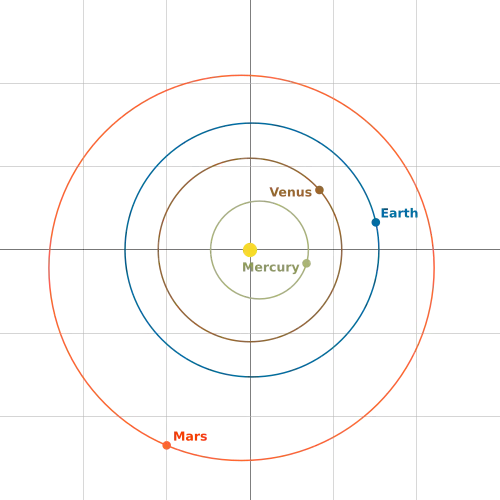

The reason lies in the small size of Mercury’s orbit. Mercury circles the Sun at an average distance of only about 58 million kilometers (36 million miles). It never gets as close to us as Venus does, but when it swings around to the far side of the Sun, it doesn’t get nearly as far away either. It never comes very close, but it never strays very far. Averaged out, that makes Mercury the nearest.
Everyone’s next-door neighbor
The same reasoning leads to an even more surprising result. Mercury turns out to be, on average, the closest planet not only to Earth but also to Venus, to Mars and Jupiter, and even to Neptune at the outer edge of the solar system. Because it hugs the Sun in a small orbit, Mercury never ends up extremely far from any other planet.