Is there ice on Mercury, the planet closest to the Sun?
Yes. Near its north and south poles are crater floors that never see sunlight, and water ice has collected there.
−173°C
Mercury orbits the Sun at an average distance of about 58 million kilometers (36 million miles), closer than any other planet. According to NASA, its daytime surface reaches 430°C (800°F), hot enough to melt lead.
And yet Mercury has ice. Not a thin film of frost, either: it is thought to hold thick deposits of nearly pure water ice. Where on a scorching planet could ice possibly hide?
Places the Sun never reaches
The secret lies in Mercury’s axis. Earth’s axis is tilted about 23.4 degrees, which is what gives us seasons. Mercury’s axis, by contrast, stands almost perfectly upright, tilted less than one degree.
As a result, at Mercury’s north and south poles the Sun always hangs right at the horizon. In deep craters near the poles, the floors stay in the shadow of the crater rims and never see sunlight at all. And because Mercury has almost no atmosphere, there is no air to carry warmth into these permanently shadowed spots, so they stay frigid.
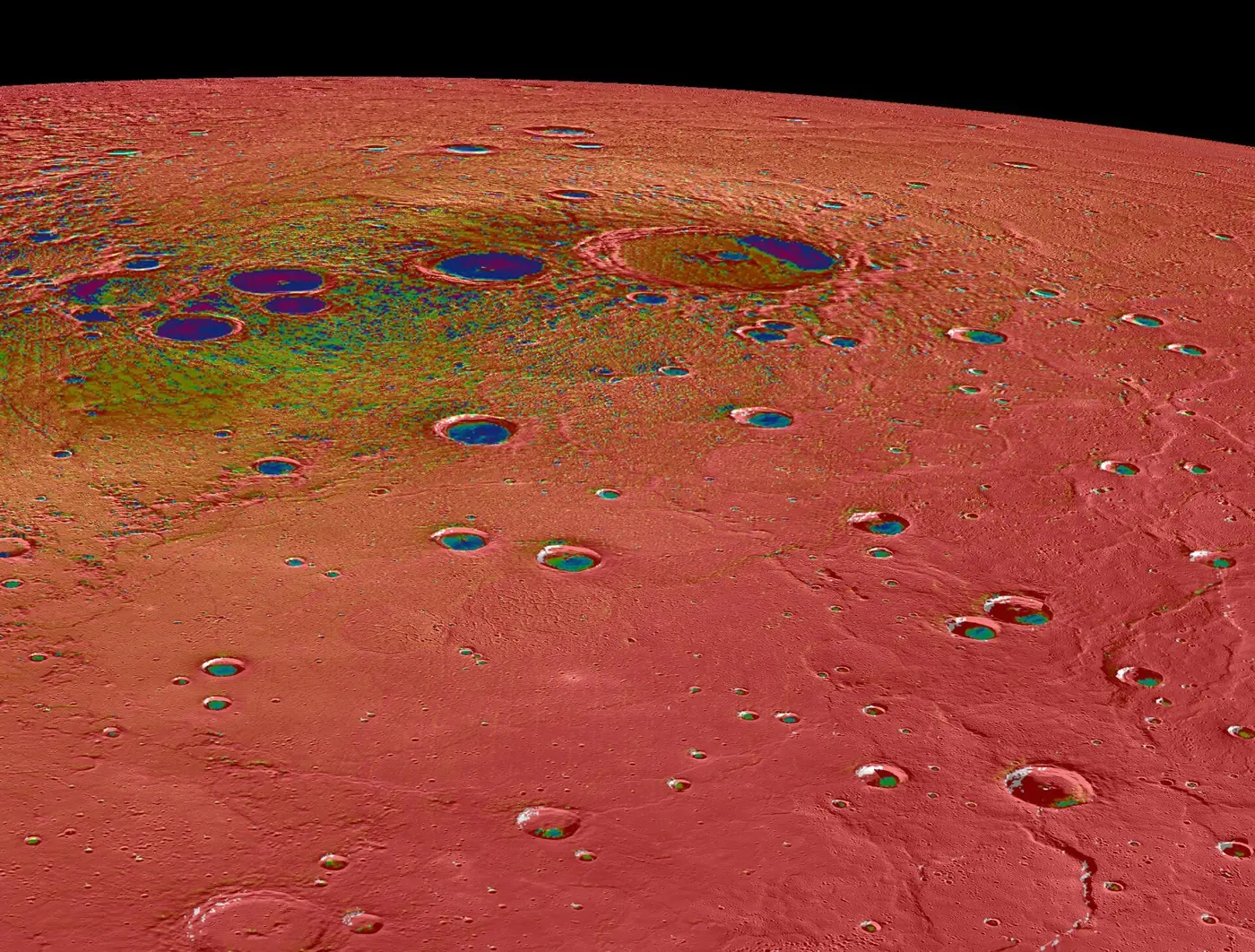

According to NASA, the craters closest to the poles have surface temperatures below 100 kelvins, or −173°C (−280°F). At that temperature, water ice does not evaporate and can survive for billions of years.
1991: bright spots on the radar
Scientists had suggested decades earlier that ice might lurk at Mercury’s poles. The idea got a major boost from radar observations in 1991.
According to the Johns Hopkins University Applied Physics Laboratory, when the Arecibo radio telescope in Puerto Rico bounced radio waves off Mercury, it found patches at the north and south poles that reflected the waves unusually strongly, just as one would expect if there were water ice. Observations that combined a NASA antenna at Goldstone, California, with the Very Large Array radio telescopes in New Mexico picked up similar bright patches.
Many of the patches lined up with craters photographed by the Mariner 10 spacecraft in the 1970s. But Mariner 10 had seen less than half of the planet, so the maps of the polar regions were incomplete, and no one could be sure the patches really lay in shadow. Some scientists also argued that materials other than ice could explain them, and the question stayed open.
MESSENGER’s “unanimous verdict”
The answer came from NASA’s MESSENGER spacecraft. After it went into orbit around Mercury in March 2011, its images confirmed that every one of the radar-bright patches lay in shadow.
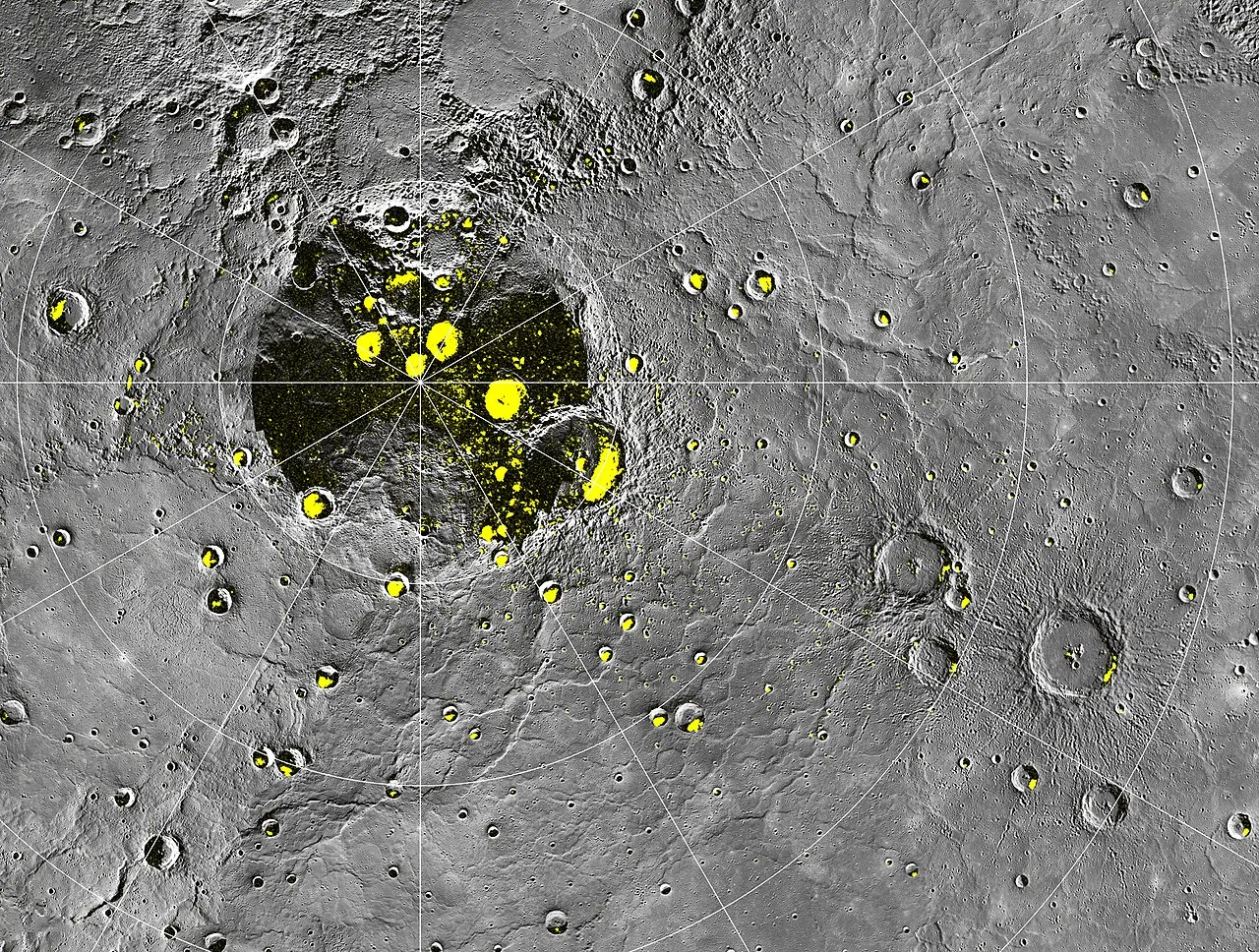

On November 29, 2012, three papers appeared online in the journal Science. Neutron measurements revealed a layer containing enough hydrogen to match nearly pure water ice, lying beneath a surface layer 10 to 20 centimeters (4 to 8 inches) thick. Laser measurements of how the surface reflects light showed that in the coldest spots the ice is exposed, while in slightly warmer ones it is buried under a layer of dark material. That dark material is thought to be organic matter delivered, along with the water, by comets and asteroids.
Sean Solomon of Columbia University, MESSENGER’s principal investigator, put it in courtroom terms: “For more than 20 years the jury has been deliberating on whether the planet closest to the Sun hosts abundant water ice in its permanently shadowed polar regions. MESSENGER has now supplied a unanimous affirmative verdict.” In 2014, the team even managed to photograph the ice inside the permanent shadows, using the faint light scattered off sunlit crater walls.
Next up: BepiColombo
Out of fuel, MESSENGER crashed into Mercury on April 30, 2015, ending its mission. Its successor is BepiColombo, a joint mission of the European Space Agency (ESA) and the Japan Aerospace Exploration Agency (JAXA). Launched in October 2018, it is due to arrive at Mercury in December 2026. ESA lists the question of why there is ice in the polar craters of this scorched planet among the mysteries the mission hopes to solve.