What happened to the Venus de Milo’s arms?
Already missing when the statue was found, they have never turned up. A hand holding an apple was found nearby.
204cm
In the Louvre in Paris, one sculpture always has a crowd around it: a goddess with a gentle twist to her body and drapery wrapped around her hips. This is the Venus de Milo. And when we picture her, the first thing that comes to mind is that she has no arms.
Beautiful without arms—or, some would say, beautiful precisely because she has none. So what became of those arms?
From a field on Milos, 1820
The statue was found in April 1820 on the Greek island of Milos in the Aegean Sea. A local farmer tilling his field dug a marble statue of a woman out of the ground. It lay in two large pieces, an upper half and a lower half.
Olivier Voutier, a French naval cadet whose ship happened to be calling at the island, was present at the dig and made a sketch of what was found. Near the statue lay a fragment of an arm, a hand holding an apple, and two herms (pillars topped with carved heads). After negotiations by French diplomats, the statue passed into French hands, and in March 1821 it was presented to King Louis XVIII and placed in the Louvre.
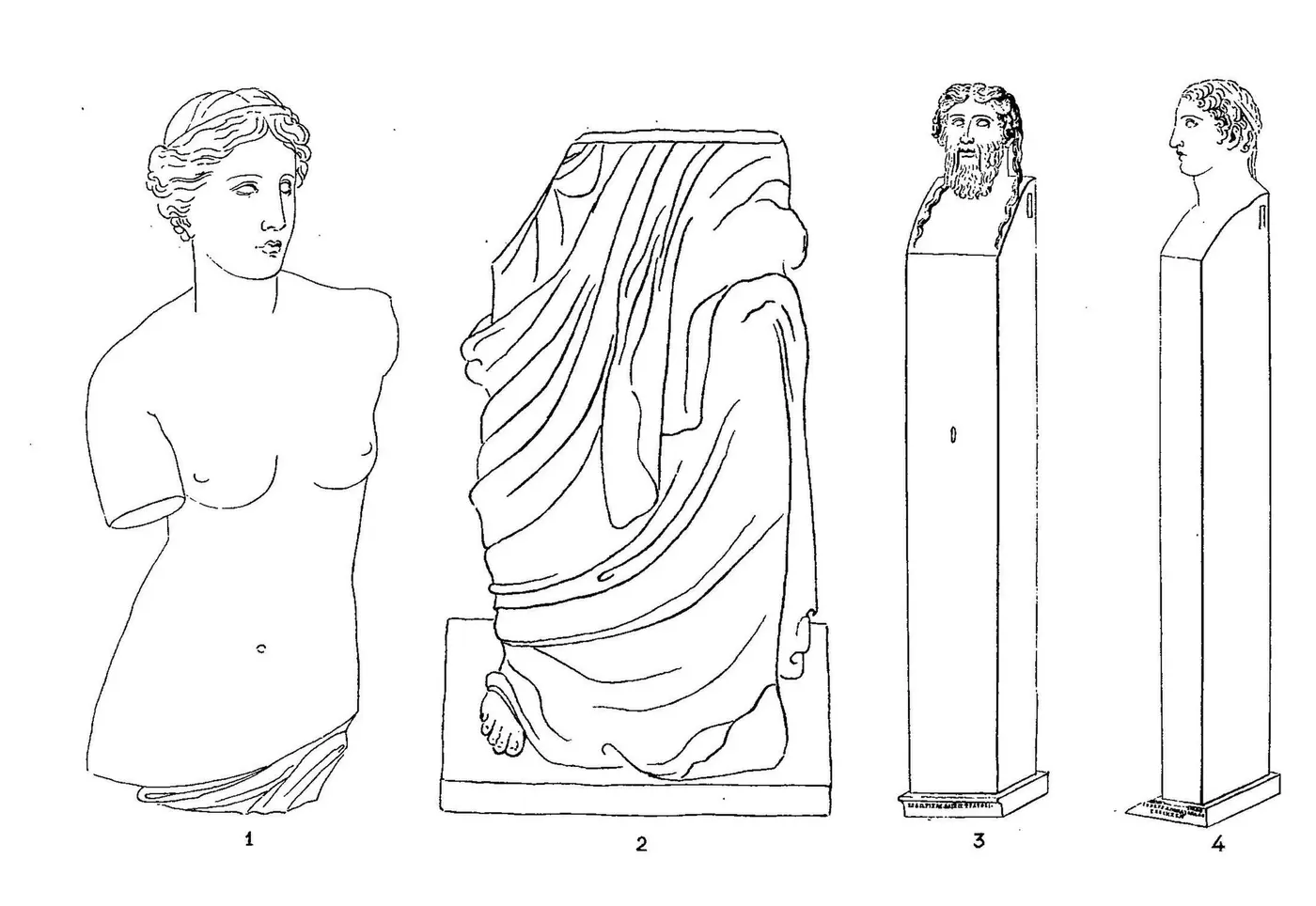

The statue is carved from marble from the island of Paros and stands about 2 meters (6 feet 8 inches) tall. It is thought to date from around the 2nd century BC. It is believed to depict Aphrodite, the Greek goddess of love and beauty—Venus in Roman myth—though some suggest it may be the sea goddess Amphitrite.
Broken in a brawl on the beach?
A dramatic story is told about the arms. As the statue was being loaded onto a ship, the tale goes, a fight broke out on the beach over who would get it, and in the scuffle its arms snapped off.
This story spread after one of those involved wrote it down in 1874, more than 50 years after the discovery. But Voutier, who had witnessed the discovery, disputed it, stating that the statue’s arms were already broken when it was found. His sketch, too, shows the statue without arms. It seems most natural to conclude that the arms were lost long before the discovery.
What were the arms doing?
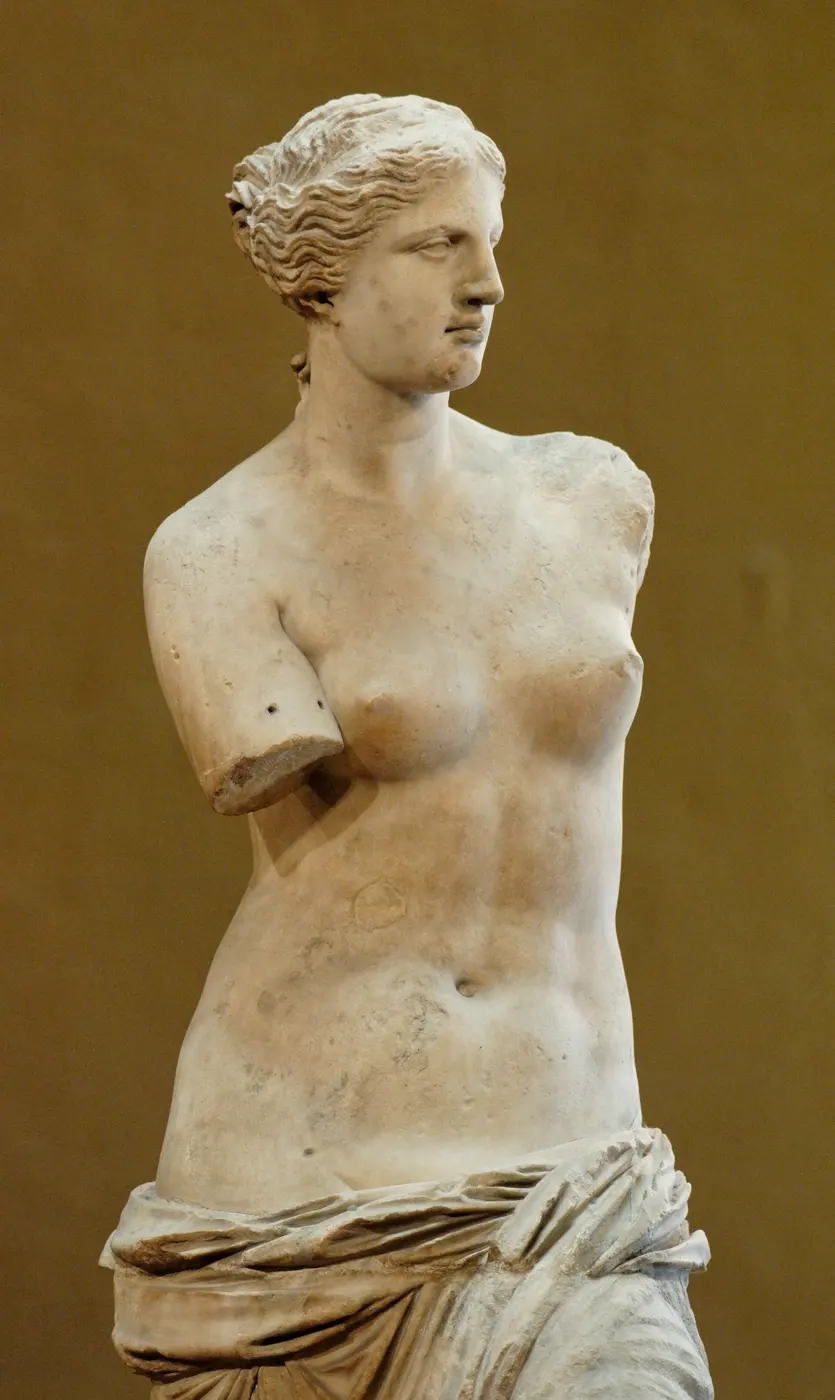
The arms themselves have never been found. So people have proposed many reconstructions of the statue’s original pose.
The most widely supported is that her right hand held up the drapery slipping from her hips while her left hand held an apple. The apple is thought to represent the golden apple from the Greek myth of the Judgment of Paris, which Aphrodite received as the most beautiful of the goddesses. The fragment of a hand holding an apple found beside the statue is made of the same type of marble, and analyses carried out during the 2010 restoration also supported the view that it was originally part of this statue.
Many other ideas have been proposed as well: that she was gazing at herself in the shield of Ares, god of war, as if in a mirror; that she was part of a group standing beside Ares; or that she held a wreath or a spear.

Choosing to leave her armless
When the statue first entered the Louvre, there was debate over whether to carve new arms to replace the missing ones. But on the advice of the art historian Quatremère de Quincy and others, it was decided to display the statue just as it had been found.
Had arms been added from imagination back then, the Venus de Milo we know would look entirely different. Because no one knows what she held, each viewer pictures the lost arms in their own way. Her missing arms have, over time, become part of her very appeal.
Since entering the Louvre, the statue has left France only once. In 1964 it was shown in Tokyo and Kyoto, drawing great crowds from all over Japan.