Why is “The Last Supper” so badly damaged?
Mainly because Leonardo used an experimental technique on a dry wall instead of the standard fresco method.
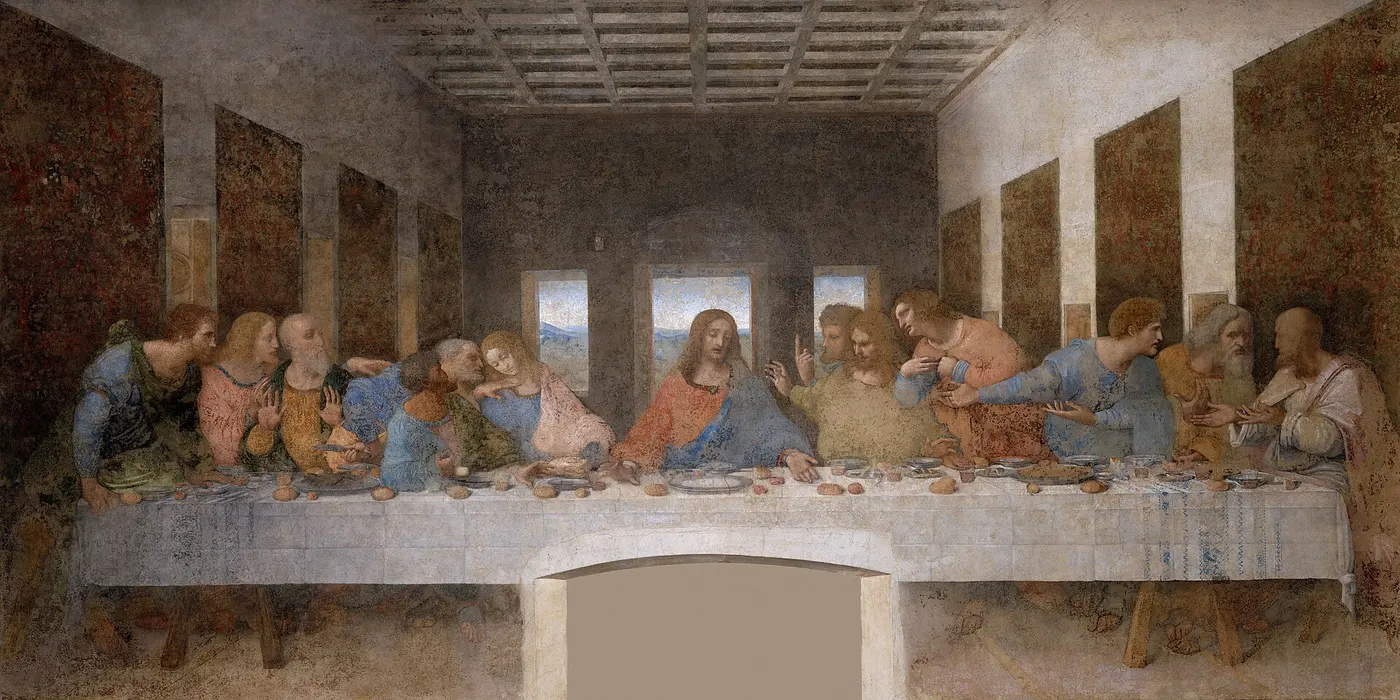
In Milan, Italy, stands the convent of Santa Maria delle Grazie. Across the full width of one wall in the refectory, where the friars once took their meals, is Leonardo da Vinci’s The Last Supper. It measures about 4.6 meters high and 8.8 meters wide (roughly 15 by 29 feet). The masterpiece captures the moment Christ announces, “One of you will betray me,” and the turmoil that ripples through his disciples.
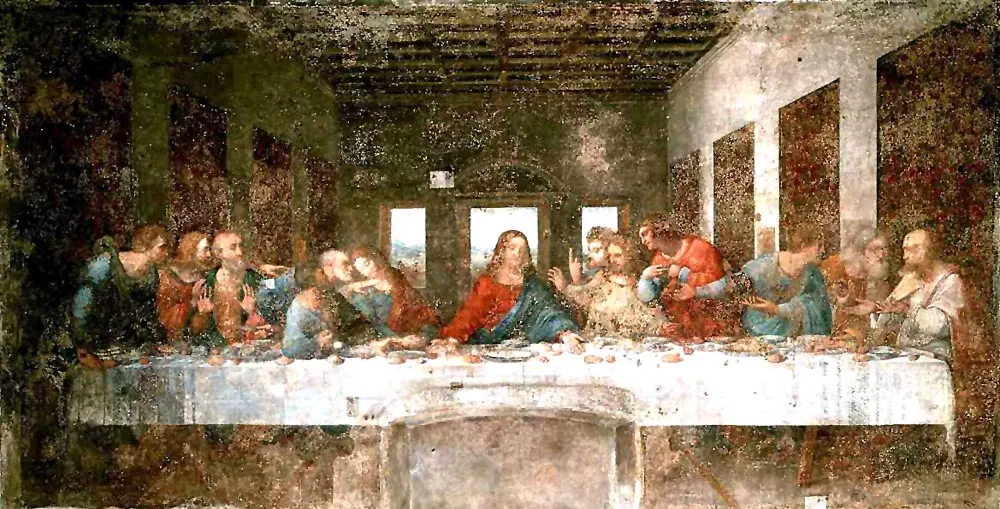
Yet many people standing before the real thing are taken aback. The colors are faded, paint has flaked away in places, and the figures’ outlines are hazy. This is not just the work of 500 years. The damage was set in motion the moment the picture was painted.
The genius who passed on fresco
The mural was painted from around 1495 to around 1498, commissioned by Ludovico Sforza, Duke of Milan.
At the time, the standard technique for wall painting was fresco: painting with pigments mixed in water onto plaster while it is still wet. As the plaster dries, the pigment is locked into the wall, which makes it extremely durable. The catch is that the painter has to finish before the plaster dries, and once something is painted it can hardly be corrected.
For Leonardo, who liked to observe closely and rework his paintings again and again, this was a serious limitation. So he chose a different method: painting on a dry wall with tempera (pigment bound with egg or similar) and paints containing oil. He could prepare the ground as he wished, build up color over time, and work in fine detail. For his art, it was an ideal method.

Flaking within 20 years
The method had a fatal weakness, however. Because the paint doesn’t soak into the wall but sits on its surface, it peels away easily when affected by moisture in the wall and the like.
The damage began almost immediately. By 1517, about 20 years after completion, the paint was already reported to be flaking. Giorgio Vasari, the painter and biographer who saw the picture in the mid-16th century, wrote that it had become little more than “a muddle of blots.”
After that, people added damage of their own. In 1652, a section at the bottom center of the wall was cut away to make a doorway between the refectory and the kitchen, and Christ’s feet were lost. In the 18th century there were several attempts at restoration, but some of them, such as painting over the surface, ended up hiding the original instead.
Soldiers, floods and bombs
The misfortunes kept coming. In 1796, soldiers of Napoleon’s French army who had entered Milan are said to have thrown stones at the painting and climbed ladders to scratch out the apostles’ eyes. The refectory is also said to have been used as a stable. In 1800 the room was flooded, and in 1821 a restorer who tried to detach the mural and move it, working on the mistaken assumption that it was a fresco, badly damaged the central section.
The greatest crisis came in August 1943, during the Second World War. Allied bombing hit the convent, and part of the refectory’s roof and walls collapsed. The mural, protected by sandbags and other measures put in place beforehand, miraculously survived. Even so, for some time afterward it was left exposed to wind and rain with no roof overhead.

A restoration that took over 20 years
Full-scale restoration of the battered Last Supper began in the late 1970s. Led by the restorer Pinin Brambilla Barcilon, the team removed, little by little, the grime and the layers of paint added by earlier restorations, finally finishing in May 1999. It was a monumental undertaking lasting more than 20 years.
The restoration revealed Leonardo’s original bright colors, hidden for centuries. Areas where the original had been lost were filled in with watercolor in subdued tones, so that the additions can be told apart. At the same time, some critics argue that too much was removed, and debate over how the restoration was handled continues to this day.
Today, seeing the mural requires a reservation, and each visit is limited to about 15 minutes. The aim is to reduce the effects of moisture, dust and the like brought in by visitors and to preserve the conditions the painting needs. Painted with an experimental technique 500 years ago, the mural is still carefully guarded, just barely holding on to its image.