Was the snap-off blade knife invented in Japan?
Yes. Yoshio Okada, who later founded the company OLFA, came up with it in 1956, inspired by the grooves on a chocolate bar.
59°
Opening a cardboard box, trimming a sheet of paper, stripping old wallpaper: you push out a little of the blade, and when it stops cutting cleanly you snap off the tip with a satisfying click. Snap-off blade knives, often just called box cutters or utility knives, are so ordinary that hardly anyone wonders where they came from.
The answer is Japan. The idea came from a young man working at a print shop, and his inspiration came from two unlikely places: street shoemakers and a bar of chocolate.
“Know a good knife for cutting paper?”
The inventor, Yoshio Okada, was born in 1931. According to the official website of OLFA, the company he later founded, his family ran a paper-cutting business, and he loved blades from childhood. He worked in several trades, from electrical work to machine repair, and it was while he was employed at a print shop that he hit on the snap-off blade.
It started with a question from his younger brother Saburo, who worked at another printing company: did Yoshio know of a good knife for cutting paper? Printers at the time cut paper with bare razor blades pinched between their fingers. That was dangerous, and it was wasteful too, because once the very tip went dull, the whole blade was thrown away.
Broken glass and a chocolate bar
Okada remembered the shoemakers who worked on the street. Instead of knives, they used shards of glass to shave shoe soles, and whenever an edge went dull, they cracked the glass with a stone to get a fresh one.
His second clue was a memory from his youth in postwar Japan: American soldiers munching on bars of chocolate. A chocolate bar is scored so that it breaks into neat pieces. Score a blade in the same way, Okada reasoned, and every time it went dull you could snap off the end, getting a brand-new tip again and again from a single blade.
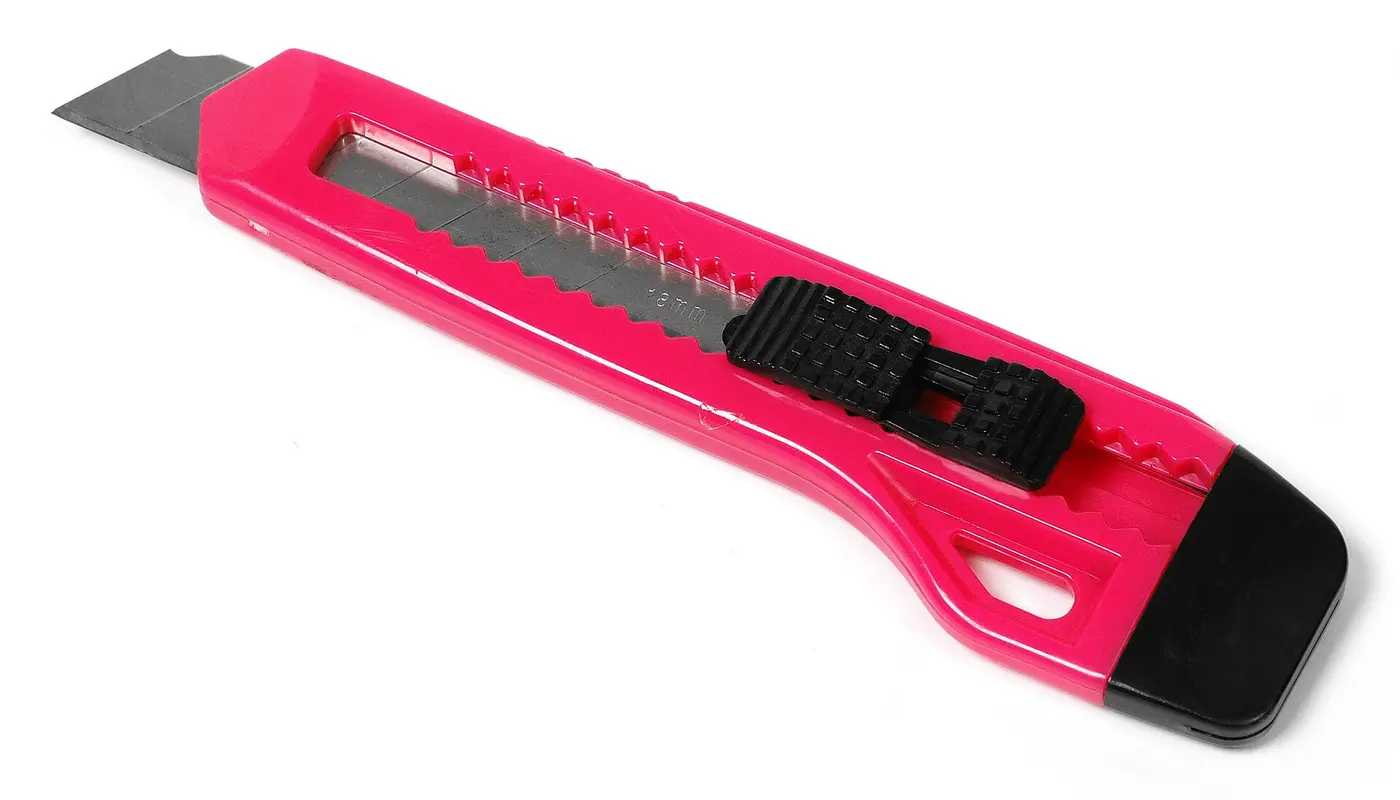

The 59-degree answer
Okada grew more confident after hearing at a public industrial research institute that about 80 percent of a blade’s work is done by its tip. Through prototype after prototype, he tested how far apart the score lines should be, how deep, how hard the steel should be tempered and how precisely it should be ground. This is also when he arrived at the blade angle of 59 degrees that is still used today. His first prototype, finished in 1956, was about 13 centimeters (5 inches) long and 1 centimeter wide, with score lines about 5 millimeters apart.
Manufacturers were not impressed. A blade that was meant to break sounded like a contradiction; a Japanese proverb about defeat even speaks of swords snapping and arrows running out. So Okada paid for production himself. The 3,000 knives he ordered from a small workshop came back so uneven that he fixed them one by one with pliers and files. The knife finally went on sale in 1959.
A worldwide standard
In 1967, Okada and his brothers founded a company and named the brand OLFA, from the Japanese oru ha, “breaking blade.” The company says he first thought of spelling it OLHA but switched the H to an F because the letter H is silent in some languages. The bright yellow body, OLFA explains, was chosen so the knife would stand out in a toolbox and help prevent accidental cuts.
Okada’s patent covered Japan only. Overseas toolmakers began producing knives to the same specifications, and as a result the snap-off blade spread around the world faster than it otherwise might have. There is no official standard for blade sizes, such as a Japanese Industrial Standard, but according to OLFA other makers appear to follow the dimensions of the original blade, so the angle and widths Okada chose have become a de facto global standard.
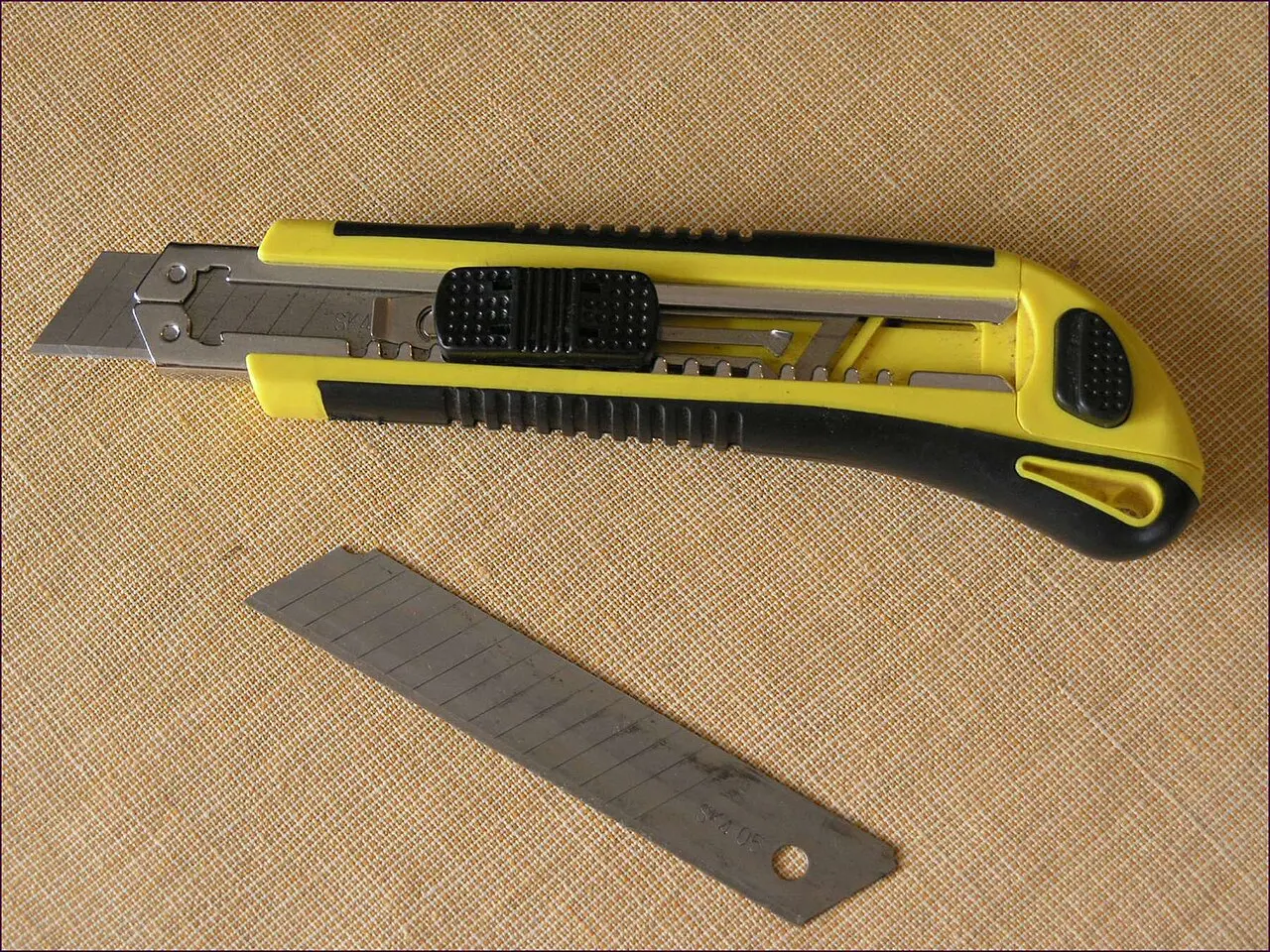

Handy as it is, the knife deserves some care. OLFA advises extending the blade by no more than one segment at a time, because a blade pushed out too far can snap unexpectedly. When the knife stops cutting easily, don’t force it: snap off the tip or change the blade.