Why do bullet trains have such long noses?
To cut air resistance, and also to muffle the “boom” that rings out when a train leaves a tunnel.
15m
Line up Japan’s shinkansen, or bullet trains, at a platform and compare them, and their faces look remarkably different. Some are round and friendly, some are pointed like a beak, and some, like the Hayabusa on the Tōhoku Shinkansen line, stretch far out in front. On the E5 Series that runs as the Hayabusa, the “nose” is about 15 meters (49 feet) long—more than half the length of the lead car.
It would be natural to assume this is because cutting air resistance matters for speed. That is certainly one reason. But the hidden force behind those long noses turns out, surprisingly, to be tunnels.
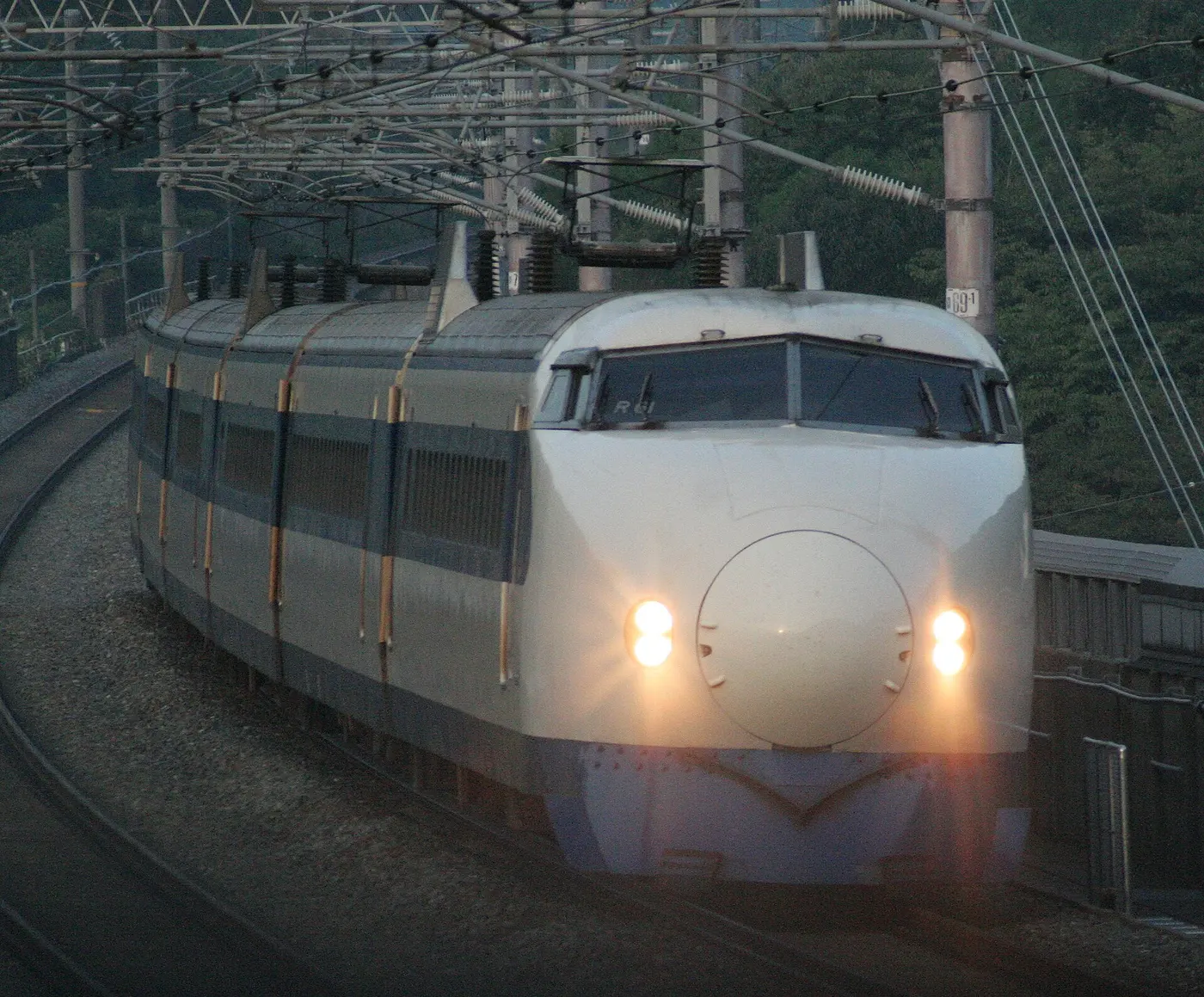
The round-nosed 0 Series
The 0 Series, which debuted with the opening of the Tōkaidō Shinkansen in 1964, was known for its short, rounded front end. It was a friendly shape, said to have been modeled partly on the airliners of the day. Its top speed was 210 kilometers per hour (130 mph). At that speed, tunnel noise was not yet a serious problem.

The “boom” from the tunnel
The problem came to light around 1975, when the San’yō Shinkansen opened all the way to Hakata. This line runs through mountainous country and has many long tunnels. Complaints began coming in that when a train entered a tunnel, a bang like an explosion rang out near the exit at the other end, rattling the windows and doors of nearby houses.
This is a phenomenon called a “tunnel micro-pressure wave.” When a high-speed train plunges into a tunnel, the air at the entrance is suddenly squeezed, creating a wave of compressed air. The wave races through the tunnel at the speed of sound, ahead of the train, and when it reaches the exit it bursts out as a pulse of pressure. That is why it sounds like a gunshot. In long tunnels laid with concrete slab track instead of gravel ballast, the compression wave doesn’t weaken much along the way, and this is said to have made the problem worse.
What a longer nose changes
The strength of the micro-pressure wave released at the exit is said to be roughly proportional to how steeply the compression wave rises as it travels through the tunnel—in other words, how abruptly the pressure builds. And the faster the train goes, the sharper that rise becomes. As long as engineers wanted more speed, there was no getting around the problem.
The solution they came up with was to make the front end long and slender, so that the train’s cross-section grows gradually. Think of pushing in the plunger of a syringe slowly instead of all at once. The air is compressed more gently, and the wave rises less sharply.
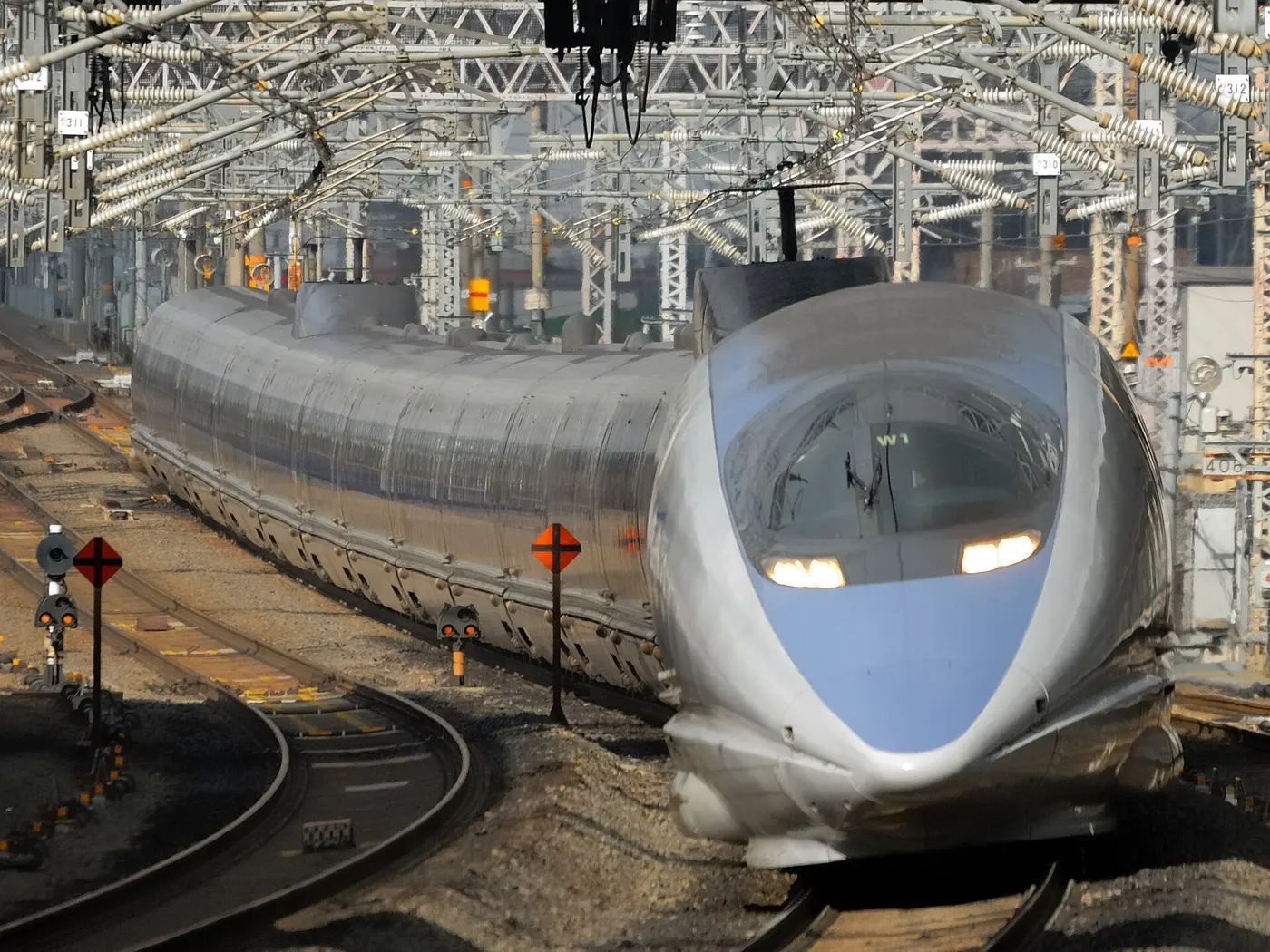
The nose of the N700 Series is about 10.7 meters long, and those of the 500 Series and the E5 Series about 15 meters. ALFA-X, a test train for the next generation of shinkansen, has a lead car with a nose of about 22 meters (72 feet). Alongside changes to the trains, hood-like “buffer” structures have also been added to tunnel entrances.
The 500 Series and the kingfisher
In the search for the right nose shape, nature sometimes provided the hint. JR West’s 500 Series, which entered service in 1997, was the first train in Japan to run in regular service at 300 kilometers per hour (186 mph). One of the engineers involved in its development, Eiji Nakatsu, was a keen birdwatcher. The shape of the kingfisher’s beak, which lets the bird dive from the air into water with barely a splash, is said to have informed the design of the front end. The same 500 Series also borrowed from the feathers of the owl, which flies in near silence, to reduce the noise of the pantograph that draws power from the overhead wires.

A long nose comes at a price, though. The longer the nose, the shorter the passenger cabin in the lead car, and the fewer seats it holds. How far to stretch the nose is decided through a tug-of-war between speed, quiet and the number of people a train can carry. The familiar face of a bullet train is the answer to a balancing act among noise, speed and seats.