Was conveyor-belt sushi inspired by a beer factory?
Yes. Osaka restaurateur Yoshiaki Shiraishi got the idea from a conveyor belt at a brewery, then spent about 10 years making it work before opening the first restaurant in 1958.
10years
Plates of tuna and salmon glide past on the belt in front of you. You take whatever you like, and at the end of the meal your bill is worked out from the stack of empty plates. Conveyor-belt sushi, or kaitenzushi (“revolving sushi”), is now a fixture of eating out in Japan, with more than 4,000 restaurants across the country.
The system was invented by Yoshiaki Shiraishi (1913–2001), who ran a sushi restaurant in Osaka. His inspiration was a conveyor belt at a beer factory. But it took him about 10 years to get from that idea to his first restaurant.
Too busy for its own good
According to an article by the Organization for Small & Medium Enterprises and Regional Innovation, a Japanese government agency, based on interviews with Shiraishi’s eldest son, Hiroshi, Shiraishi moved from his native Ehime Prefecture to Osaka in 1947 and opened a restaurant in the city of Fuse, now part of Higashiosaka. Before long he was serving sushi too. Back then sushi was a treat for special occasions. Shiraishi wanted the young factory workers and students of the neighborhood to be able to enjoy it, so he served it standing-room-only, at 20 yen for a plate of four pieces. That was about 30 percent cheaper than other shops, and he displayed his prices clearly. Business boomed.
In fact it boomed too much. He couldn’t keep up with the customers, and the young sushi chefs, fresh out of junior high school, kept quitting because the work was so hectic. One surprising bottleneck was the time it took for a chef to hand each order to a customer.
“That’s it!”
Then Shiraishi joined some local business owners on a tour of a beer factory in Suita, a city north of Osaka. Watching a conveyor belt carry bottles along the production line, he thought: that’s it. A conveyor running all the way around the counter could carry plates of sushi past the customers, and they could help themselves. That was in 1948.
The hard part was the corners. A straight track was easy, but at the bends the conveyor jammed and plates fell off. Stuck, Shiraishi happened to watch some children holding playing cards fanned out in their hands, and had another flash of insight: fan-shaped pieces might be able to turn a corner smoothly. Plying local machine-shop owners with sake, he worked with them on the problem until they had a uniquely shaped conveyor plate he called uroko, or “scale.” After more work, including a search for materials that wouldn’t rust, his “conveyor-type revolving dining counter” was completed in 1957.
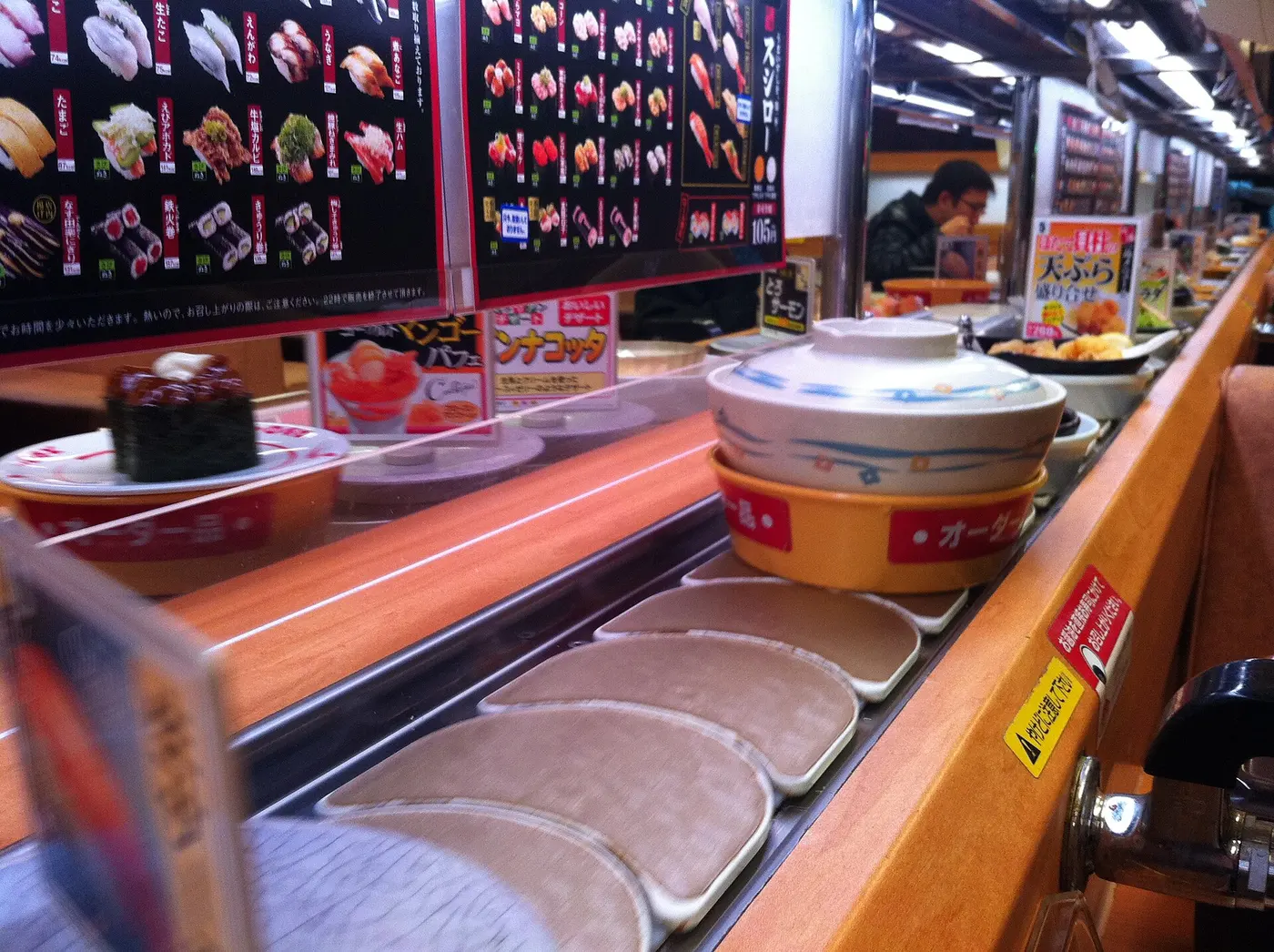

In April 1958, the first Mawaru Genroku Sushi (“Revolving Genroku Sushi”) opened near Fuse Station. Grabbing sushi as it went by suited the famously impatient people of Osaka, and the moving counter, visible from the street, was a novelty in itself. The restaurant was packed every day. Many conveyors in Japan run clockwise, and the usual explanation is that Genroku chose to send the plates from right to left, so that right-handed customers could keep their chopsticks in their right hand and take plates with their left.
Expo ’70 makes it famous
What made conveyor-belt sushi famous nationwide was the 1970 World Exposition in Osaka. When the local chamber of commerce asked whether someone from Higashiosaka would open a stall at the fair, Shiraishi volunteered, setting up next to a station of the monorail that circled the site. The crowds grew until there were long lines, and the staff were so busy they could not send out sushi topping by topping, so they put 300-yen sets in wooden tubs on the belt instead. According to Genroku’s own history, the restaurant received an award at the Expo for its outstanding food service.
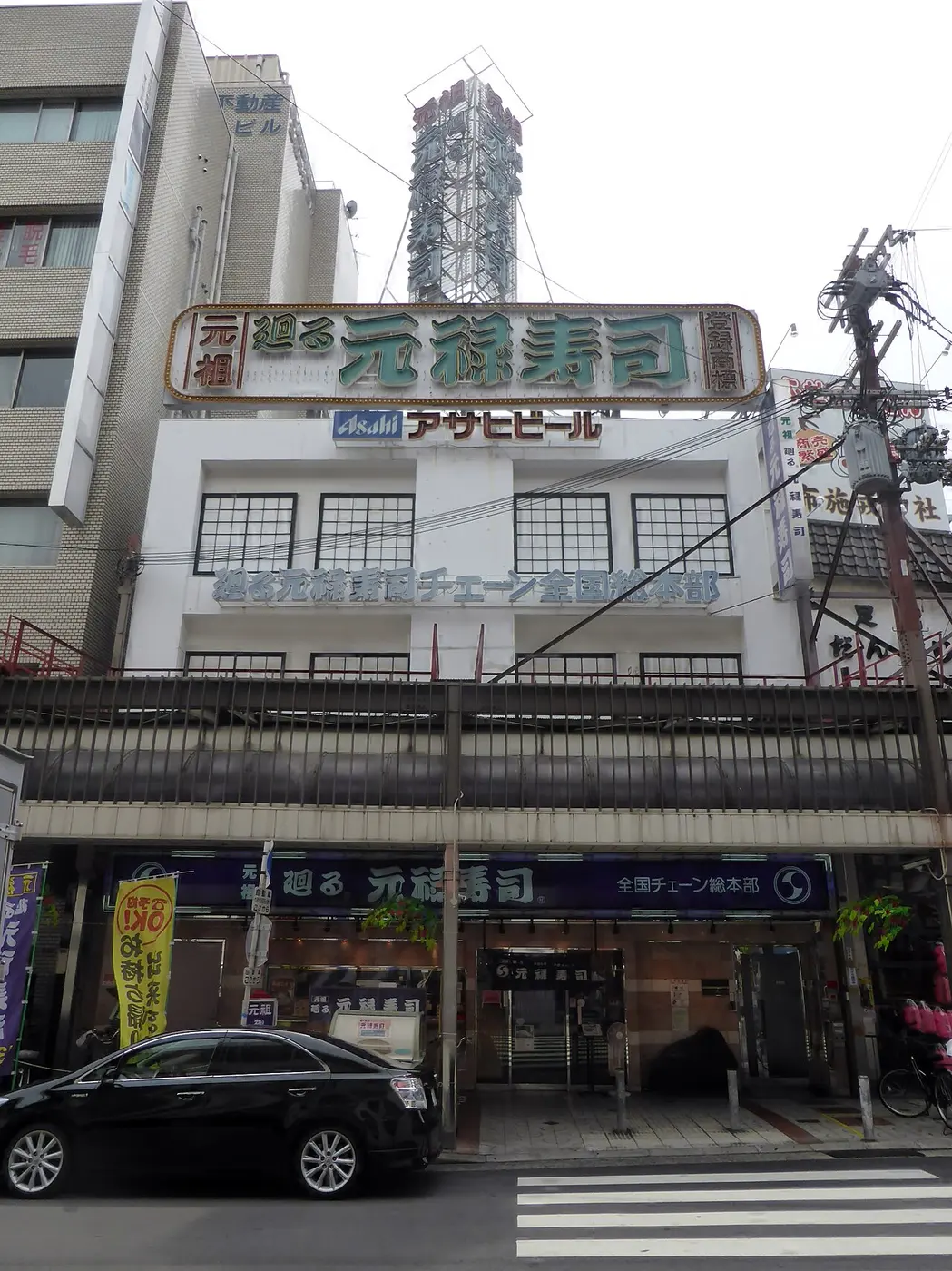

After the Expo, Genroku Sushi spread across Japan, largely through franchising, peaking at about 250 restaurants. Shiraishi had patented his conveyor counter in 1962 and sent warnings to copycats, but when the patent expired in 1978, all kinds of companies jumped into the business. In 2021 the Japan Society of Mechanical Engineers recognized a 1985 conveyor still in use at Genroku’s Sakai-Higashi restaurant, together with the early “scale” plates, as a Mechanical Engineering Heritage.