Can a tree stump’s rings tell you which way is south?
No. Rings grow lopsided not because of the sun, but because of the forces a slope or the wind puts on the trunk and branches.
594
If you get lost in the mountains, find a tree stump. The rings are wider on the south side, so you can work out which way you are facing. In Japan, many people learned this as children. It sounds sensible enough: surely a tree grows more on its sunny side.
Tree specialists, however, agree that it doesn’t work. What lopsided rings reveal is not a compass direction but the forces the tree was pushing against as it grew.
South isn’t always wider
The Nagano Prefecture Forestry Research Center in central Japan tackled this piece of folklore in an explainer for children. A tree that grows normally, it says, thickens equally in every direction, so its rings form neat concentric circles. Rings become lopsided when a tree growing on a steep slope or in a windy spot thickens the parts under strain so that it won’t topple over. The center shows a stump from a tree that grew on flat ground with strong southerly winds. Its rings were not wider to the south at all, but bulged far out to the north.
Taisai Hori, a lecturer at Tokyo University of Agriculture and head of a nonprofit group that studies trees, went further at a public lecture in 2017. The belief that rings are wider on the south side, he said, is “a terrible mistake.” In a straight tree with evenly spread branches, the rings are roughly the same width on every side.
Downhill for conifers, uphill for broadleaves
On a slope, trunks lean and branches tend to crowd onto one side. To support that weight, the tree lays down extra wood on one side, known as reaction wood. According to a Japanese chemistry dictionary published by Morikita, conifers form “compression wood” on the lower side of a leaning trunk or branch, while broadleaf trees form “tension wood” on the upper side. In other words, conifers prop themselves up from below, and broadleaf trees hold themselves up by pulling from above.
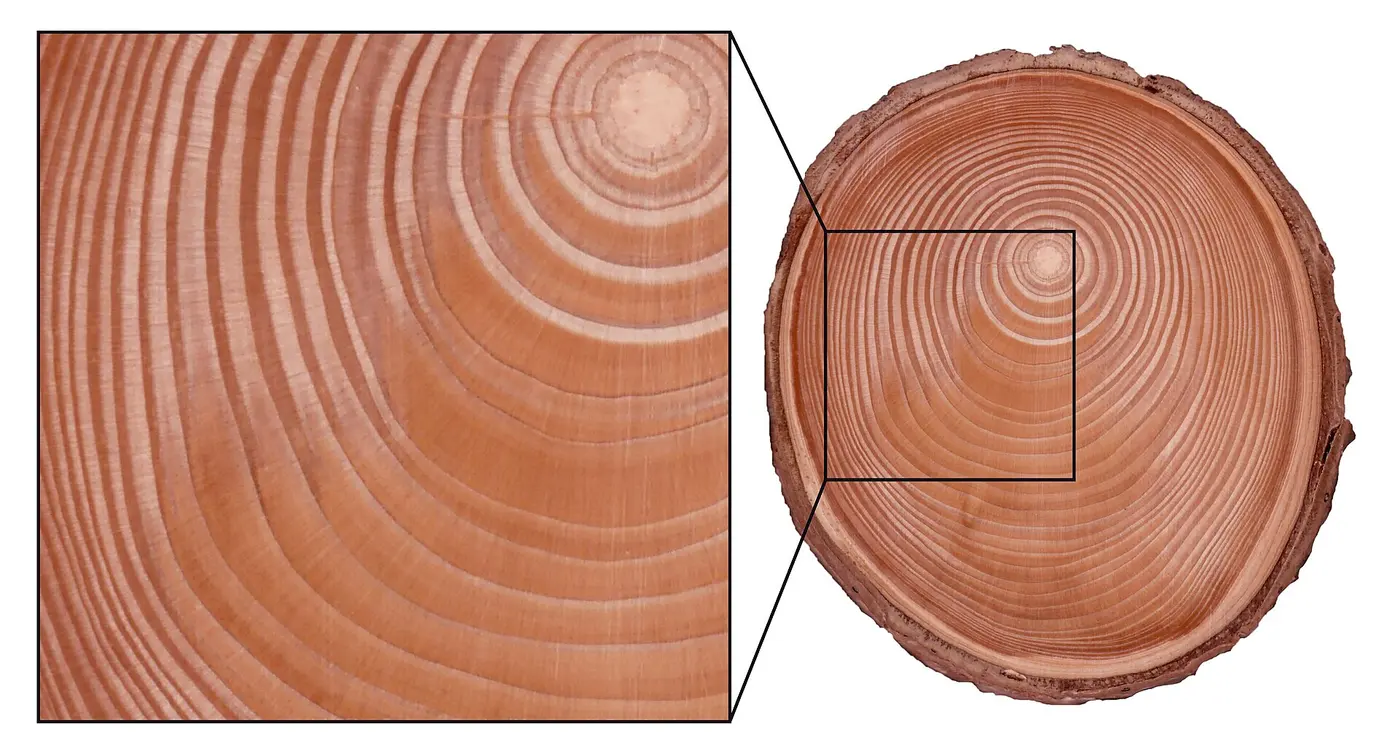

So on a steep slope, a conifer’s rings are wider on the downhill side and a broadleaf tree’s on the uphill side. Hori explains that trees on a slope find the uphill side crowded by the branches of trees above them, so they grow their branches downhill, shifting their center of gravity that way.
Where, then, did the south-side story come from? Hori has a theory. People tend to farm, build huts and rest on south-facing slopes, where the sun is best. On those slopes, downhill happens to be south. What was really “wider on the downhill side” may have been mistaken for “wider on the south side.”
A diary written one ring a year
Tree rings may not point south, but they record a great deal. According to the Japanese encyclopedia Nipponica, trees in temperate regions grow vigorously in spring and summer and rest in winter, so they add one ring a year. The width of each ring varies with that year’s weather.
Dendrochronology uses the pattern of wide and narrow rings to date wood. According to the Heibonsha World Encyclopedia, the American astronomer A. E. Douglass discovered the principle in the early 20th century while investigating links between sunspots and climate, and the University of Arizona founded a tree-ring laboratory in 1937. Starting from trees whose dates are known, researchers link up overlapping ring patterns from old buildings and archaeological timber to build a yardstick reaching back thousands of years. Some doubted it could work in Japan, where terrain and climate change over short distances, but in the early 1980s researchers, among them Takumi Mitsutani of the Nara National Research Institute for Cultural Properties, showed that it could, using timber excavated from sites in Nara.
A pillar felled in 594
One striking result came from Hōryū-ji, a temple near Nara famous for having some of the oldest wooden buildings in the world. The central pillar of its five-story pagoda had rotted at the base, and during repairs from 1941 to 1952 the bottom was cut away and replaced with new wood. In 2001 Mitsutani examined a disc about 10 cm (4 inches) thick that had been cut from the removed section.
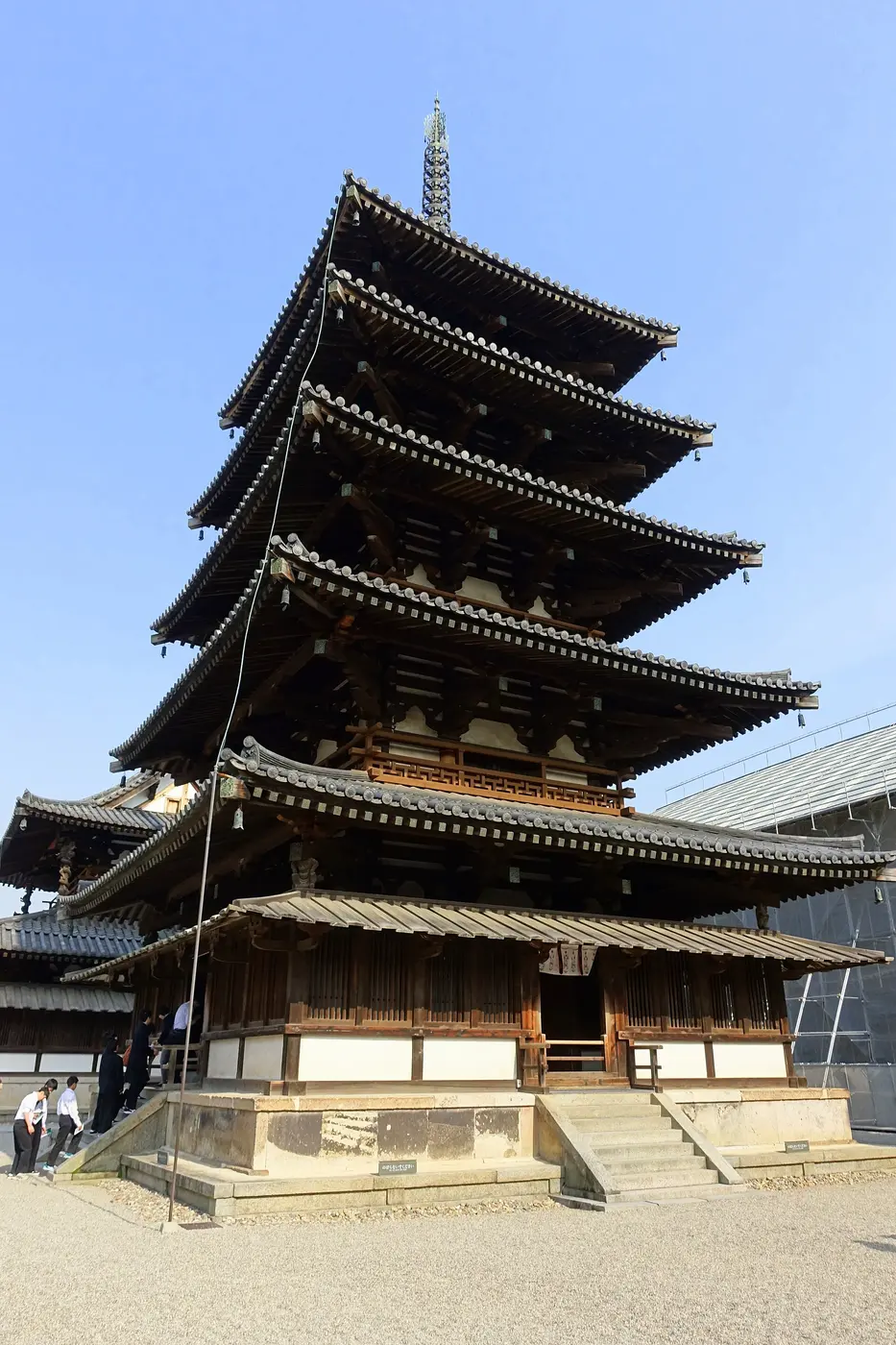

Part of the disc preserved wood from just under the bark, so its outermost ring marked the year the tree was cut. Mitsutani measured 351 rings and matched them against a Japanese cypress (hinoki) yardstick running from 37 BCE to 838 CE. The answer: the pillar came from a tree felled in 594. The scholarly consensus had been that the temple was rebuilt after burning down in 670, and Mitsutani wrote that a date roughly a century earlier would have a major impact on archaeology, architectural history and related fields.
A later study, announced by the institute in 2004, found that other timbers in the pagoda were felled around 673. Why the central pillar is so much older remains a puzzle. The rings had answered one question and raised another.