Does tall goldenrod cause hay fever?
Not to any significant degree. Goldenrod is pollinated by insects, and its pollen does not travel far on the wind. It has long been confused with ragweed, which blooms at the same time of year.
In autumn, vacant lots, riverbanks and railway embankments across Japan glow with tall goldenrod, its yellow flower plumes nodding on the tips of stems taller than a person. The plant, Solidago altissima, is an immigrant from North America. Since it is in full bloom just as autumn sneezing season arrives, it is easy to assume its pollen is to blame.
In the 1970s, it was indeed accused of causing hay fever and denounced as a kōgai-sō, a “pollution weed.” But a 2010 review in Kusa to Midori (Weeds and Vegetation Management), a Japanese journal of weed science, notes that this idea has since been rejected.
The “pollution weed”
According to the invasive species database of Japan’s National Institute for Environmental Studies, tall goldenrod arrived in Japan around 1900, brought in as an ornamental and as a source of nectar for honeybees. The 2010 review adds that beekeepers, who valued it as a late-autumn nectar source, sometimes grew it in their gardens and handed it out to be planted elsewhere.
The plant’s real expansion came after World War II. During Japan’s rapid economic growth from the 1950s, it moved into land cleared for construction and along railways and roads, and by the 1970s it had spread nationwide. At the time, stands about 3 meters (10 feet) tall were common.
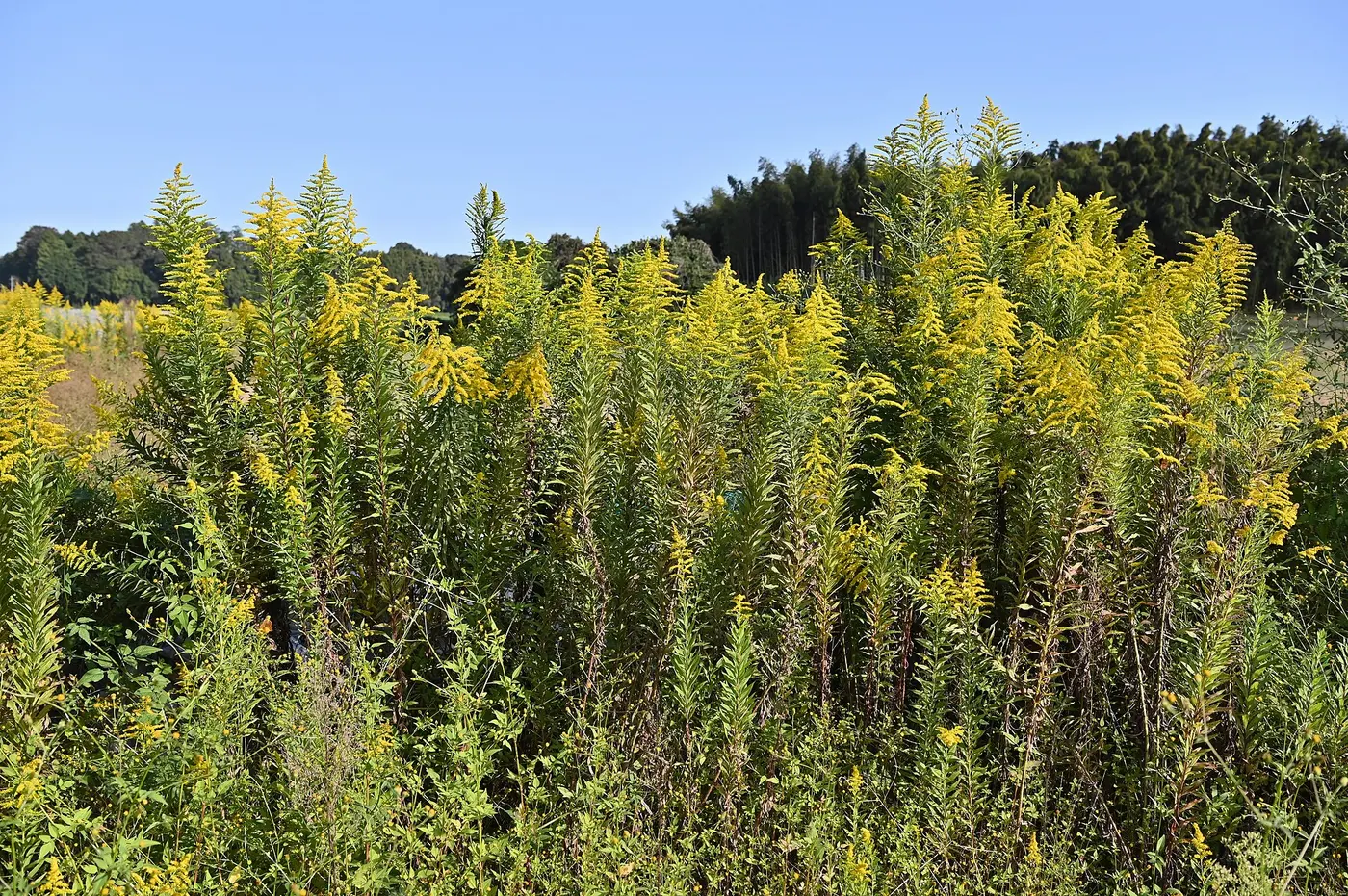

Its rampant growth, combined with suspicions that it caused hay fever, made goldenrod a target for eradication. The media called it “the devil’s weed” and “the cancer of nature,” and some local governments even handed out free herbicide to residents who wanted it. According to a 2021 article in the same journal, concerns about hay fever in children helped prompt the city of Ibaraki in Osaka Prefecture, followed by many other municipalities, to pass ordinances requiring the control of “pollution weeds.”
Pollen carried by insects, not wind
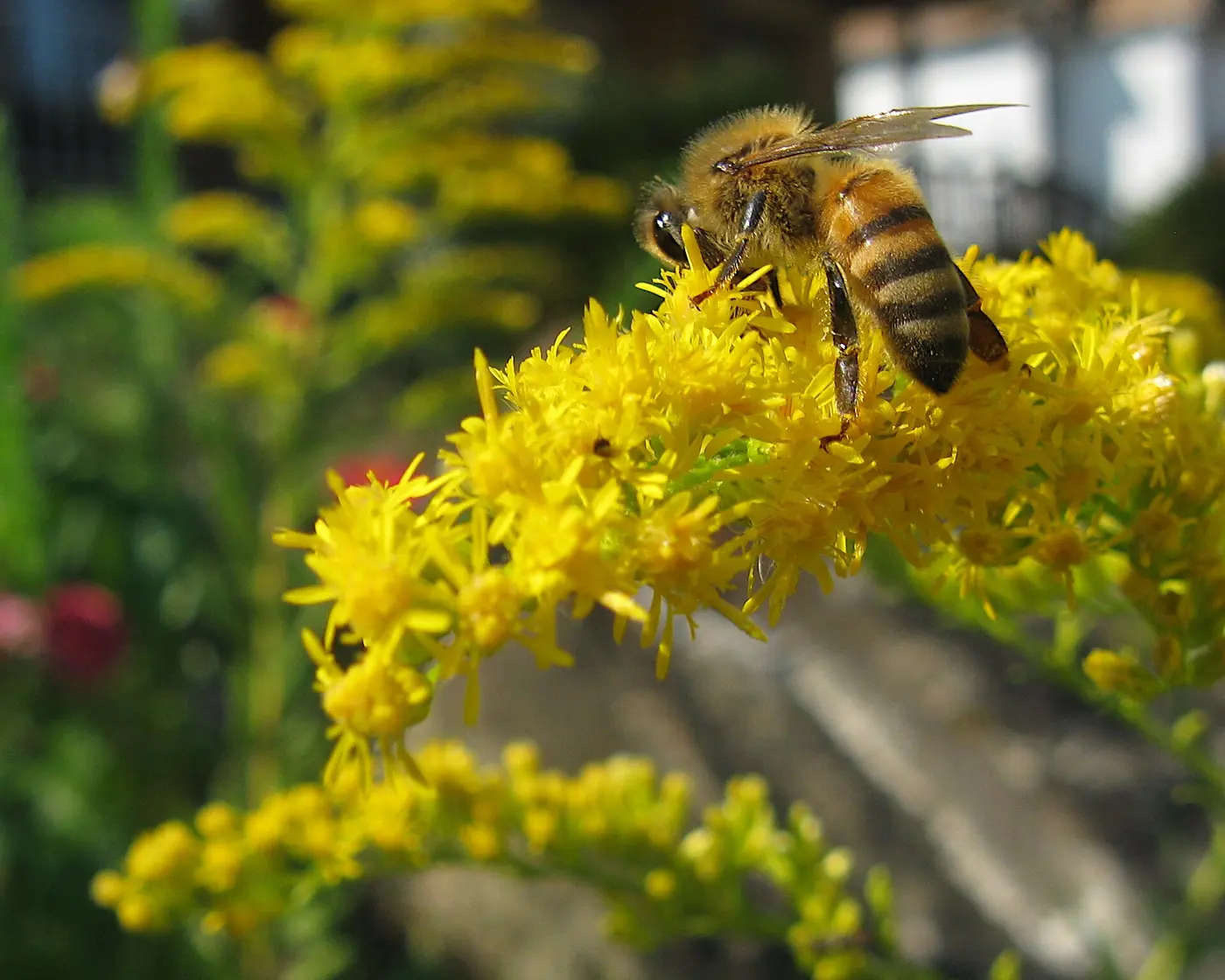
Tall goldenrod, however, relies on insects to carry its pollen. As a 2022 article from University of Illinois Extension explains, goldenrod pollen is large and sticky so that it can hitch a ride on pollinators, and too heavy to be carried by the wind. Its showy yellow flowers are advertisements aimed at insects.
Ragweed, a member of the same daisy family, is different. It is pollinated by the wind, and its drab green flowers release huge amounts of pollen into the air. According to the Japanese Ministry of the Environment’s hay fever manual, pollen from ragweed and its relatives fills the air from late summer into autumn. Ragweed is also a North American native, and in postwar Japan it was nicknamed “MacArthur’s souvenir.” When it comes to autumn sneezing, the inconspicuous ragweed growing nearby is a far likelier suspect than the showy yellow flowers.
The same mix-up happens in North America, goldenrod’s home. Japan’s largest dictionary, the Nihon Kokugo Daijiten, even describes tall goldenrod as “famous in America as a plant that causes pollen allergies.” The Illinois Extension article, however, says goldenrod blooms “attract attention and are often falsely blamed for hay fever allergies.”

Not entirely harmless
That doesn’t mean goldenrod pollen can never cause allergies. The Ministry of the Environment’s manual lists the pollen allergies reported in Japan, and among them is a case of tall goldenrod pollinosis reported in 1977. The 2021 article points out that goldenrod pollen shares allergenic components with ragweed pollen and that even insect-borne pollen can drift in the air. Whether pollen causes allergies, it warns, depends on whether it contains allergens, not on how the plant is pollinated.
Still, because so little of its pollen gets into the air, tall goldenrod is not considered a major cause of the autumn hay fever that troubles so many people.
Chemical warfare underground
Goldenrod’s rapid spread is often credited to allelopathy, in which a plant releases chemicals that hinder the germination or growth of its neighbors. In the 1970s, Japanese researchers isolated a growth-inhibiting compound, cis-dehydromatricaria ester, from its underground stems. According to a 1974 review by Akio Kobayashi and colleagues at Tohoku University, the compound stunted rice seedlings and also inhibited the germination of ragweed seeds.
The 2010 review cautions, though, that in a dense stand of goldenrod only a few percent of outside sunlight reaches the ground in summer, so shading may do more to suppress other plants than chemistry does. According to the same review, the 3-meter giants of the 1970s are now much less common, and some goldenrod stands give way after a few years to grasslands of Japanese silver grass.