Is mistletoe a parasite?
Yes, but only half of one. Mistletoe draws water and nutrients from its host tree while making its own food by photosynthesis in its green leaves, which is why it is called a hemiparasite.
1,400
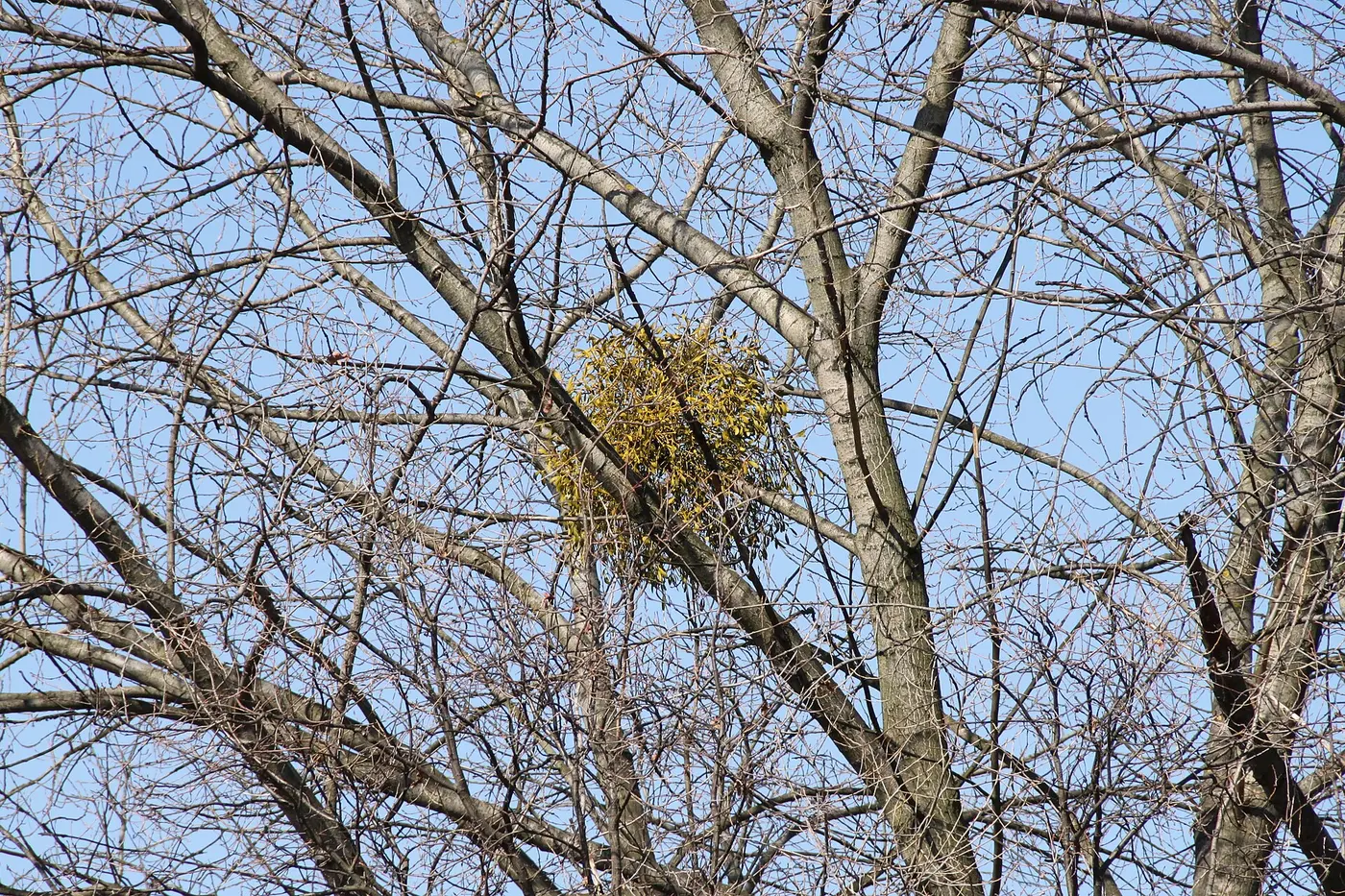
In winter, when zelkovas and cherry trees in Japan have dropped their leaves, you may spot round, bushy clumps of green high in their branches. They look a bit like birds’ nests, but they are plants called mistletoe. According to the Japanese dictionary Daijisen, Japan’s mistletoe, a subspecies of the European mistletoe, is an evergreen shrub about 50 centimeters (20 inches) tall that grows on deciduous trees such as hackberries and cherries. Its green stems fork again and again until the plant forms a ball.
As the Japanese name yadorigi, “lodging tree,” suggests, it lives on other trees. But it is not entirely a freeloader.
Half a parasite
A mistletoe seed germinates on a branch of its host. According to a 2023 report in the journal Tree and Forest Health by Hideaki Ishiguro, a tree doctor in Mie Prefecture, its root grows into a parasitic root that pierces the host’s bark and reaches the xylem, the tissue that carries water and nutrients. The mistletoe takes up water and nutrients from there.
At the same time, it makes its own food by photosynthesis in its green leaves and stems. That is why it is called a hemiparasite rather than a full parasite. Unlike rafflesia, which has no leaves or roots and depends on its host for everything, mistletoe does part of the work itself.
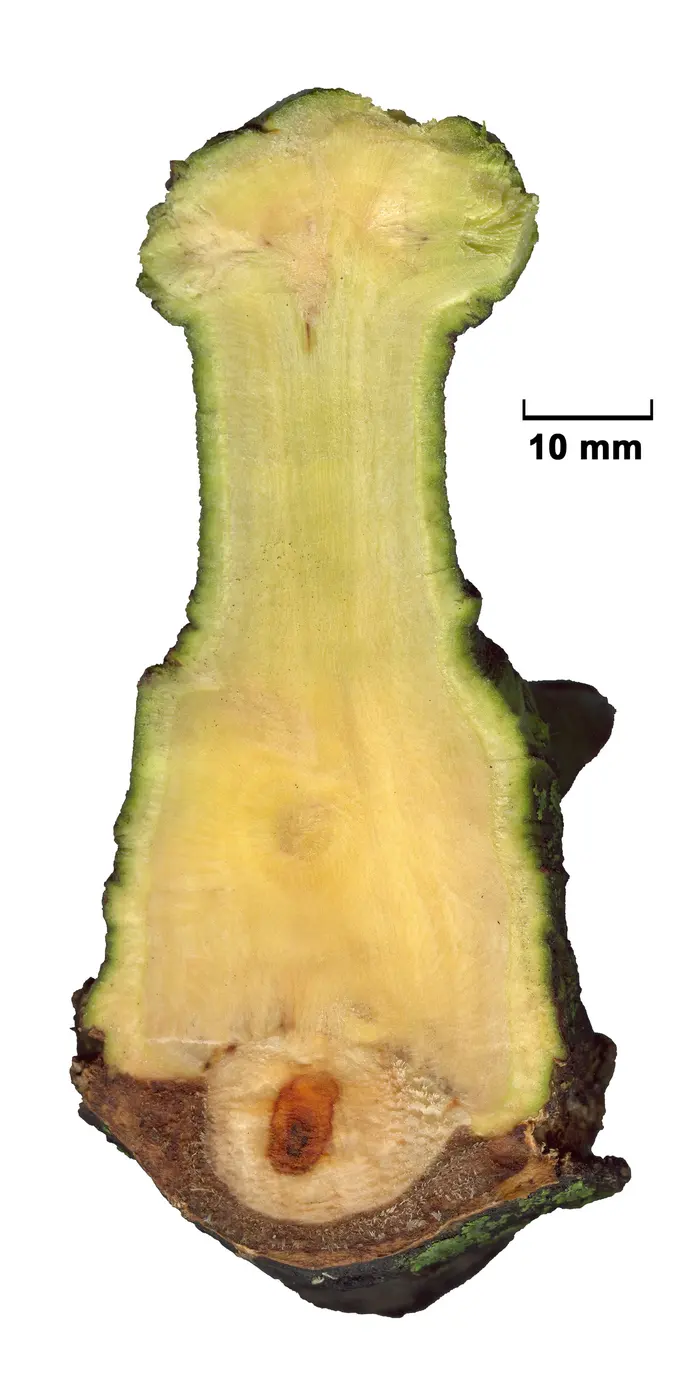

According to a 2022 article in the same journal, there are about 1,400 species of mistletoe in some 80 genera worldwide, and most are hemiparasites. They are said to weaken and sometimes kill their hosts. Mistletoes are thought to pull water out of their hosts partly by losing water through their leaves faster than the host does during the day. In Japan, mistletoe does not grow on conifers or evergreen broadleaf trees, but it is widespread on deciduous broadleaf trees.
Sticky seeds, carried by birds
How do the seeds get up into the trees? Birds carry them. Mistletoe plants are either male or female, and around November the female plants bear round yellow or reddish berries. The flesh inside is very sticky. When birds such as waxwings swallow the berries whole, the seeds come out in their droppings, still sticky, and if they stick to a branch, the planting is done.
A team from Gifu University reported in 2016 that waxwings are the birds known to spread mistletoe seeds in Japan, and that they have a habit of resting in flocks on the branches of tall trees. The team itself watched flocks of waxwings fly in and eat mistletoe berries in winter.
Ishiguro’s report includes an unusual case: on a hackberry in the city of Tsu, in Mie Prefecture, one mistletoe was growing on top of another. Seeds evidently do not always land on the branches of trees.
The Druids’ sacred plant
Evergreen mistletoe stands out on bare winter branches, and people have long treated it as special. In his Natural History, the first-century Roman writer Pliny the Elder reported that the Druids, the priests of Gaul, held nothing more sacred than mistletoe growing on an oak. A priest in a white robe climbed the tree, cut the mistletoe with a golden sickle and let it fall into a white cloak, and two white bulls were sacrificed. Pliny added, rather coolly, that such reverence for trifling objects can be found among nearly all nations.

Mistletoe appears in Norse mythology too. In the Prose Edda, written in Iceland in the 13th century, the goddess Frigg makes everything in the world swear not to harm her son Baldr, but skips the mistletoe because it seems too young. The trickster god Loki has the blind god Hoder throw it at Baldr, and Baldr falls dead. Retellings often end with Frigg declaring mistletoe a symbol of love, but that ending is not in the Edda.
When did the kissing start?
So how old is the custom of kissing under the mistletoe at Christmas? According to a 2018 article in Time, the British writer Mark Forsyth, who has written a book on the origins of Christmas customs, places its beginnings in England between 1720 and 1784. A 1720 study of mistletoe says nothing at all about kissing, and the earliest reference he found is a song published in 1784. Why mistletoe was chosen is unknown.
The custom was popularized by the American writer Washington Irving’s Sketch Book (1819–20). “The mistletoe is still hung up in farm-houses and kitchens at Christmas,” Irving wrote, “and the young men have the privilege of kissing the girls under it, plucking each time a berry from the bush. When the berries are all plucked the privilege ceases.” In the same book, a parson scolds a church sexton for decorating the church with mistletoe, calling it an unholy plant profaned by the Druids.