Is there a tree called the “donguri tree”?
No. In Japanese, “donguri” (acorn) is a catch-all name for the nuts of several trees in the beech family, including sawtooth oak, konara oak and evergreen oaks.
155
In autumn, Japanese children fill their pockets with donguri, the glossy acorns that litter parks and woodlands. People often speak of the “donguri tree,” but you won’t find a tree by that name in any field guide.
That is because donguri is not the fruit of a single species. The word covers the nuts of a whole group of trees, including several kinds of oak, both deciduous and evergreen. English “acorn” works much the same way: there is no “acorn tree” either, only the many oaks that bear them.
A name for a group
The authoritative Nihon Kokugo Daijiten dictionary defines donguri as a general term for the fruit of oaks in the beech family, such as evergreen oaks, sawtooth oak and Japanese emperor oak. In its narrowest sense, it says, the word refers to the fruit of the sawtooth oak, kunugi. A field guide used in a citizen science survey run by Japan’s Biodiversity Center, part of the Ministry of the Environment, notes that donguri usually means the fruit of oaks in the genus Quercus, but also counts the nuts of the related stone oaks and of the chinquapins, known in Japanese as shii.
An acorn is a nut, a fruit with a hard shell that does not split open when ripe. Its base sits in a little cup, or cap, called a cupule, formed from many tiny leaflike bracts that grow together. The spiny bur of a chestnut is also a kind of cupule. Acorns and chestnuts are cousins.
Read the cap
The caps differ from tree to tree. According to Japanese encyclopedias, the sawtooth oak bears round acorns more than half buried in a cap shaggy with long, curling scales. The Japanese emperor oak’s cap is also covered with long scales that curl back. The konara oak has slender acorns in caps covered with fine scales, while the caps of Japan’s evergreen oaks, such as the bamboo-leaf oak, are marked with stacked rings. In the chinquapins, the cupule wraps the entire nut.
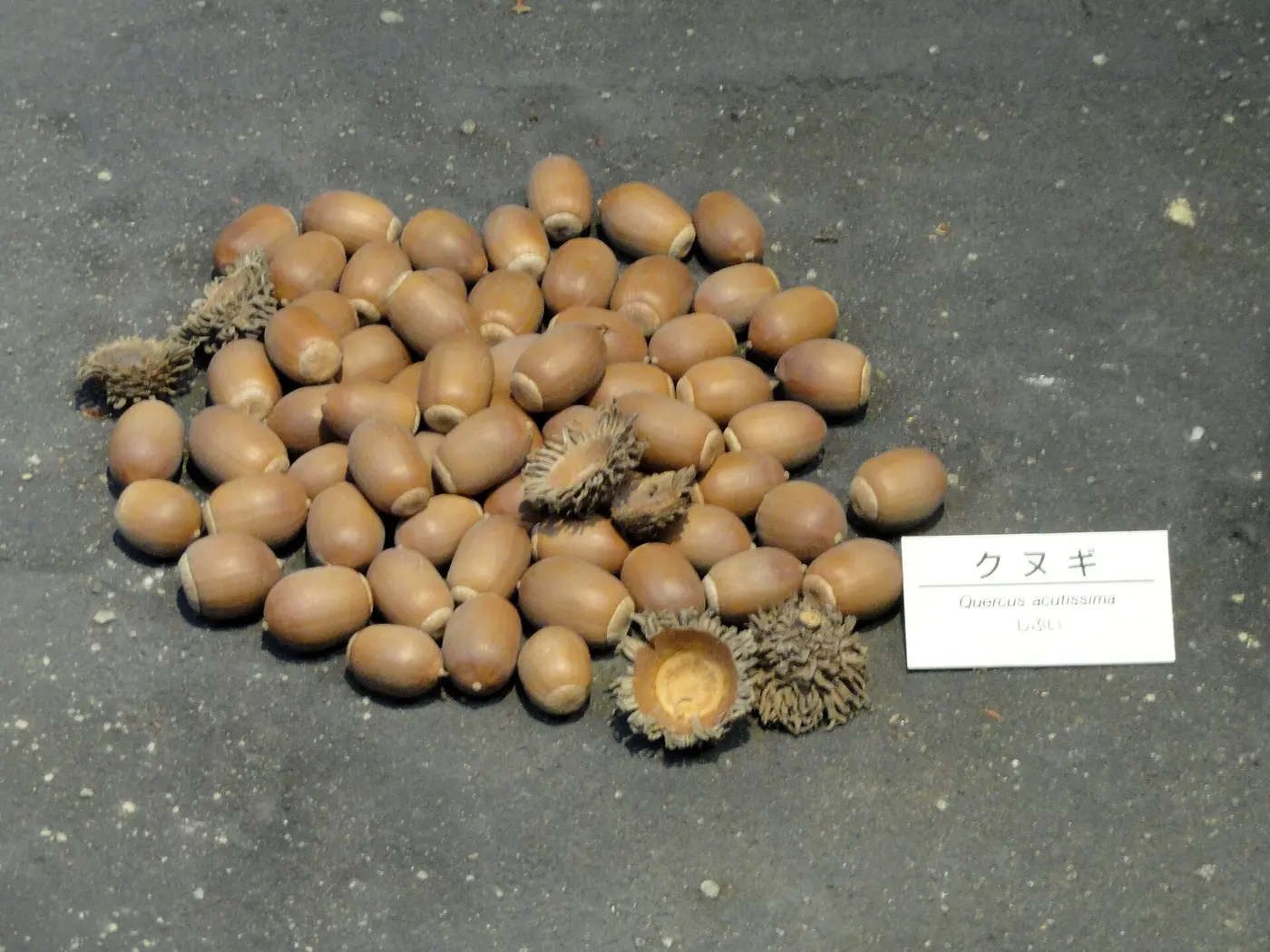

The time they take to ripen varies too. Konara and bamboo-leaf oak acorns ripen in the autumn of the year they flower. Sawtooth oak and stone oak acorns need more than a year, ripening the following autumn. Not every acorn you pick up grew in a single season.
Food for the Jōmon people
Acorns were once an important food in Japan. Most contain tannins that make them too bitter to eat raw. According to Heibonsha’s World Encyclopedia, people dried the nuts of evergreen oaks in the sun, crushed them and soaked them in running water to wash out the bitterness, then cooked them. Deciduous oaks such as the sawtooth oak required even more elaborate treatment using wood ash or boiling water. Chinquapin nuts contain little tannin, and the Ministry of the Environment’s guide notes that they were eaten in the Jōmon period, Japan’s prehistoric hunter-gatherer era. Until quite recently, the encyclopedia adds, some mountain villages stored acorns as emergency food against crop failure.
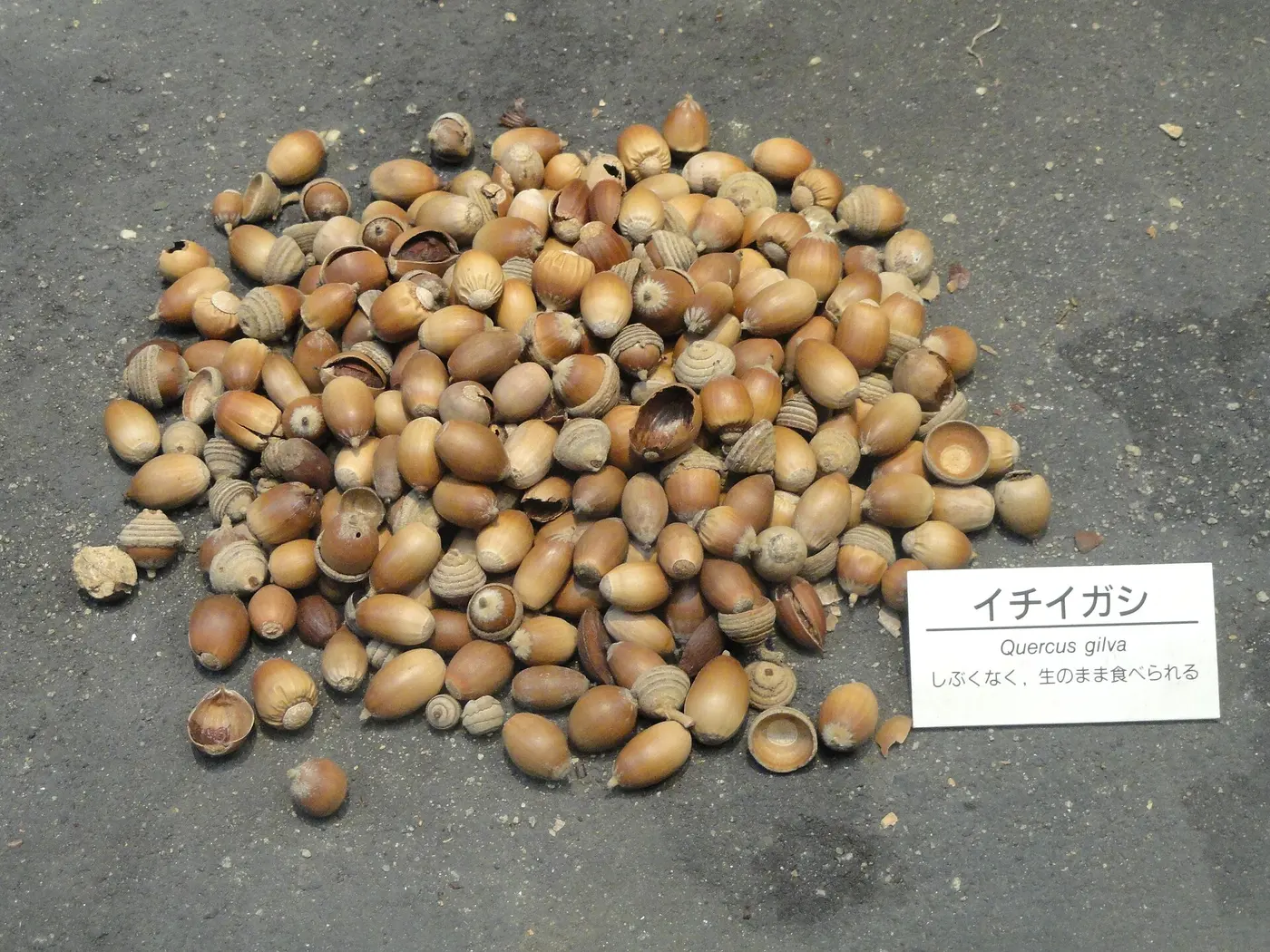

The Higashimyo site in Saga, on the island of Kyushu, is a Jōmon settlement dating back about 8,000 years. In a low wetland now 2 to 3 meters (7 to 10 feet) below sea level, archaeologists found 155 storage pits that held acorns from three kinds of oak, including the sawtooth oak. According to Japan’s Agency for Cultural Affairs, most of the pits are thought to have been used to store acorns. More than 700 woven baskets were found in them. According to Heibonsha’s encyclopedia, the acorns most often found stored at archaeological sites in Japan are those of the ichiigashi oak, which are not very bitter. Some researchers have suggested that storing acorns in waterlogged pits also helped leach out their bitterness.
Where the word comes from
No one is sure where the word donguri comes from. Shogakukan’s Dictionary of Japanese Etymology lists three theories: that it is a corruption of tochiguri, “horse chestnut”; that it means danguri, written with characters for “round chestnut”; or that it comes from tsumuguri, an old word for a spinning top, because children used acorns as tops. Some dictionaries treat the Chinese characters used to write it, which mean “round chestnut,” as ateji, characters fitted to the word after the fact.
The earliest example cited by the Nihon Kokugo Daijiten comes from a medical herbal of the late 14th century. Before that, acorns were known as tsurubami.