Why do runners go counterclockwise around the track?
The international athletics federation is said to have made it the rule in 1913. Why left? Theories differ.
Whether it’s a race at a school sports day or the 400 meters at the Olympics, runners on a track always curve to the left, against the direction of a clock’s hands. The rules of athletics state plainly that in any race that includes a bend, runners go with their “left hand on the inside.”
It is so familiar that it’s hard to picture anyone running the other way. Yet at the first modern Olympics, the athletes ran clockwise.
The first Olympics ran clockwise
In 1896, the first modern Olympic Games were held in Athens. The athletics events took place in the Panathenaic Stadium, a restored ancient arena. According to Olympedia, a database of Olympic records, the organizing committee chose to have the athletes run clockwise. At the time, some races in Britain were also run that way, though not all.
The track was short, only about 330 meters around, with long straights and very tight bends. Its surface was soft, loose cinders, and it is said to have been hard to run on.
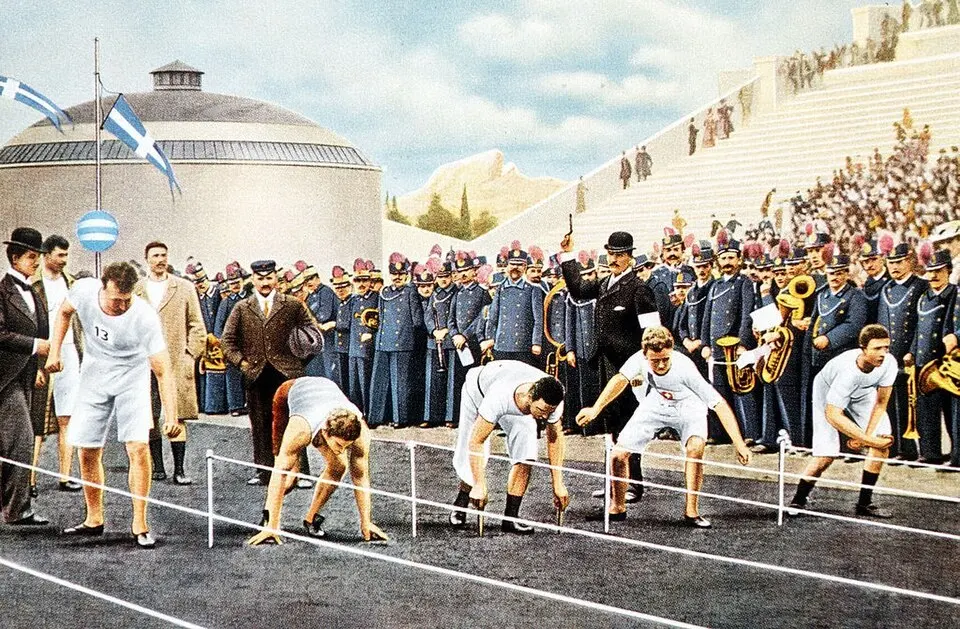

1913: counterclockwise becomes the rule
For a while afterward, the direction seems to have varied from one event to the next. The 1908 London Games are said to have adopted counterclockwise running.
What settled the matter was the International Amateur Athletic Federation (IAAF, today World Athletics), founded in 1912. In 1913, the following year, the IAAF is said to have made counterclockwise running the rule for track events. Since then, official competitions around the world have been run counterclockwise, and the Japan Association of Athletics Federations includes the same rule in its regulations.
What no one has found, however, is a document from the time that clearly states why left was chosen. It is sometimes explained that counterclockwise running was thought to produce better times, but no records from the period have been produced to back that up.
“Because the heart is on the left”?
That means every explanation offered for counterclockwise running was thought up after the fact.
One you often hear is that “the heart is on the left side, so running counterclockwise puts less strain on the body.” But the heart sits close to the middle of the chest, tilted only slightly to the left. No solid evidence has been presented that the direction you run changes the load on your heart.
Another theory looks at handedness and footedness. Most people are right-handed, the argument goes, so running counterclockwise, with the right arm and leg on the outside where they can work harder, feels more natural. It is also sometimes said that bearing the body’s weight on the left foot and pushing off hard with the right comes more easily. It sounds plausible, but this, too, has never been confirmed as the reason counterclockwise was chosen. Honestly, none of these theories gets beyond speculation.
Other sports that turn left
Athletics isn’t the only sport that goes counterclockwise. Speed skating does too, as does track cycling. In baseball, runners circle the bases counterclockwise as well: first, second, third.


On the other hand, some sports run in both directions, horse racing among them. If counterclockwise were a clear advantage for everyone, you might expect every racecourse to run that way, but they don’t. Do humans naturally prefer turning left, or has the original agreement simply been handed down? Even in the direction of the track we see all the time, there is still a mystery waiting for an answer.