Does toast really land butter side down?
When it slides off a table, yes, more often than not. It simply doesn’t have time to turn more than about half a revolution before it hits the floor.
3m
An elbow nudges the plate, the toast slides off, and when you pick it up, there it is: butter side down. English speakers have long said that bread always falls buttered side down, as shorthand for a day when nothing goes right. In 1884 the English writer James Payn published a comic verse lamenting that he had never had a piece of toast “particularly long and wide” but it fell upon the sanded floor, “and always on the buttered side.”
Is that just because we remember the disasters and forget the lucky landings? Or is something real going on?
Toss it, and it’s 50-50
“If something can go wrong, it will.” That is Murphy’s Law, and falling toast has long been its poster child. Most scientists, though, dismissed the whole thing as a trick of memory. Toast, they assumed, is like a coin: heads or tails, half and half.
In 1991 the BBC science program QED put this to the test by having people toss buttered bread into the air. According to later accounts, it landed butter side down about half the time, a result indistinguishable from chance.
One person objected to the method: Robert Matthews, a physicist at Aston University in Birmingham who also worked as a science journalist. Toast, he pointed out, is almost never flung into the air. It slides off the edge of a table or a plate.
Only half a turn before it lands
Matthews became interested in the problem in 1994, after reading a letter in a magazine. The writer had noticed that a paperback sliding off a desk front cover up almost always landed face down. Matthews assumed at first that this was chance, but when he tried it himself, it clearly wasn’t.
When toast slides far enough over the edge for its center of gravity to pass it, the slice tips, pivots on the edge and starts to rotate as it falls. The trouble is that gravity gets it spinning only slowly. Dropping from a table about 75 centimeters (30 inches) high, the toast hits the floor in less than 0.4 seconds, by which time it has turned roughly half a revolution. The buttered side, which started out on top, is facing down just as it lands.
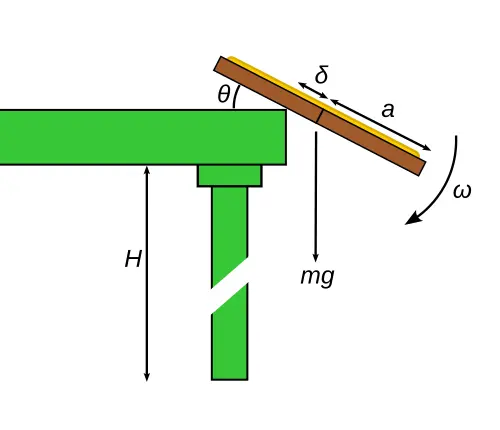

Matthews published his analysis in the European Journal of Physics in 1995. Treating the toast as a thin plate, he found that air resistance hardly matters, and neither does the thin layer of butter. The toast lands butter side down simply because the butter starts out on top. To make it turn all the way over and land butter side up, the table would need to be about 3 meters (10 feet) high.
Matthews readily admitted that others had published similar analyses before him. What made his paper famous was where he took it next.
Human height and the constants of nature
Tables are not 3 meters high because they are built for people. So why are people the height they are?
Here Matthews borrowed an idea from the American astrophysicist William Press. Humans walk upright on two legs, which makes us prone to toppling over. If we were much taller, every fall would risk a serious blow to the head. The balance between the strength of the chemical bonds in our skulls and the pull of gravity sets an upper limit on human height, and those strengths are in turn fixed by fundamental constants of nature, such as the charge on the electron.
Matthews calculated that limit at around 3 meters, still short of a toast-friendly table. In other words, toast lands butter side down because that is how the universe is built. For this paper, Matthews received the 1996 Ig Nobel Prize in Physics, awarded for research that first makes people laugh and then makes them think.
Twenty-one thousand drops
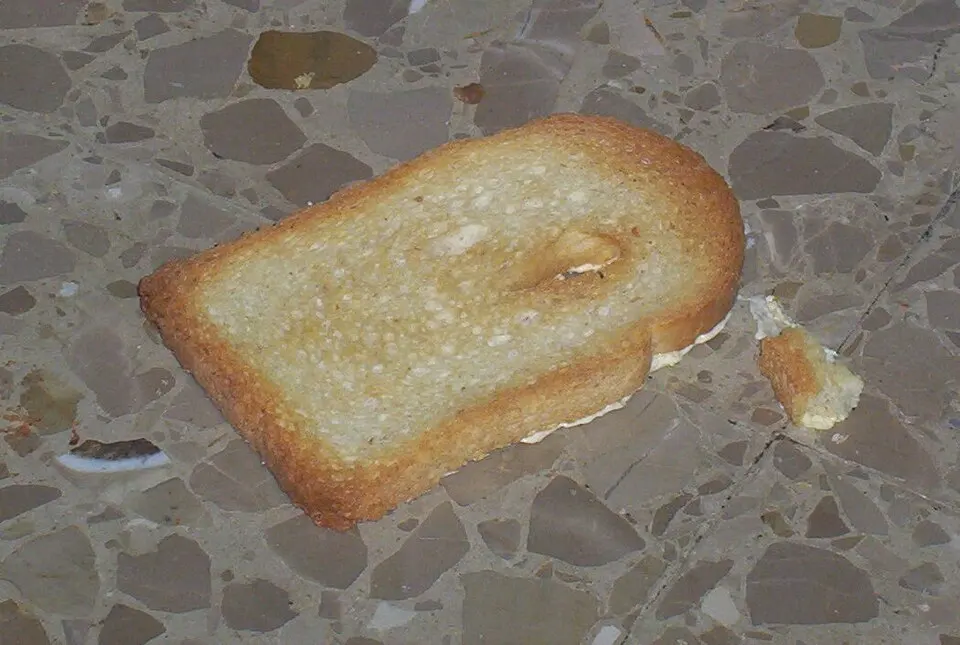
In 2001 Matthews put the theory to a large-scale test with the help of British schools. Children slid toast off plates and recorded which side ended up on top. According to Matthews, more than 1,000 children took part, dropping toast 21,000 times in all, and the toast landed butter side down more than 60 percent of the time.

His 1995 paper even offered a remedy. If you see toast going over the edge, give it a quick flick forward. Launched briskly, it reaches the floor before it has had time to rotate much, and is more likely to land butter side up. Whether anyone can react that fast at breakfast is another matter.