Can a Japanese 1-yen coin float on water?
Yes. It is made of aluminum, which is about 2.7 times denser than water, but set down gently it is held up by surface tension and doesn’t sink.
1g
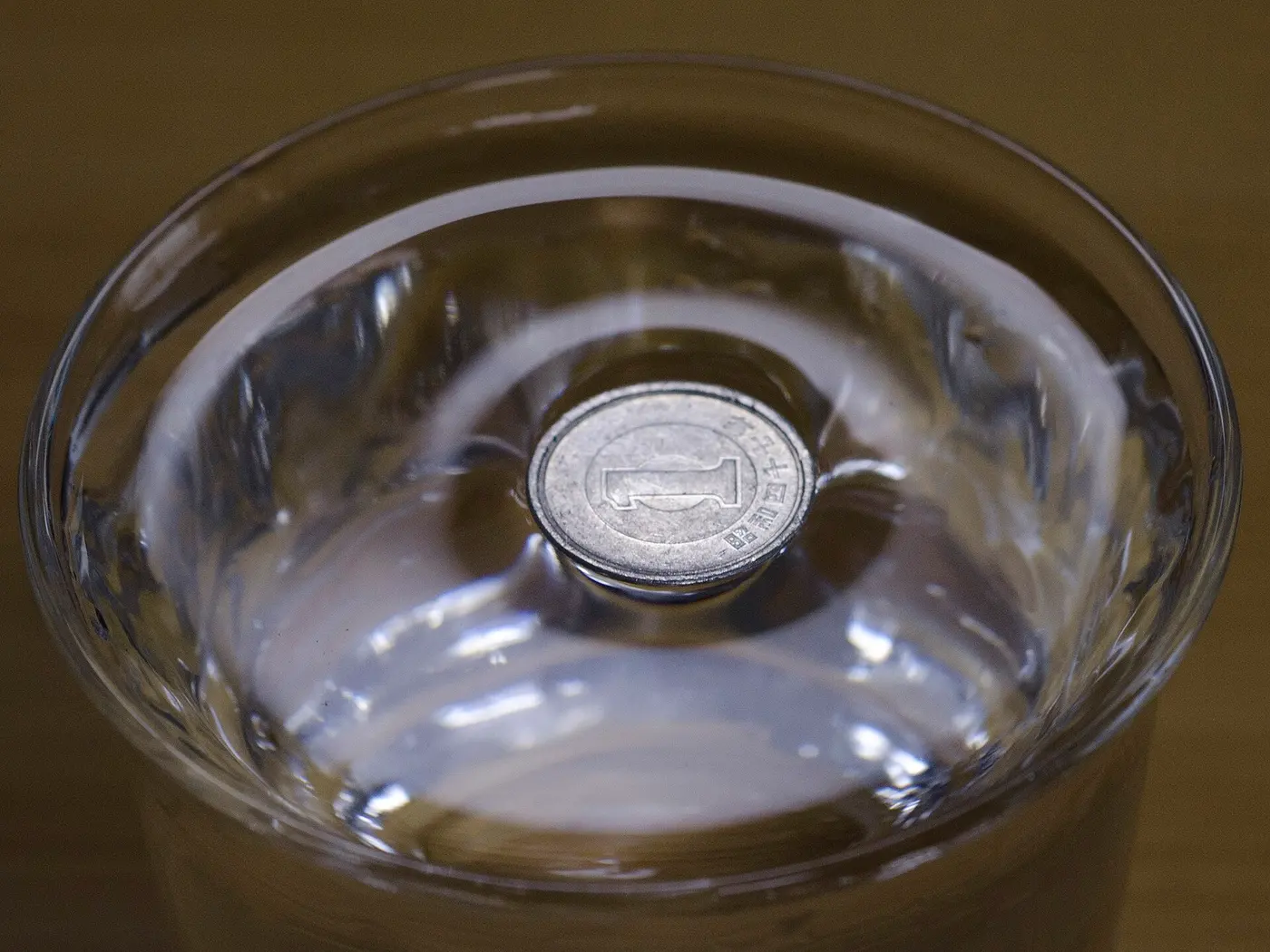
The 1-yen coin is the lightest coin in a Japanese wallet, and the lowest in value. It weighs exactly 1 gram (0.035 ounces) and measures 2 centimeters (0.8 inches) across. Place one gently on the surface of a glass of water and, instead of sinking, it floats.
Today’s aluminum 1-yen coin was introduced in 1955, and it is the only coin currently issued in Japan that is made of pure aluminum, with no copper. Aluminum is light for a metal, but it is still about 2.7 times denser than water. So the coin does not float the way a piece of wood does, by being lighter than water. What is holding it up?
The water’s surface is like a stretched skin
The key is surface tension. Water molecules attract one another. A molecule deep in the water is pulled equally in all directions by its neighbors, but a molecule at the surface has no neighbors above it to pull upward. As a result, the surface behaves like a stretched elastic skin that tries to make its area as small as possible.
At 20°C (68°F), water’s surface tension is about 72.8 millinewtons per meter, higher than that of most other liquids and more than three times that of ethanol. It also varies with temperature: about 75.6 at 0°C and about 72.0 at 25°C, so cold water is slightly “tighter.”

A dimple that pushes back
When you set the coin down gently, its weight pushes the surface down into a shallow dip. Like a stretched skin trying to spring back, the curved surface pulls up on the coin’s edge. On top of that, because the coin now sits lower than the surrounding water level, the water it displaces provides buoyancy. Together, these two forces carry the coin’s 1 gram.
A quick calculation shows why both are needed. Even if surface tension pulled straight up all the way around the coin’s edge, which is about 6.3 centimeters (2.5 inches) long, it could support only about half a gram. The buoyancy from the dimple makes up the rest.
The trick is to use a dry coin and lay it down flat and gently. For an object to be held up by surface tension, its surface must not be easily wetted. A metal paper clip can be floated the same way.
Add a drop of soap
What happens if surface tension is weakened? Add some dishwashing liquid to the water and the coin sinks. Detergents contain surfactants, molecules with one end that likes water and another that likes oil, which gather at the surface and can cut water’s surface tension roughly in half. With its skin weakened, the water can no longer hold up the coin.
Water striders use the same trick
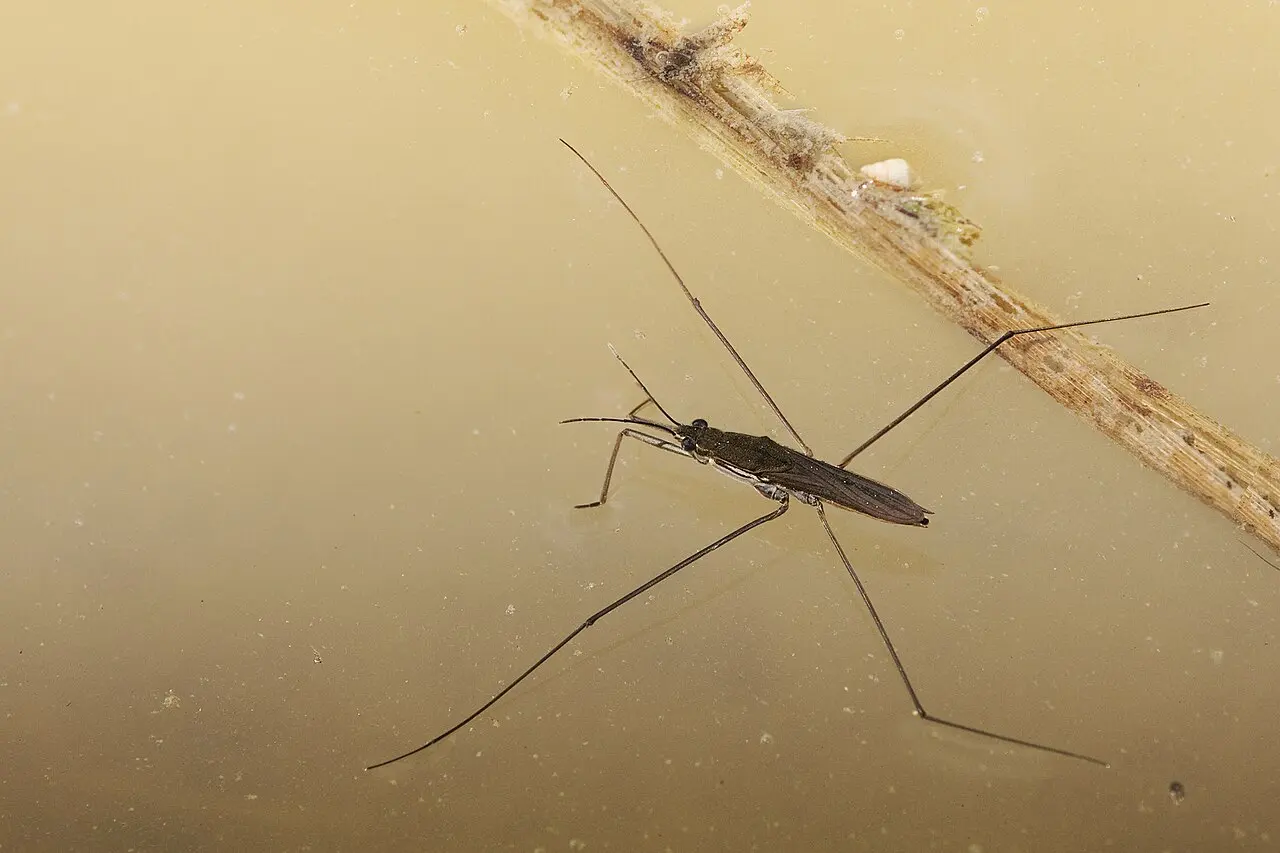
Water striders, the insects that skate across ponds and puddles, rely on surface tension too. Members of the true bug order, the same group as stink bugs, they touch the water only with the hairs at the tips of their legs and row across the surface with their middle legs, which are often much longer than their bodies. Their slender legs merely dimple the water without breaking through. Japan’s common water strider is called amenbo, said to come from ame-bō, “candy stick,” because the insect gives off a sweet, candy-like smell and has a long, thin body.
It was long thought that water striders’ legs repel water thanks to a waxy secretion. But in 2004, researchers at the Chinese Academy of Sciences reported in Nature that the structure of the legs matters more. The legs are covered with huge numbers of tiny hairs all pointing the same way, and each hair is etched with even finer grooves.