Why won’t dry spaghetti snap in two?
The first break sends a wave of bending racing along each piece, briefly making it curve even more sharply, so it snaps again somewhere else.
250°
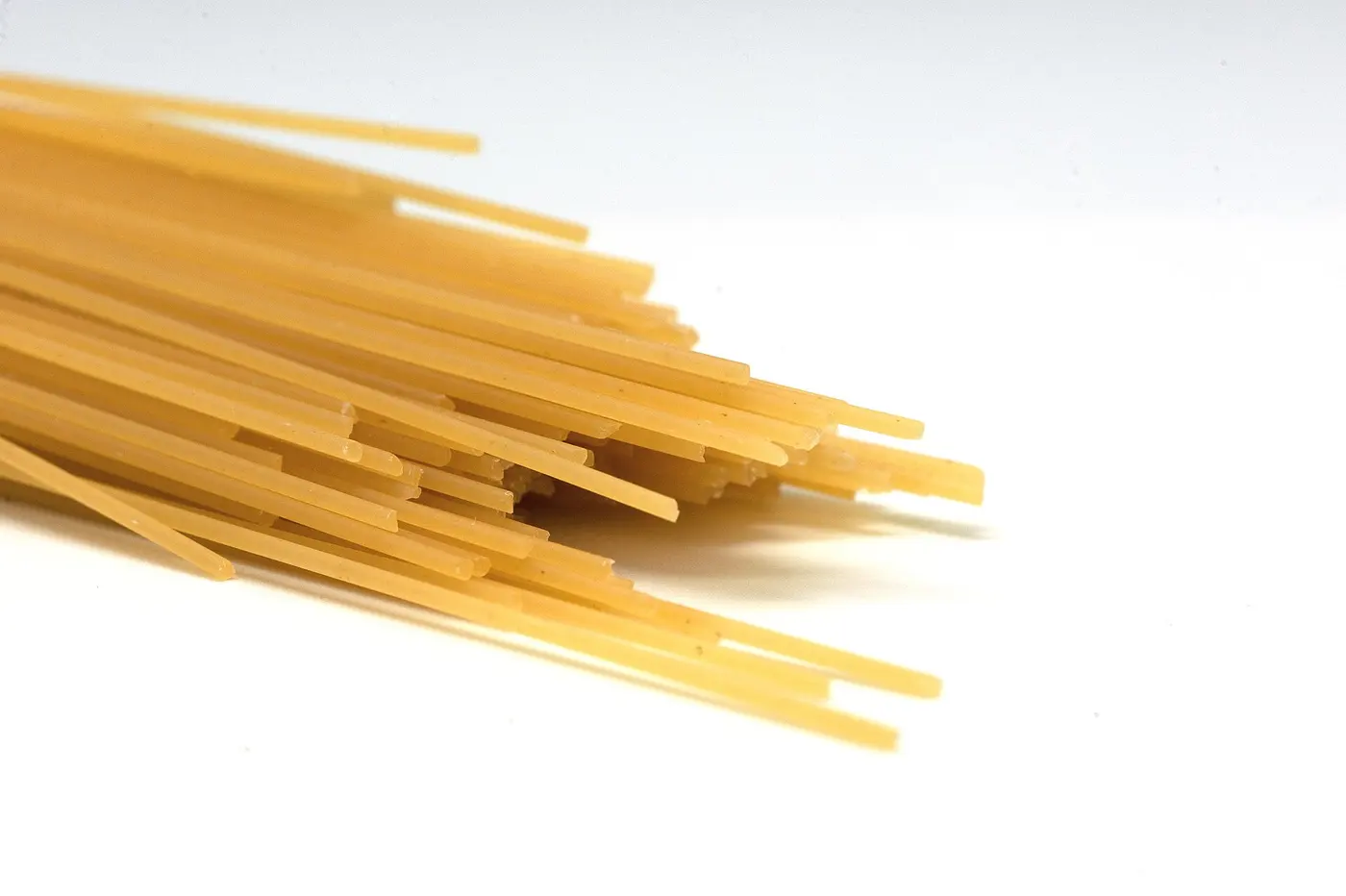
If your pot is too small, you might try snapping a handful of dry spaghetti in half. Hold a single strand by both ends and bend it slowly, and with a sharp crack, little pieces go flying across the kitchen. You are left holding not two pieces but three, sometimes four or more. Breaking spaghetti neatly in two is surprisingly hard.
A thin rod, you would think, should break once at its weakest point and be done. So why does spaghetti break in several places?
The puzzle that stumped Feynman
One famous scientist who took up the question was the American physicist Richard Feynman, who shared the 1965 Nobel Prize in Physics for his work on quantum electrodynamics.
According to his friend, the computer scientist Danny Hillis, the two of them noticed the effect in the kitchen one evening and spent the next two hours coming up with “crazy theories” about why spaghetti breaks into three. They never found an answer that satisfied them, and all they had to show for it was broken spaghetti all over the kitchen. Hillis’s recollection appears in a biography of Feynman built from the memories of his friends and colleagues, and later research papers have cited it.


The wave that follows the first crack
The answer came from France. In 2005, Basile Audoly and Sébastien Neukirch of Pierre and Marie Curie University in Paris published a paper in Physical Review Letters with the subtitle “Why Spaghetti Does Not Break in Half.”
When you bend spaghetti from both ends, it first breaks at its weakest point. So far, so expected. The interesting part is what happens next. At the moment of that first break, the freshly broken end of each piece is suddenly released from the bending that was holding it. That abrupt release sends a burst of bending waves running along the piece.
The researchers calculated that as these waves pass, they make the strand curve even more sharply than before, by up to about 1.43 times. Since the spaghetti was already bent almost to its breaking point, it can’t take the extra strain, and it snaps again somewhere else. The breaks cascade, typically leaving three or four fragments. Audoly and Neukirch confirmed the explanation with a high-speed camera filming at 1,000 frames per second.
The work earned the 2006 Ig Nobel Prize in Physics, awarded for research that first makes people laugh and then makes them think.
Twist first, then bend
So is there any way to break spaghetti cleanly in two? A team at the Massachusetts Institute of Technology (MIT) found one.
Ronald Heisser, who began the project as an undergraduate at MIT, and Vishal Patil, a mathematics graduate student, built a device that clamps a strand at both ends, twisting one end while sliding the other toward it to bend the strand. They cut spaghetti to a uniform 24 centimeters (about 9.5 inches), broke hundreds of strands, and filmed the results with high-speed cameras. If they first twisted the spaghetti by more than about 250 degrees and then bent it slowly, it almost always broke into just two pieces. The results appeared in the Proceedings of the National Academy of Sciences in 2018.

Twisting helps for two reasons. A twisted strand breaks before it is bent very far, so there is less energy to snap back. And when it does break, the twist unwinds, sending out a “twist wave.” That wave travels faster than the bending wave and carries off energy, preventing a second break.
The same study looked at bending speed, too. The slower the two ends were brought together, the fewer fragments there were; the faster, the more. Don’t overdo the twisting, though. The team’s spaghetti snapped from the twisting alone, without any bending, at around 360 degrees.