How does carbon-14 tell us how old things are?
Living things take in carbon-14 in the same proportion as the air around them. When they die, the supply stops, and the carbon-14 they contain halves about every 5,730 years.
5,730 years
News of an archaeological find often comes with a phrase like “radiocarbon dating shows it to be about 3,000 years old.” How can a scrap of wood or a fragment of bone reveal a date thousands of years in the past?
The key is carbon-14, a form of carbon that is radioactive.
A clock made in the sky
Almost all carbon atoms are carbon-12, which stays the same forever. But high in the atmosphere, cosmic rays from space slam into air molecules and knock loose neutrons, and when those neutrons hit nitrogen atoms, they turn them into carbon-14. The new carbon-14 combines with oxygen to form carbon dioxide and spreads through the atmosphere. According to the speech presenting the 1960 Nobel Prize in Chemistry, only about one carbon atom in a trillion is carbon-14.
Plants take in that carbon dioxide through photosynthesis, and animals eat the plants. So while an organism is alive, the proportion of carbon-14 in its body stays about the same as in the air. When it dies, no new carbon comes in. Carbon-14 slowly turns back into nitrogen by giving off an electron, so the amount left in the remains steadily declines. Its half-life, the time it takes for half of it to disappear, is about 5,730 years. After 11,460 years a quarter is left, and after another 5,730 years, an eighth. Measure how much remains, and you can work out how long ago the organism died.
Checking against Egyptian tombs
The method was devised by Willard Libby, a chemist at the University of Chicago. According to the Nobel presentation speech, Libby published the idea in 1947 and quickly set about testing it. For samples of known age, he turned to wood and charcoal from Egyptian tombs. The oldest, about 5,000 years old, came from the time of the official Hemaka, and the youngest, about 2,000 years old, from the Ptolemaic period. His results matched the dates Egyptologists had already worked out. He also checked the method against the heartwood of redwood trees whose ages were known from their rings.


Libby developed the method in 1949 and won the 1960 Nobel Prize in Chemistry. At the time, it could date material from about 500 to 30,000 years old. Improved techniques now reach back about 50,000 years. Beyond that, only about 1/400 of the original carbon-14 is left, too little to measure reliably.
Lake Suigetsu’s yardstick
The clock has its quirks. According to the Oxford Radiocarbon Accelerator Unit, the proportion of carbon-14 in the atmosphere has varied by a few percent over time. And the half-life Libby used, 5,568 years, was later revised to about 5,730. Even so, by convention, radiocarbon ages are still calculated using 5,568 years and assuming the atmosphere always held the same proportion of carbon-14 as in 1950, and they are reported as years “before present,” meaning before 1950. Turning those figures into true calendar dates requires calibration.
Calibration relies on a yardstick built from carbon-14 measurements of samples whose ages are known. Tree rings are the classic example. Further back in time, a key part of the world standard comes from the varves, or annual layers, on the bed of Lake Suigetsu in Fukui Prefecture, Japan. According to the Fukui Prefectural Varve Museum, the lake has been laying down one light-and-dark layer a year without interruption for 70,000 years, and measuring the carbon-14 in leaves trapped in the layers revealed precisely how carbon-14 levels relate to calendar years. In 2012, a team of British, Japanese and other researchers published in Science a record of atmospheric carbon-14 reaching back about 52,800 years.
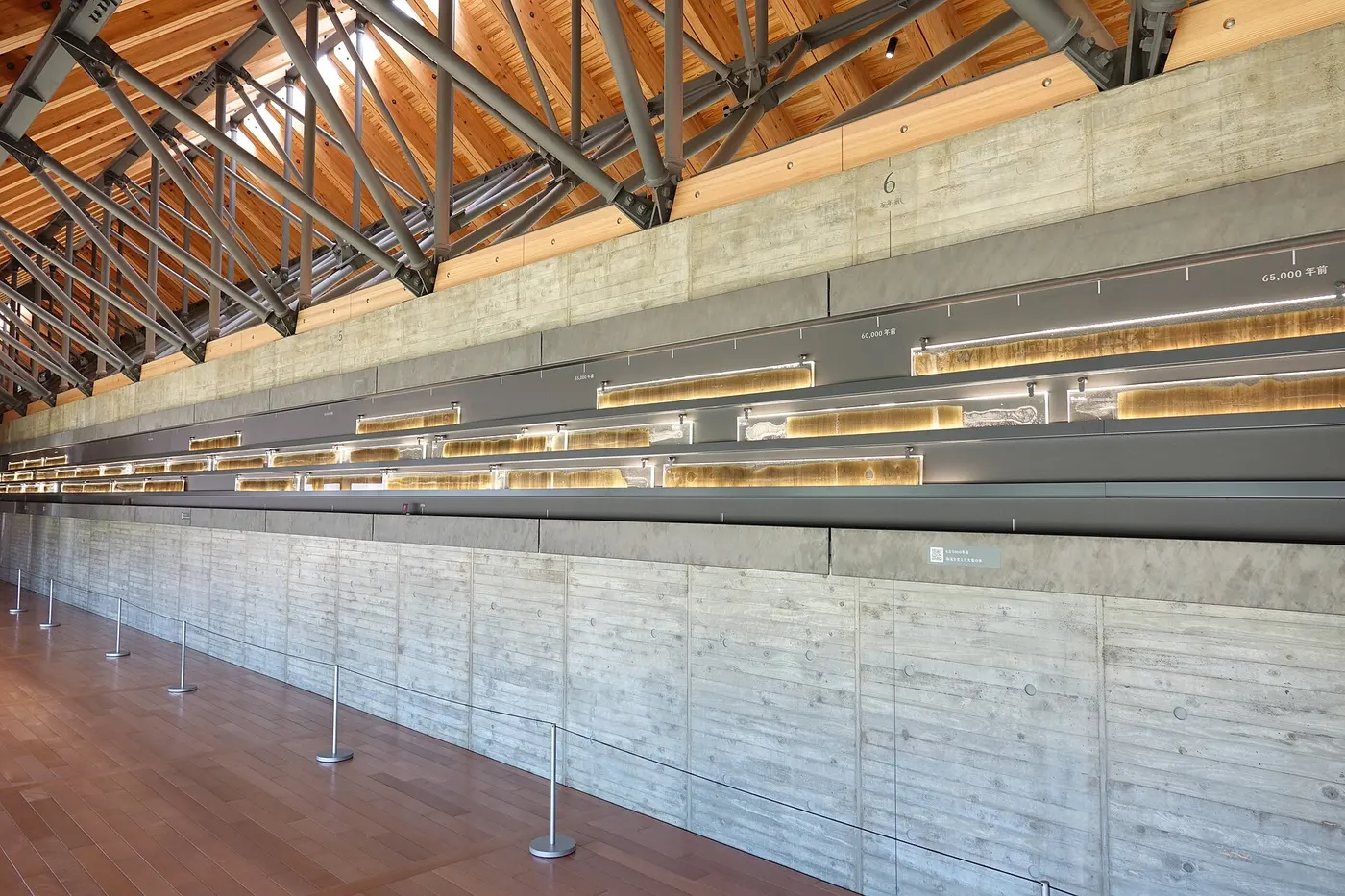

A mark left by the bomb
In the 20th century, human activity began to disturb the clock. Coal and oil contain no carbon-14, so burning them diluted the proportion in the air. Then, in the 1950s, a series of atmospheric nuclear tests sent carbon-14 levels soaring. According to the radiocarbon laboratory at Utrecht University in the Netherlands, they almost doubled by the 1960s. In the Northern Hemisphere they peaked in 1963–1964 and then fell steadily, and a study published in 2021 found that by 2019 they were nearly back to pre-bomb levels.
That sharp spike became a new kind of marker. In 2005, a team at Sweden’s Karolinska Institute measured carbon-14 in the DNA of human brain cells and showed that neurons in the occipital cortex, at the back of the brain, are as old as the person, evidence that no new ones form there after birth.