Why is homemade ice cloudy?
Air dissolved in the water is pushed inward as the ice freezes from the outside, until it collects in the middle and is trapped as countless tiny bubbles.
48hours
Take an ice cube from your freezer tray and hold it up to the light. The outside is reasonably clear, but the middle is milky white. Look closely and you may see a cluster of tiny bubbles, and perhaps a few cracks.
Yet the ice in a café or cocktail bar, or the blocks sold by an ice maker, can be as clear as glass. It is all frozen water. Why the difference?
The cloudiness is bubbles
Tap water contains dissolved air, even though you can’t see it. It also contains minerals such as calcium.
When water freezes, the ice crystal builds itself in a neat lattice made only of water molecules. The dissolved air and minerals can’t fit into the crystal, so they are pushed away into the water that hasn’t frozen yet. As freezing goes on, that remaining water holds more and more air, until it can’t keep it all dissolved. The excess comes out as tiny bubbles, which are then frozen in place.
Each bubble is just clear air, but light bounces and bends wherever ice meets air. With lots of tiny bubbles, light is scattered in every direction, and the ice looks white. It is much the same reason snow looks white.
Frozen from the outside in
Why does the cloudiness gather in the middle? It comes down to the order in which the water freezes. An ice cube tray sits surrounded by cold freezer air, so each cube freezes from the top, bottom and sides at once, working from the outside in. The advancing ice pushes the air and minerals inward, step by step, until they end up in the center, the last part to freeze. That is why the outside of a cube tends to be clear while the middle is cloudy.
Water also expands when it freezes. When the last water in the middle, trapped inside a shell of ice, finally freezes, it can push hard enough to crack the cube from within. Those cracks add to the cloudy look.
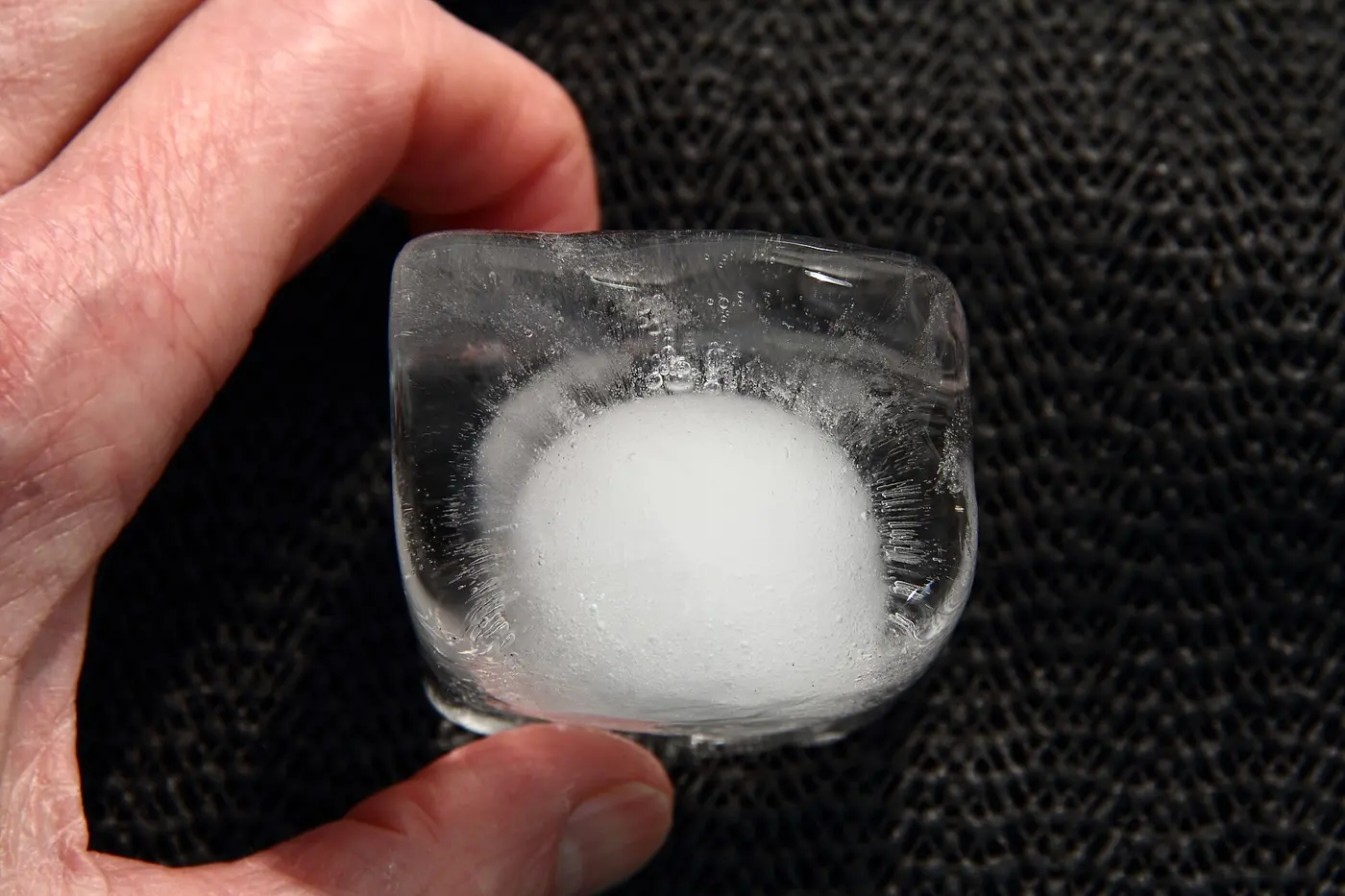

Speed matters, too. A home freezer runs at around −20°C (−4°F), so water freezes fast and the bubbles have no time to escape. Japan’s national federation of ice retailers notes that ice from automatic ice machines, made by spraying tap water onto plates chilled to around −25°C (−13°F) and freezing it quickly, also comes out whitish, because the air and impurities freeze right along with the water.
Freeze it from one direction
The fix, then, is to control the direction of freezing. A lake or pond in winter freezes from the surface downward, so dissolved air escapes into the water below, and the ice tends to be clear.
The person who popularized a way to copy this in a home freezer was Camper English, an American writer on cocktails and spirits. After months of experiments, he published the method on his website in December 2009. Fill a hard-sided, insulated picnic cooler with water and put it in the freezer with the lid off. With the sides and bottom insulated, the water can only freeze from the top surface downward. Air and minerals are driven toward the bottom, and only the last quarter or so to freeze turns cloudy. Take the block out before that point, or cut off the cloudy part, and you have a slab of crystal-clear ice.
This technique, known as directional freezing, is now widely used, and it has been built into commercial clear-ice trays. A common tip says to boil the water first, but when English tested it, boiling made no significant difference. As long as the water freezes from the outside in, the middle will still turn cloudy.
Japan’s “pure ice”
The clear ice sold by traditional ice shops in Japan takes far more care. According to the national federation of ice retailers, the water is purified and poured into metal molds called ice cans, which are immersed in brine, a calcium chloride solution kept at about −10°C (14°F). Compressed air is piped into each can to stir the water and drive out remaining air and other impurities.
The water freezes slowly from the can’s five walls, every side except the top, toward the center. After 24 to 30 hours, the unfrozen water left in the middle, where the impurities have collected, is sucked out and replaced with fresh water. This is repeated several times. Freezing takes at least 48 hours, and close to 72 at some plants, and produces a clear block weighing about 135 kilograms (300 pounds). In Japan such ice is sold as junpyō, “pure ice.”
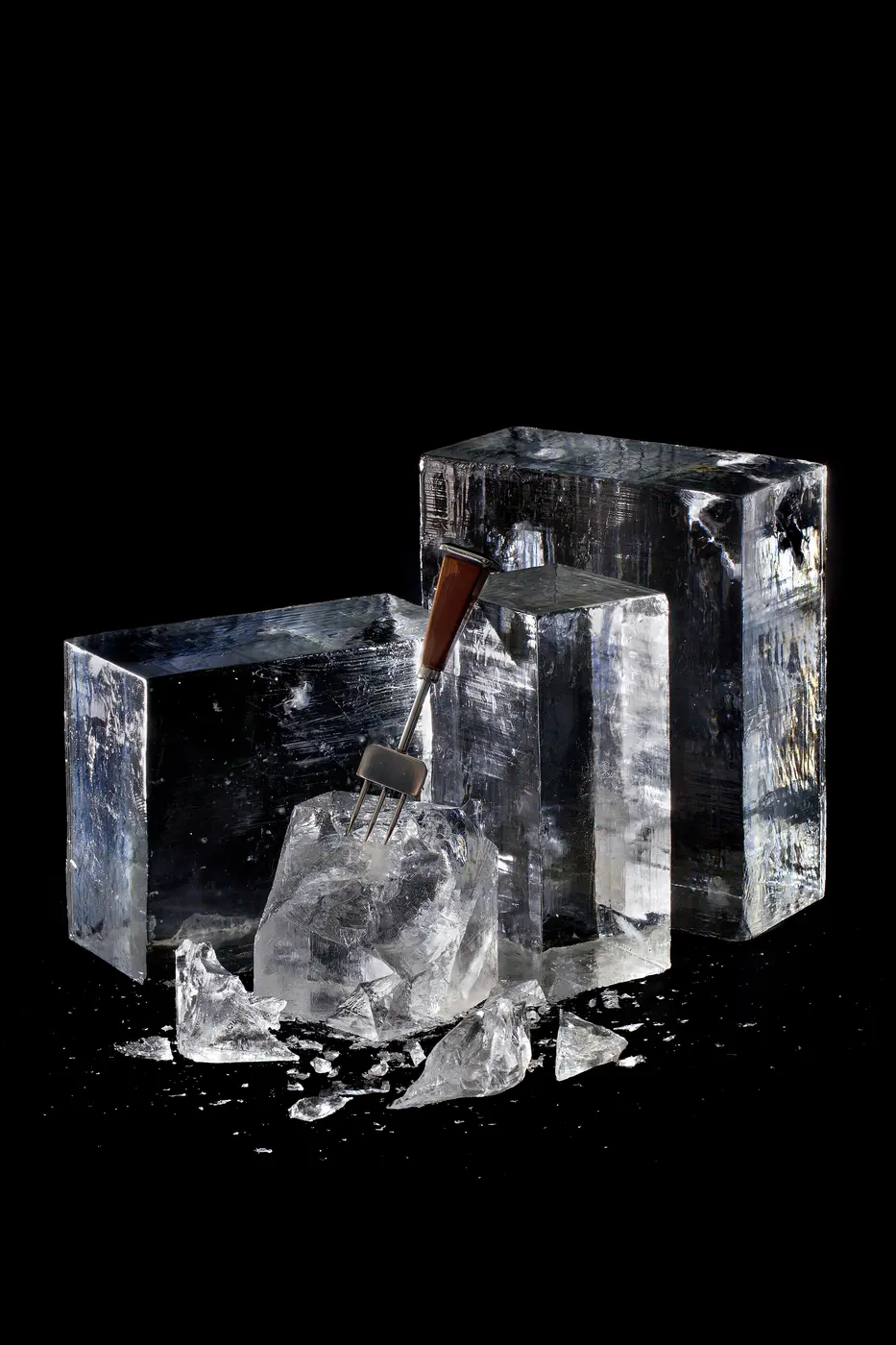

Freeze at a warmer temperature than a home freezer, take your time, and keep the water moving. The secret of clear ice, it seems, is not to rush.