If nothing sticks to Teflon, how does Teflon stick to the pan?
The metal is roughened, then given a primer that bonds both to metal and to the coating. Layers of PTFE go on top and are baked until they fuse.
An egg slides across the pan without a drop of oil. That is the whole point of a nonstick coating, often called by its best-known brand name, Teflon: nothing sticks to it.
Stop and think about it, though, and something seems off. If nothing sticks to the coating, how does the coating itself stick to the pan? The puzzle stumped the very company that discovered the material.
White powder in a gas cylinder
According to the magazine Invention & Technology (2000), the story begins on the morning of April 6, 1938. At DuPont’s Jackson Laboratory in New Jersey, a 27-year-old chemist named Roy Plunkett and his assistant, Jack Rebok, were working on new refrigerant gases. Their raw material, a gas called tetrafluoroethylene, was stored in small pressure cylinders.
That morning, when Rebok opened the valve on a cylinder, nothing came out. Weighing it showed that most of the gas was still inside. Plunkett removed the valve, turned the cylinder upside down and shook it, and flecks of white powder floated out. When they sawed the cylinders open, the walls were lined with a smooth, waxy white coating. The gas molecules had linked themselves into long chains inside the cylinder. This was PTFE, polytetrafluoroethylene, later sold as Teflon. In his notebook that day Plunkett wrote, “A white solid material was obtained, which was supposed to be a polymerized product.”
Tests showed it would not dissolve in water, acetone or even concentrated sulfuric acid, and a soldering iron neither charred nor melted it. During World War II it went into the Manhattan Project, which built the atomic bomb, as gaskets and seals that could survive the highly corrosive gas used to enrich uranium.
Why nothing sticks
A PTFE molecule is a long backbone of carbon atoms completely sheathed in fluorine atoms. The bond between carbon and fluorine is extremely strong, so PTFE barely reacts with anything. And the fluorine sheath has little pull on other molecules, so water, oil and burnt food can’t get a firm grip on the surface.
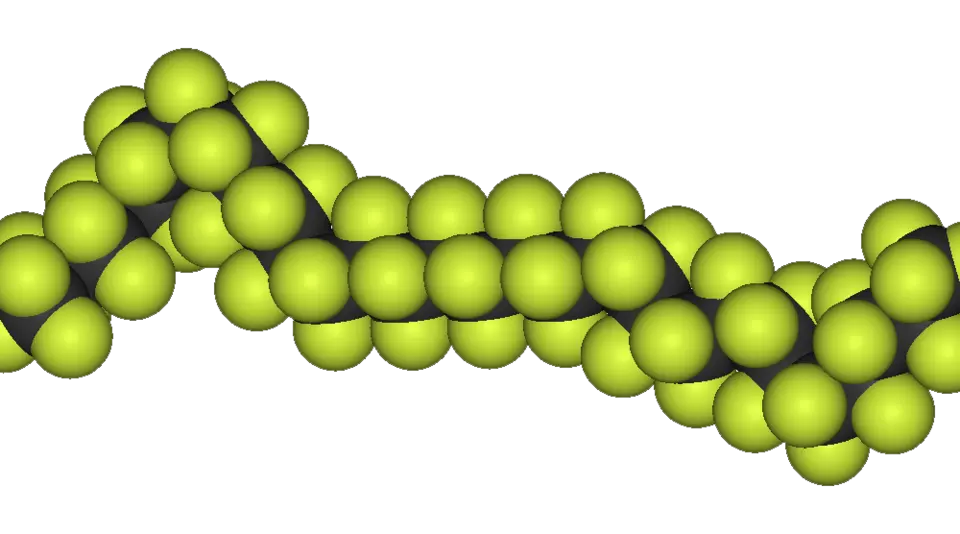

According to the Japan Fluoropolymers Industry Association, PTFE melts at 327°C (621°F) and can be used continuously at up to 260°C (500°F). Its coefficient of friction, a measure of slipperiness, is 0.1, low even among fluoropolymers.
Locking it into the bumps
So how do you fasten a material that sticks to nothing? One answer was to hold it in place by shape rather than by chemistry.
According to the same magazine, the French engineer Marc Grégoire heard from a colleague about a way to fix a thin layer of PTFE to aluminum. The aluminum was etched with acid until its surface was covered in microscopic pits, then dusted with PTFE powder and heated, so the plastic flowed into the pits and locked on. Grégoire, a keen angler, planned to coat his fishing tackle to keep the line from tangling. His wife, Colette, the story goes, thought her cooking pans would be a better use. There are several versions of this tale, though. Even Tefal’s own websites say both that he got the idea watching his wife struggle with an egg stuck to a pan and that it came from a conversation over a pot of boiling milk.
What is certain is that Grégoire received a patent in 1954 and that the couple founded the Tefal company in May 1956. The name is said to be a blend of “Teflon” and “aluminum.”
Modern pans use the same basic idea. Typically the aluminum is roughened, for instance by blasting it with fine grit, and a primer is baked on. The primer mixes fluoropolymer with another resin that bonds well to metal. More layers of fluoropolymer go on top, and the whole stack is baked at close to 400°C (750°F). The primer’s resin grips the rough metal, while the fluoropolymer in the primer fuses with the layers above into a single film. About the only thing PTFE sticks to readily is more PTFE.
A hit in America, then a peeling problem
The pan was brought to the United States by Thomas Hardie, a businessman with a love of all things French. On December 15, 1960, in the middle of a snowstorm, Macy’s in New York put the pans on sale for $6.94, and they sold out. By the middle of the following year, orders had reached a million pans a month.
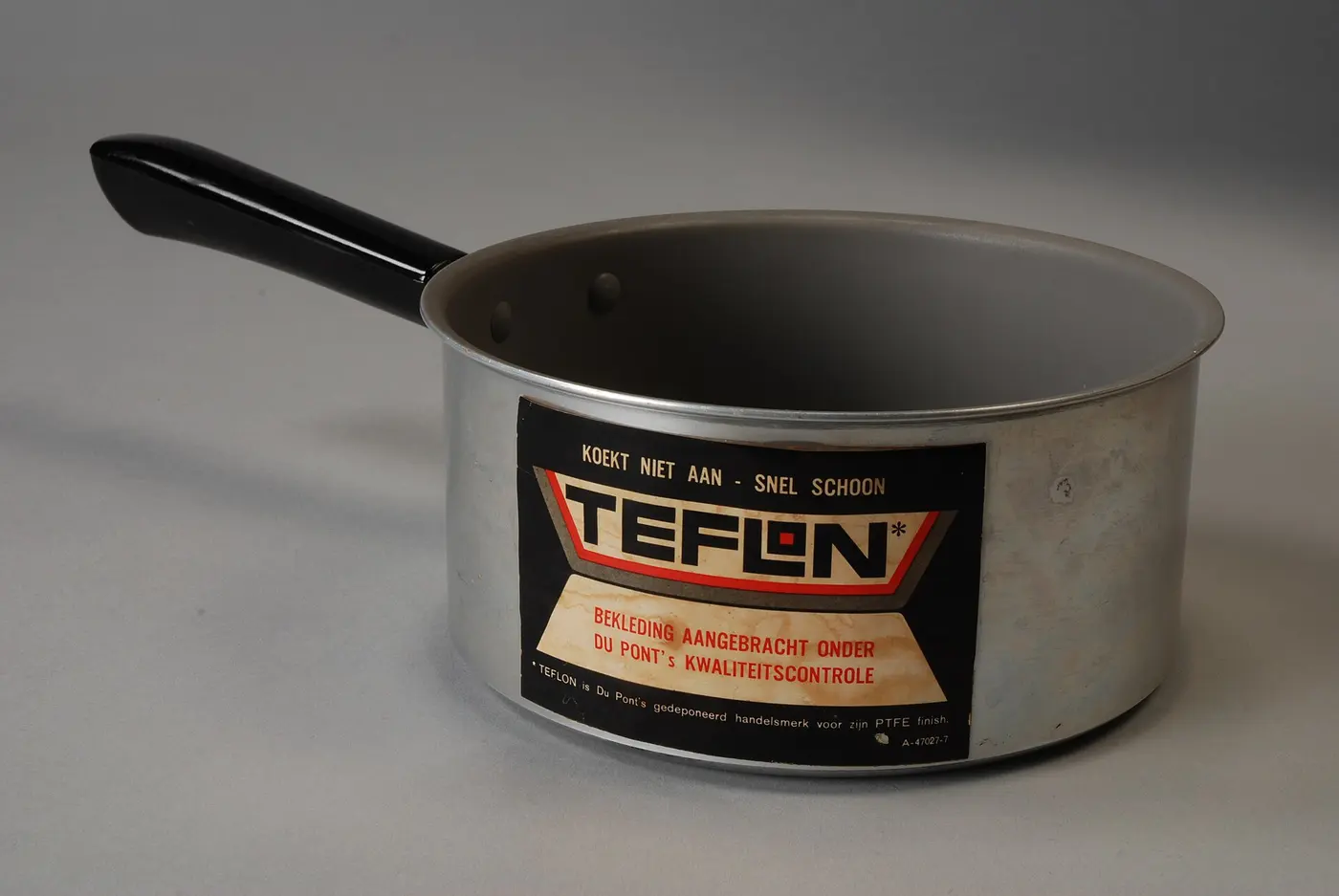

Then major American cookware makers jumped in, and many of their pans had coatings that scraped off far too easily. The nonstick pan’s reputation slumped. DuPont responded by setting coating standards and launching a certification program with an official seal of approval, running more than 500 tests a month to check quality. Keeping a nonstick coating stuck to the pan, it turned out, was the real secret of nonstick cookware.