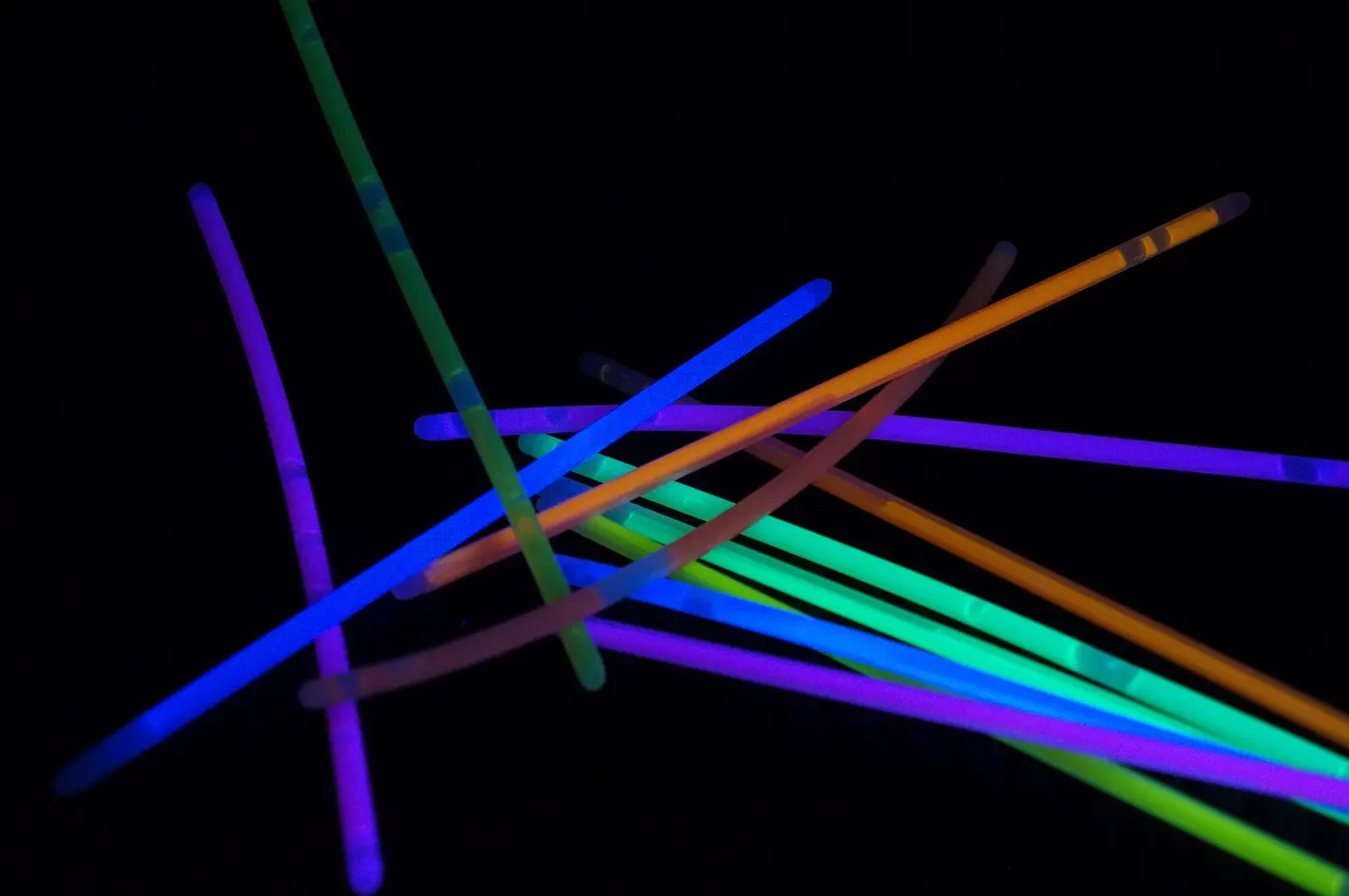
Why do glow sticks glow?
Two liquids inside mix and react, and a fluorescent dye takes the energy released by the reaction and turns it into light. It is “cold light” that gives off almost no heat.
Waves of light swaying in a concert crowd, a tiny glow bobbing on a night angler’s float, a stick tucked into an emergency kit. A glow stick lights up when you bend it and give it a shake, and then keeps shining for hours.
There’s no battery inside and no flame, and it doesn’t even feel warm in your hand. So where does the light come from?
Two liquids, kept apart
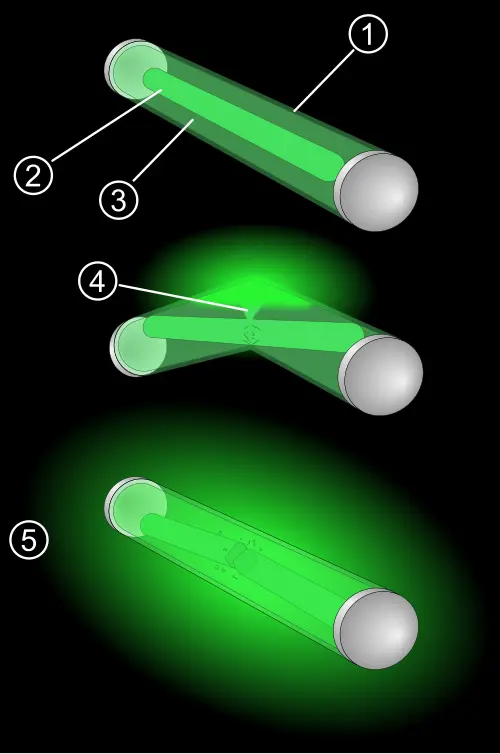
A glow stick holds two liquids, kept separate until you need them. According to the Japanese manufacturer Lumica, the outer case is a flexible tube of polyethylene or polypropylene, and sealed inside it is a slender capsule, or ampoule, of thin borosilicate glass. Bend the stick and the glass breaks, the liquids mix, and the light comes on.
Lumica publishes what is in the liquids. One, which it calls the oxidizing solution, is an ester solvent and alcohol with about 5 percent hydrogen peroxide, plus a tiny pinch of a salicylate salt to speed the reaction along. The other, the fluorescent solution, is a solvent containing about 8 percent of an oxalate ester and less than 1 percent of a fluorescent dye.

A relay race for energy
When the liquids mix, the hydrogen peroxide reacts with the oxalate ester to form a highly unstable molecule packed with energy. It is thought to be 1,2-dioxetanedione, made of just two carbon atoms and four oxygen atoms, and it quickly splits into two molecules of carbon dioxide.
The energy released is picked up by a dye molecule nearby. Excited by that energy, the dye molecule then settles back into its calm state by giving off the extra energy as light. The energy from the reaction is handed to the dye like a baton in a relay. Light produced by the energy of a chemical reaction in this way is called chemiluminescence.
The color depends on the dye. 9,10-Diphenylanthracene glows blue, for example, 9,10-bis(phenylethynyl)anthracene green, and rubrene yellow to orange. Unlike a light bulb or fireworks, which glow because something is heated until it is very hot, much of the energy goes straight into light, so there is very little heat. Lumica calls it “cold light.”
A one-day experiment at Bell Labs
The underlying chemistry was discovered by Edwin Chandross, a chemist at Bell Labs in New Jersey. He became fascinated by chemiluminescence after watching a demonstration of luminol, a compound that glows when it reacts, at the Massachusetts Institute of Technology, and he joined Bell Labs in 1959. There he found that oxalyl chloride, a relative of oxalic acid, reacts with hydrogen peroxide to make a fluorescent compound glow, and he reported it in the journal Tetrahedron Letters in 1963. In a 2013 interview, Chandross recalled that the experiments took just one day. But Bell Labs’ patent attorney declined to pursue it, and Chandross’s name is not on any U.S. glow stick patent.
It was Michael Rauhut and his colleagues at the chemical company American Cyanamid who made the reaction bright and long-lasting enough to be practical. In 1967 they published research on more convenient oxalate esters, and the company later sold its products under the trademark Cyalume. At the U.S. Navy’s China Lake laboratory, a team led by Herbert Richter also worked on chemical light. A light that needs no flame and gives off little heat was ideal for marking the location of downed pilots so they could be spotted from the air.
Warm for brightness, cold for staying power
Chemical reactions run faster at higher temperatures. Warm a glow stick and the reaction speeds up, so it shines brighter but runs out sooner. Cool it and the reaction slows down, so the light is dimmer but lasts longer. That is why a glowing stick that has been chilled in the refrigerator brightens again as it warms up.
Don’t overdo it, though. Lumica warns against warming a stick over a flame, with a hair dryer or in boiling water, which can damage it, and against putting one in the freezer, where the contents can crystallize and the tube can turn brittle and leak. The glowing time printed on the package, the company adds, is how long the stick stays usefully bright. It will glow faintly for a while afterward, but once the reaction is over, it will never glow on its own again.