How does soap get rid of grease?
A soap molecule has a head that loves water and a tail that loves oil. The tails dig into the grease, wrap it up and carry it off into the water.
Grease in a frying pan, butter on your fingers: run water over them and the water beads up and rolls off, leaving the slick film behind. Rub in a little soap, though, and the grease comes right off.
Soap doesn’t dissolve dirt the way a solvent does, and it doesn’t scour it off like sandpaper. What it does is play matchmaker between two substances that normally refuse to mix: water and oil.
Water and oil don’t get along
A water molecule carries a slight negative charge on its oxygen side and a slight positive charge on its hydrogen side, so water molecules cling tightly to one another. Oil molecules have almost no such lopsided charge. Water sticks with water, and oil, unable to join in, gets pushed out. That is why a shaken salad dressing separates again after a while.
The Japan Soap and Detergent Association calls the boundary where two unlike substances such as water and oil meet an “interface,” and a substance that works at that boundary to bring the two together a surfactant, short for surface-active agent. Soap is the classic example.
A head for water, a tail for oil
Soap is made by reacting fats or oils with a strong alkali. Fats such as beef tallow, coconut oil and palm oil are built from fatty acids joined to glycerol. Add sodium hydroxide and the fatty acids pair up with sodium to become soap, while the glycerol splits off. According to the association, ordinary bar soap is made with sodium hydroxide and liquid soap with potassium hydroxide.
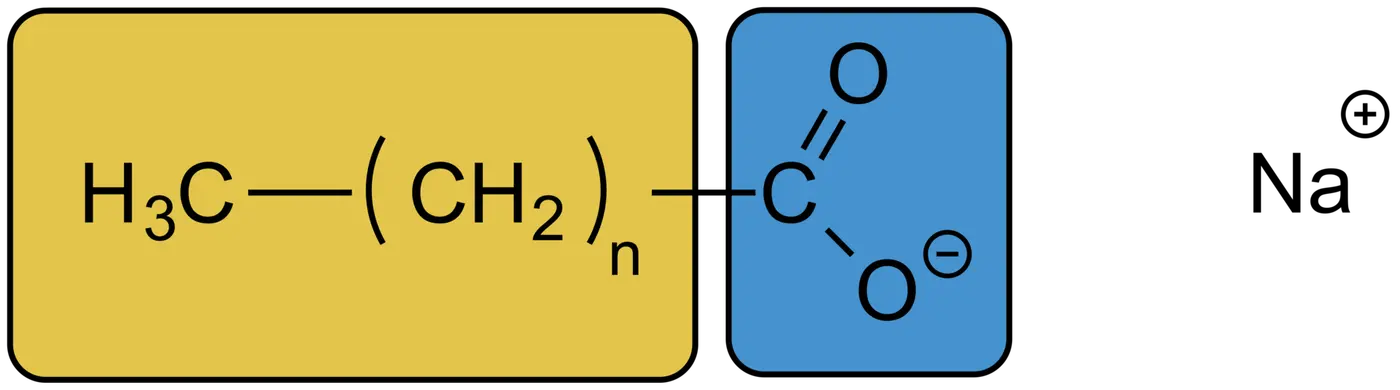

The resulting soap molecule is shaped a bit like a matchstick. Its long chain of a dozen or more carbon atoms is at home in oil, while the small group at one end carries a negative charge in water and is at home there. A single molecule can reach into both worlds at once.
Wrapping up the grease
When soapy water meets grease, the molecules line up with their tails pushed into the oil and their heads facing the water. Once the oil’s surface is densely coated, it looks to the water like a droplet wrapped in water-loving heads. With rubbing and scrubbing, the oil rolls up, lifts off the cloth or skin and breaks into tiny droplets that drift away into the water. The association calls this “rolling up.”
Soap molecules gather together in water even when there is no dirt around. Above a certain concentration they form tiny balls with their tails pointing inward and their heads facing out. These are called micelles. Because the inside of a micelle is all oil-loving tails, it can hold oil.
And because the heads around each oil droplet all carry a negative charge, the droplets repel one another and are less likely to clump together again or settle back onto the fabric. Rinse, and the oil is carried away.
Soap does have a weakness. In water rich in calcium and other minerals, soap combines with calcium to form an insoluble “metallic soap” that can no longer clean. That is the scum that collects around a bathtub or washbasin.
Clay tablets and a mythical hill
Soap is often said to be very old. Histories of chemistry commonly report that a Sumerian clay tablet from Mesopotamia, in what is now Iraq, dating to around 2500 BC, describes washing wool with a substance made from oil and ash.
Whether that was soap as we know it is less clear. In a 2024 paper in the journal EXARC, the British experimental archaeologist Sally Pointer noted that ancient texts sometimes use the same words for alkaline substances such as lye and for soap-like ones. Pointer reasoned that simply degreasing wool with lye would not produce visible amounts of soap. In her experiments, though, cloths used to strain fat in perfume making, washed for long periods in strong, warm lye, did produce soap clearly.
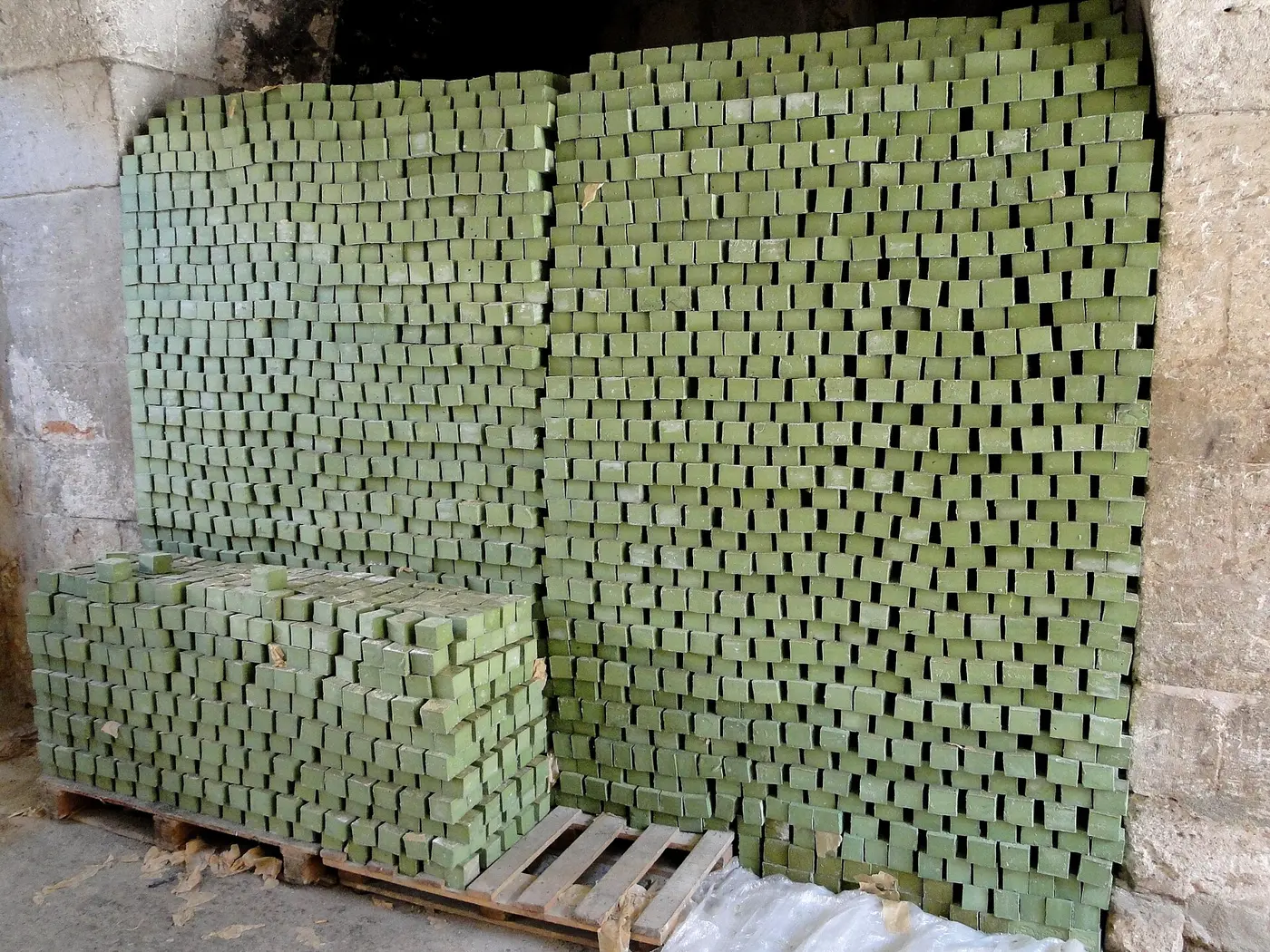

The first secure mention of soap by name comes in the Natural History of Pliny the Elder, the first-century Roman naturalist. Pliny describes sapo as an invention of the Gauls, the people of what is now France, for dyeing hair red. It was made from tallow and ashes, he says, the best from beech ash and goat fat, and came in a hard form and a liquid form, both used more by men than by women among the Germanic peoples. It was less a cleanser than a hair product.
The popular story of Mount Sapo, on the other hand, remains a legend. On this hill near Rome, the tale goes, fat from sacrificed animals mixed with ashes and washed down into the river, where the clay became wonderful for cleaning, and that is where the word “soap” comes from. No one has been able to locate such a hill, and linguists generally think Latin sapo was itself borrowed from a Germanic word.