Was the first image on Japanese television the katakana letter “イ”?
Yes. On December 25, 1926, Kenjiro Takayanagi displayed the character イ (i), written on a sheet of mica, on a cathode-ray tube. The camera end was still mechanical.
40lines
A television picture is built from thin horizontal lines called scan lines. Today’s high-definition sets use 1,080 of them. At the end of 1926, in the city of Hamamatsu in central Japan, a tiny screen with just 40 lines lit up with a single katakana character, イ, pronounced “i.” Japanese television is said to have started there.
The man behind it was Kenjiro Takayanagi, an assistant professor at Hamamatsu Higher Technical School, now the engineering faculty of Shizuoka University. His picture, though, was made in a way that differs from the television we know.
A letter written on mica
According to the Institute of Electrical Engineers of Japan, Takayanagi (1899–1990) arrived in Hamamatsu in 1924, a year before radio broadcasting began in Japan, convinced that the television of the future would be electronic. Similar research was under way in Europe and America, but news from abroad was scarce, and he worked largely on his own.
For his test subject he chose イ, the first character of the iroha, the traditional poem used to order the Japanese syllabary, much like “A” in the ABC. His camera was so insensitive that the subject had to be flooded with intense light. So that it would not burn, the character was written on a sheet of mica, as the optical communications pioneer Yasuharu Suematsu explained in the journal of the Institute of Image Information and Television Engineers.
On December 25, 1926, after improving the apparatus, Takayanagi saw イ appear on the tube, steady and unbroken. In his memoir, Terebi Kotohajime (“The Beginnings of Television”), he recalled rushing out of the darkroom and shouting for his assistants and fellow teachers to come and look.
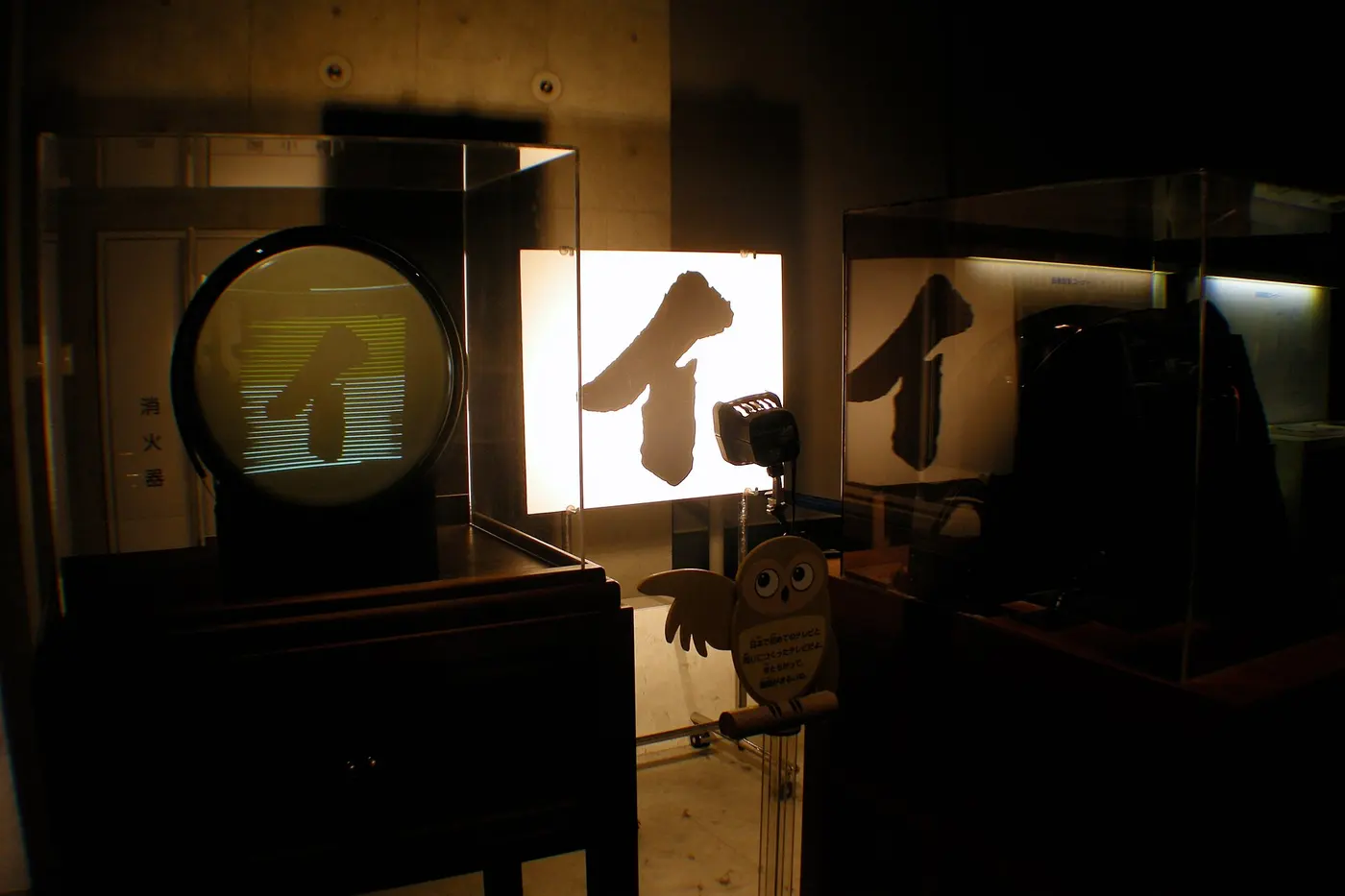

A mechanical camera, an electronic screen
The two ends of the system worked in different ways.
The sending end was mechanical. According to Shizuoka University, strong light from an arc lamp passed through a spinning disk pierced with a spiral of small holes and fell on the character. As the disk turned, a spot of light swept across the letter from left to right, dropped down a step, and swept across again. Six photoelectric tubes on either side of the subject turned the reflected light into an electrical signal. This kind of disk had been devised by the German inventor Paul Nipkow and is known as a Nipkow disk.
The receiving end was a cathode-ray tube. Takayanagi believed that mechanical systems could never produce detailed pictures, so he turned to the tube, in which a beam of electrons makes a fluorescent screen glow. On a tube he had asked Tokyo Electric (now Toshiba) to build, the beam traced 40 lines, brightening and dimming with the signal, and assembled the character.
Baird’s mechanical television
At about the same time in Britain, the Scottish inventor John Logie Baird was working on television of his own. According to Historic England, on October 2, 1925, in an attic workshop in London’s Soho, Baird transmitted the face of a ventriloquist’s dummy called Stooky Bill, with real shades of light and dark. On January 26, 1926, he demonstrated his system to members of the Royal Institution.
Baird’s system used spinning disks at both ends. At the receiver, a neon lamp brightened and dimmed with the signal and was viewed through a second rotating disk. Making the receiver electronic was the key difference in Takayanagi’s approach.
Was it a world first?
Shizuoka University and other Japanese sources describe Takayanagi’s experiment as the first time a character was shown on a cathode-ray tube. The IEEE, which honored his work with one of its engineering history Milestones in 2009, is more careful. Its documentation notes that Boris Rosing in Russia, Édouard Belin and Fernand Holweck in France, and Bell Telephone Laboratories in the United States had all transmitted pictures to cathode-ray tubes by July 1926, and says that Takayanagi independently succeeded in producing a 40-line picture.
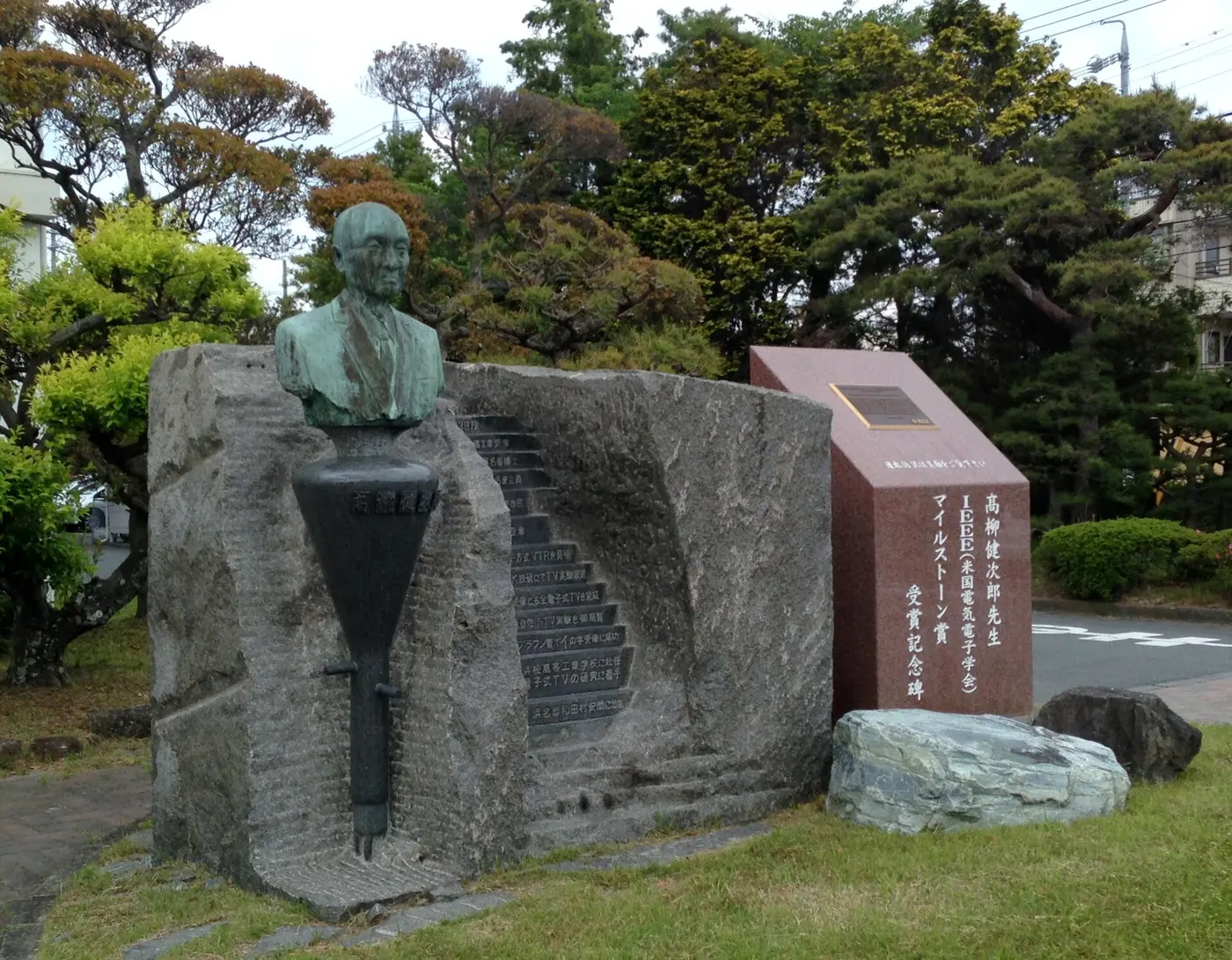

Takayanagi went on to complete an all-electronic system, with an electronic camera as well, in 1935, and later helped prepare television broadcasting at NHK, Japan’s public broadcaster. Regular broadcasts in Japan began only in 1953, after the war. Whether or not that first character counts as a world first, Japanese television started with イ.