How much bigger is a supermoon?
Compared with the smallest full Moon of the year, about 14 percent wider and 30 percent larger in area. But “supermoon” isn’t an official astronomical term.
14%
“Don’t miss tonight’s supermoon!” The headline has become a familiar one. A supermoon is a full Moon that happens when the Moon is close to Earth, and it is said to look bigger and brighter than usual.
So how much bigger is it, really? Looking into it, the first thing you run into is a problem with the word itself.
Named by an astrologer
“Supermoon” is not an official astronomical term. According to NASA, it was coined in 1979 by the astrologer Richard Nolle. Nolle himself told the website Universe Today in 2011 that he came up with it in an article for the magazine Horoscope. He used it for a new or full Moon that occurs when the Moon is “within 90%” of perigee, its closest approach to Earth in its orbit. Astronomers have a drier name for the event: a perigee-syzygy.
But it isn’t clear exactly what the 90 percent is measured against, so different publications draw the line in different places. NASA notes that, depending on how you interpret the definition, a typical year can have two to four full supermoons in a row.
Japan’s National Astronomical Observatory (NAOJ) goes further: because “supermoon” has no clear definition, it says, a question like “When is the next supermoon?” simply can’t be answered. A full Moon, by contrast, has a precise definition: the moment when the Moon and the Sun are 180 degrees apart in celestial longitude.
Fourteen percent, at most
Because the Moon travels around Earth on an elliptical orbit, its distance keeps changing. According to NAOJ’s calculations, the closest full Moon of 2026 falls on December 24, about 357,000 km (222,000 miles) from the center of Earth. The farthest was on May 31, at about 406,000 km (252,000 miles).
The December full Moon looks about 14 percent wider than the one in May, and about 30 percent larger in area. That is roughly the difference between a U.S. nickel and a quarter. NASA likewise says the full Moon at its closest can appear up to 14 percent bigger and 30 percent brighter than the faintest full Moon of the year.
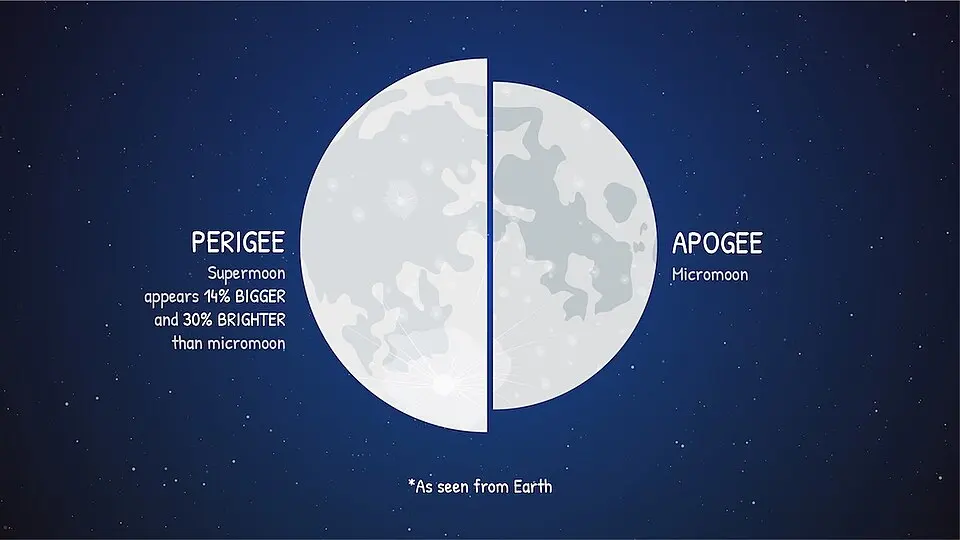

Keep in mind, though, that the 14 percent compares the biggest full Moon with the smallest. Compared with a full Moon at the average Earth–Moon distance of about 384,400 km (238,900 miles), a full Moon at 357,000 km is only about 8 percent wider.
Can you tell by looking?
NAOJ says it is very hard to look at the year’s biggest full Moon and feel that it is unusually large. Nobody can remember the exact size of the Moon from months earlier, and you can never line two full Moons up side by side in the sky.
NAOJ also recalls the fuss in November 2016, when the full Moon of November 14 was billed as the closest in 68 years. By its calculation, the Moon was then 356,520.2 km from Earth. That differed by just 30 km (19 miles) from the distance at the full Moon of January 26, 1948, and by only about 4 km (2.5 miles) from that of November 21, 1972. NAOJ points out that the distance between you and the Moon changes by about 6,400 km (4,000 miles), Earth’s radius, depending on whether the Moon is overhead or near the horizon, so it is a little odd that a difference of a few dozen kilometers made headlines.

Slightly higher tides
A nearby Moon does affect the tides. Around full and new Moon, the pulls of the Moon and Sun line up to produce spring tides, and when that coincides with perigee, the tidal range grows a little more. According to the U.S. National Oceanic and Atmospheric Administration (NOAA), in most places these “perigean spring tides” rise only a couple of inches above normal spring tides. If a storm strikes at the same time, though, flooding can be significantly worse.
Nolle has also claimed that supermoons bring earthquakes, volcanic eruptions and severe storms. According to the U.S. Geological Survey (USGS), some studies have found that during the highest tides, earthquakes on certain shallow faults, such as those in subduction zones, become about three times as likely. But because the background probability is so low to begin with, it remains very small even when tripled.