Why are sunspots dark?
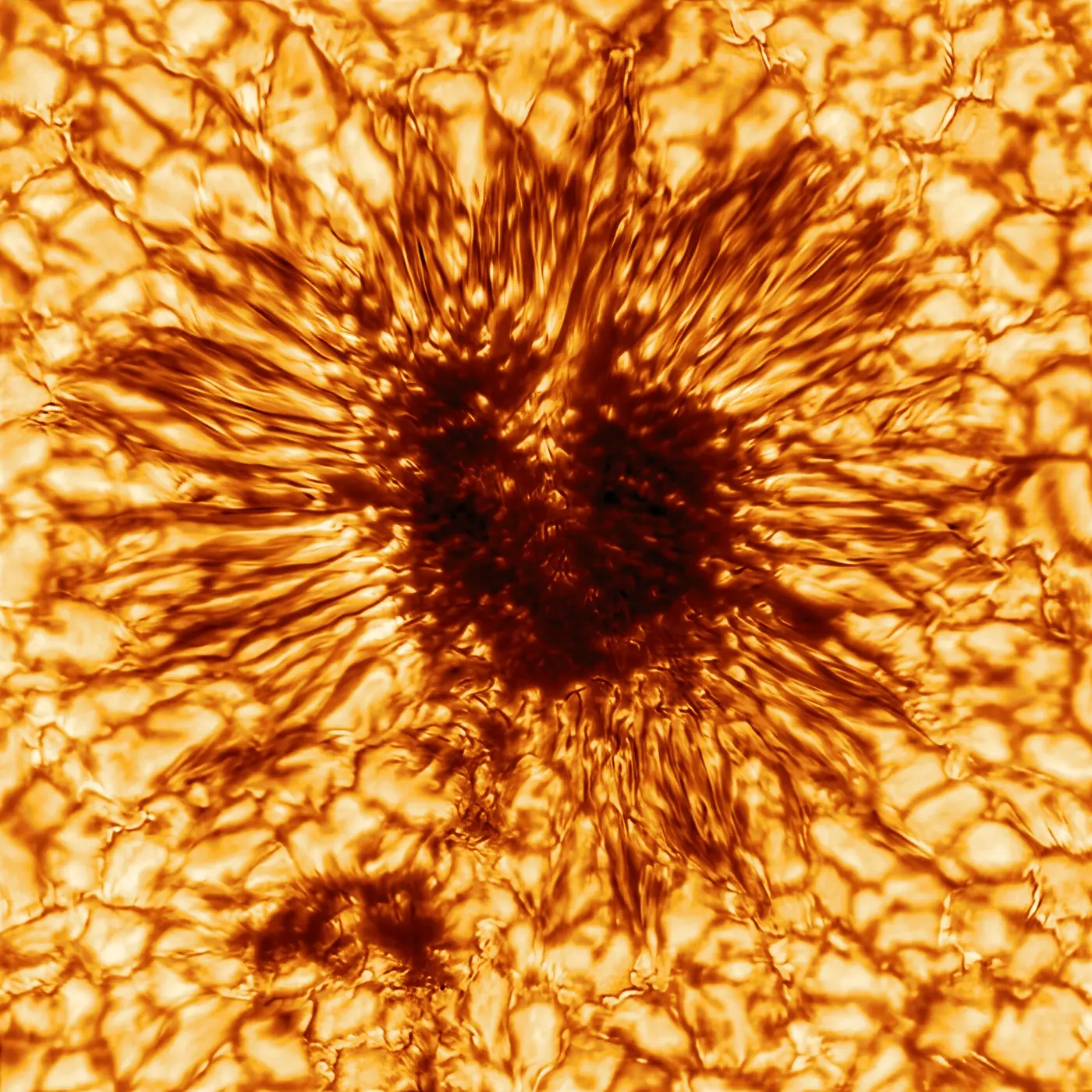
They are about 2,000°C cooler than the surface around them, so they look dark by comparison. Strong magnetic fields hold back the heat flowing up from below.
4,000°C
Photograph the Sun through a proper solar filter and you will often see dark blotches here and there on the brilliant disk. These are sunspots. They change shape over hours to months as the Sun’s rotation carries them across its face, and the biggest are large enough to swallow several Earths.
How can a dark spot form on a blazing ball of gas? (A warning first: never look at the Sun directly, with or without a telescope; it can damage your eyes.)
Dark only by comparison
According to the Japanese encyclopedia Nipponica, the Sun’s visible surface, the photosphere, gives off light like an object at about 6,000°C (10,800°F), while a sunspot shines like one at about 4,000°C (7,200°F). Hotter things glow more brightly, so the cooler spot looks dim next to its surroundings. Japan’s National Astronomical Observatory (NAOJ) says the darkest part of a sunspot, the central umbra, is only about a tenth as bright as the surface around it, which corresponds to a temperature roughly 2,000°C lower.
Still, 4,000°C is more than twice the melting point of iron. A sunspot is shining fiercely; it only looks black because its surroundings are so much brighter. Nipponica notes that the true color of a sunspot’s own light would be brownish.
Magnetism puts a lid on the heat
Why are sunspots cooler? The answer is magnetism. In 1908, George Ellery Hale at Mount Wilson Observatory in California examined the light from sunspots with a spectrograph and found a strong magnetic field. Atoms in a magnetic field give off light whose spectral lines are split, a phenomenon called the Zeeman effect, and Hale saw that splitting in sunspot light. According to Nipponica, this was the first magnetic field ever detected beyond Earth.
A typical sunspot field is around 3,000 gauss, according to the Japanese World Encyclopedia. In 2018, NAOJ researchers using data from the Japanese solar satellite Hinode reported a sunspot field of 6,250 gauss, twice the usual strength and the strongest ever measured on the Sun.
Heat from the Sun’s interior is carried to the surface by rising gas, like water churning in a boiling pot. In a sunspot, densely packed bundles of magnetic field lines hold that motion back. As NASA puts it, the magnetic fields are so strong that they keep some of the heat inside the Sun from reaching the surface. With less heat arriving from below, the spot cools. The magnetic field acts like a lid.

Seen long before the telescope
When haze, smoke or dust dims the Sun, a large sunspot can sometimes be seen with the naked eye, so records of them go back long before telescopes. According to the World Encyclopedia, systematic observations began in China in 28 BC. In Japan, an official history of the Heian period (794–1185) records that on December 2, 851, the Sun lost its brilliance and had a black spot in it “the size of a plum.”
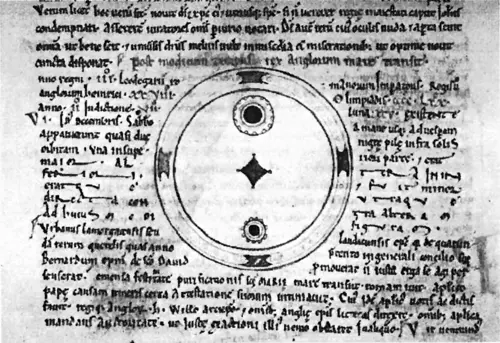
The oldest known drawing of sunspots is in the chronicle of John of Worcester, a monk in England. According to a 2001 paper in Annales Geophysicae, it shows the Sun on December 8, 1128, when “two black spheres” were seen against it from morning to evening. Five nights later, a red aurora was seen from Kaesong, in Korea. Auroras are more common when sunspots are plentiful.

Telescopic observations began around 1610–11 with Thomas Harriot in England, Johannes Fabricius and his father, and Christoph Scheiner in Germany, and Galileo Galilei in Italy. Because the spots changed shape as they moved, these observers concluded that they were features on the Sun itself.
An 11-year rhythm, and a 70-year gap
The number of sunspots rises and falls about every 11 years. According to Nipponica, the German astronomer Heinrich Schwabe stumbled on this while recording sunspots in search of a planet thought to orbit inside Mercury. He never found the planet, but in 1843 he announced that the number of spots went up and down in a regular cycle. Rudolf Wolf at the Zurich Observatory then dug through older records and showed that the average cycle lasts about 11 years.
Yet there was a stretch when sunspots almost vanished: roughly 70 years, from 1645 to 1715. Edward Maunder of the Royal Observatory, Greenwich, pointed it out in the 1890s, and in 1976 the American solar astronomer John Eddy revisited it in a paper in Science. The period is now called the Maunder Minimum. It overlaps with the Little Ice Age, but according to a Japanese earth science dictionary, several large volcanic eruptions also happened around then, and what drove the cold is still debated.
Solar cycles are numbered from the one that began in 1755, and the current one is Solar Cycle 25. In October 2024, NASA and the National Oceanic and Atmospheric Administration (NOAA) announced that the Sun had reached its solar maximum period. The exact month of the peak can only be pinned down once activity has clearly declined, which can take months or years.