Was the name “Big Bang” meant as an insult?
It was coined by Fred Hoyle, a leading opponent of the theory. But Hoyle said he was looking for a vivid image for radio listeners, not trying to sneer.
13,099
The universe began in a hot, dense state and has been expanding and cooling ever since. Even children know this idea as the Big Bang.
There is a well-known story about where that name came from. It was coined by the British astronomer Fred Hoyle, who opposed the theory and supposedly invented the phrase on the radio to ridicule it. Japan’s Nipponica encyclopedia, for one, says Hoyle used it to make fun of George Gamow’s theory. But according to historians who have gone back to the records, things weren’t quite that simple.
A beginning before the name
The idea that the universe had a beginning is nearly two decades older than its name. According to the Danish historian of science Helge Kragh, the Belgian astronomer and Catholic priest Georges Lemaître suggested in a short letter to Nature dated May 9, 1931, that the universe began as a single “unique atom.” He later called it the “primeval atom.” Lemaître also likened the beginning to fireworks, but he never used the term “big bang.”
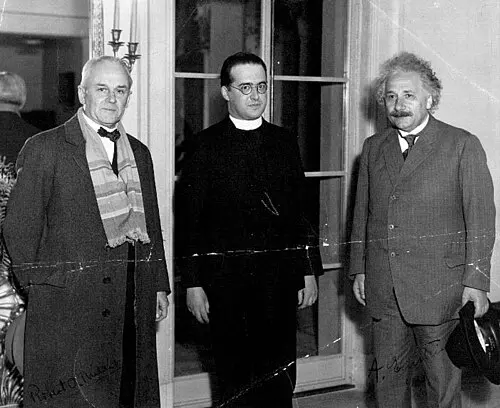

In the late 1940s, Gamow, a Russian-born American physicist, and his colleagues developed a theory in which the newborn universe was extremely hot, and the chemical elements were forged in it. But that theory had no catchy name either.
Meanwhile, in 1948, Hoyle, Hermann Bondi and Thomas Gold put forward the steady state theory. The universe is expanding, they said, but new matter is constantly being created to fill the gaps, so its overall appearance never changes.
On the radio, March 28, 1949
According to Kragh, on March 28, 1949, Hoyle gave a 20-minute talk on the BBC’s Third Programme. Less than two weeks later the text was printed in full in The Listener, the BBC’s magazine. After explaining the steady state theory, Hoyle contrasted it with theories based on “the hypothesis that all the matter of the universe was created in one big bang at a particular time in the remote past.” That is the origin of “big bang” as a term in cosmology.
Hoyle certainly opposed the idea. He closed the talk by saying, “I cannot see any good reason for preferring the big bang idea.” But as Kragh points out, Hoyle didn’t mention Gamow or his theory at all. A story later spread that Hoyle coined the phrase during a BBC debate with Gamow, but no such debate ever took place.
No insult intended?
Hoyle himself later insisted he hadn’t meant the phrase to be derogatory. In a 1989 interview with the American physicist and writer Alan Lightman, he explained that on the radio, with no visual aids, he was constantly striving for visual images, and “big bang” seemed one way of distinguishing between the steady state and the explosive universe.
Ironically, one scientist who openly disliked the name was on the other side of the debate. In a 1968 interview, Gamow said: “I don’t like the word ‘big bang.’ I don’t call it ‘big bang,’ because it is a kind of cliché.”

Slow to stick, impossible to replace
The name was slow to catch on. Kragh found only about 34 English-language sources that used it before 1965. Only after the discovery that year of faint radio waves arriving from every direction in the sky, which strongly supported the theory, did the term gradually become standard among scientists.
In 1993, the astronomy magazine Sky & Telescope held a contest to find a better name. It received 13,099 suggestions from 41 countries, but the judges, including the astronomer Carl Sagan, decided that none was worthy of replacing “big bang.” “Words are like harpoons,” Hoyle said in a 1995 interview. “Once they go in, they are very hard to pull out.” He remained a critic of Big Bang cosmology until his death in 2001.