When will Halley’s Comet come back?
Its next closest approach to the Sun will be in the summer of 2061. The comet returns about every 76 years on average, and its last visit was in 1986.
2061
Halley’s Comet is probably the most famous comet in the world. According to NASA, it circles the Sun about once every 76 years on average, and it will return in 2061. Orbit calculations by NASA’s Jet Propulsion Laboratory (JPL) put its closest approach to the Sun around July 28 of that year.
Seventy-six years is about the length of a human life, so the comet has often been tied to people’s lifetimes. The best-known example involves the American writer Mark Twain.
The comet that came back on schedule
According to NASA, in 1705 the English astronomer Edmond Halley used Isaac Newton’s theory of gravitation to work out the orbits of comets and predicted that one of them would return in 1758. He was right, and the comet has carried his name ever since.
Its period averages 76 years, but it varies a little from one trip to the next as the planets tug on it. According to NASA, the shortest interval between closest approaches on record was the 74.42 years from 1835 to 1910. The comet last swung closest to the Sun on February 9, 1986. On March 14 of that year, the European probe Giotto flew within 596 km (370 miles) of its nucleus and found that it was very dark, with bright jets of gas and dust bursting out of it. NASA puts the nucleus at roughly 15 by 8 km (9 by 5 miles).
1910: Earth in the comet’s tail
The 1910 return caused a sensation. According to a Library of Congress guide to its historic newspaper collection, the press portrayed Halley’s Comet as an “evil eye of the sky,” stoking public fear. In February 1910, the French astronomer Camille Flammarion was reported as saying that cyanogen, a poisonous gas in the comet’s tail, might snuff out all life on Earth. The reason for the worry was that Earth was expected to pass through the tail on May 18–19.
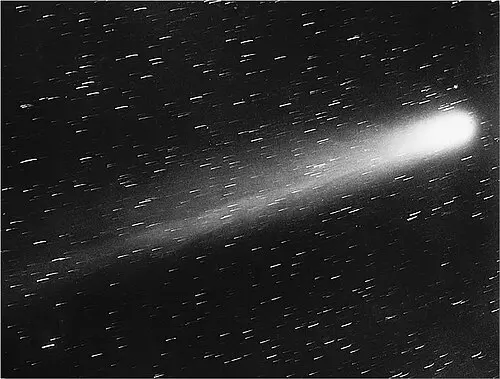

The Library of Congress guide notes that opportunistic entrepreneurs hawked “anti-comet pills,” gas masks and even comet-protecting umbrellas. Nothing happened, of course. The guide records that the comet passed between Earth and the Sun without causing any atmospheric disturbance. A comet’s tail is made of extremely thin gas and dust. Amid all the fuss, 1910 was also the first time Halley’s Comet was photographed and studied with a spectroscope, which splits light to reveal what something is made of.
“I expect to go out with it”
Mark Twain, whose real name was Samuel Clemens, was born on November 30, 1835, in the small village of Florida, Missouri. Halley’s Comet had made its closest approach to the Sun two weeks earlier, on November 16.
His biographer, Albert Bigelow Paine, recorded what Twain told him in the summer of 1909 at Stormfield, the writer’s home in Redding, Connecticut: “I came in with Halley’s comet in 1835. It is coming again next year, and I expect to go out with it. It will be the greatest disappointment of my life if I don’t go out with Halley’s comet. The Almighty has said, no doubt: ‘Now here are these two unaccountable freaks; they came in together, they must go out together.’”
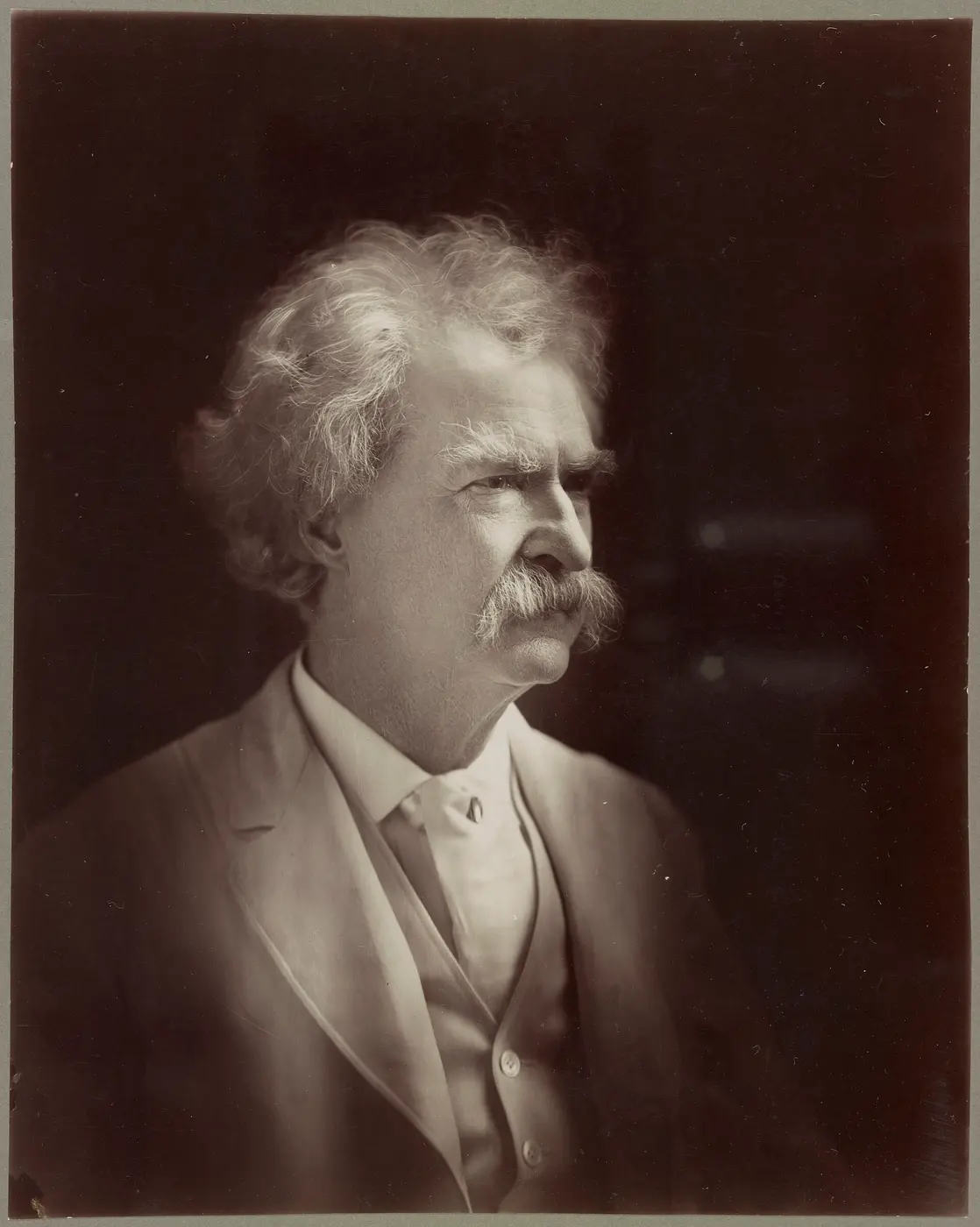

On April 20, 1910, Halley’s Comet made its closest approach to the Sun. The next evening, April 21, Twain died at his Redding home at the age of 74. In his biography, published in 1912, Paine wrote of the day before Twain’s death: “the mysterious messenger of his birth-year, so long anticipated by him, appeared that night in the sky.”
The much-quoted words come to us through Paine, who was there to write them down. The tale of the writer who came in with the comet and went out with it has become part of the comet’s legend. And it is a curious coincidence that Twain’s 74 years matched the shortest orbit of Halley’s Comet on record.