Is Earth closest to the Sun in winter?
Yes. Earth comes closest to the Sun every year in early January. Seasons are set by the tilt of Earth’s axis, not by distance.
5million km
Cold winters far from the Sun, hot summers close to it: it is tempting to explain the seasons by distance. After all, it is warm next to a heater and chilly across the room.
The truth runs the other way. Earth makes its closest approach to the Sun in early January, in the depths of winter for the Northern Hemisphere, and is farthest away in early July, at the height of northern summer.
The January Sun is the nearest of the year
Earth travels around the Sun on an orbit that is very slightly squashed, an ellipse rather than a perfect circle. The point where it comes closest is called perihelion, and the farthest point aphelion.
According to NASA’s data, Earth is about 147.1 million kilometers (91.4 million miles) from the Sun at perihelion and about 152.1 million kilometers (94.5 million miles) at aphelion, a difference of around 5 million kilometers. The US Naval Observatory calculates that in 2027, Earth will pass perihelion on January 3 and aphelion on July 5 (Japan time).
The date of perihelion shifts by a few days from year to year. As the National Astronomical Observatory of Japan explains, Earth and the Moon travel around the Sun together as a pair, so depending on where the Moon is, the moment of Earth’s closest approach can come a little earlier or later.
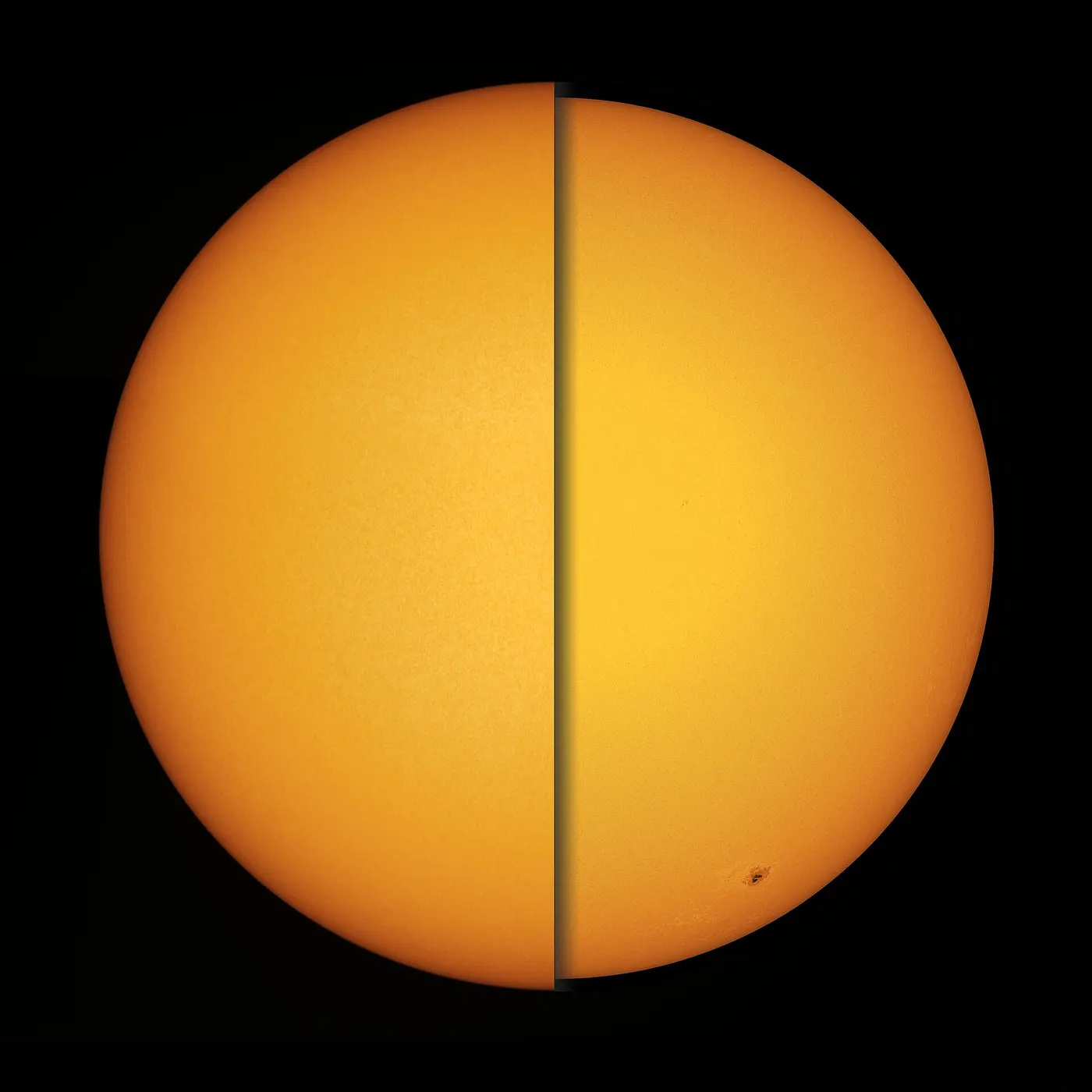

Five million kilometers sounds like a lot, but it is only about 3 percent of the distance to the Sun. Because the intensity of light falls off with the square of distance, Earth receives roughly 7 percent more sunlight in January than in July. And yet January in the Northern Hemisphere is cold.
The tilt makes the seasons
The real cause of the seasons is the tilt of Earth’s axis. The axis leans about 23.4 degrees away from the perpendicular to the plane of Earth’s orbit, and it keeps pointing in nearly the same direction all year round.
So around June, the Northern Hemisphere is tipped toward the Sun, and around December it is tipped away. When the north is turned away from the Sun, the Sun traces a low path across the sky and the days are short.
The National Astronomical Observatory of Japan’s calculations show the difference in Tokyo. At the June solstice in 2026 (June 21), the Sun climbs to 77.8 degrees above the horizon at noon, and it is up for 14 hours 35 minutes from sunrise to sunset. At the December solstice (December 22), it reaches only 30.9 degrees and stays up for just 9 hours 45 minutes. Light arriving at a low angle is spread thinly over a much larger patch of ground. That matters far more than being a little closer to the Sun.
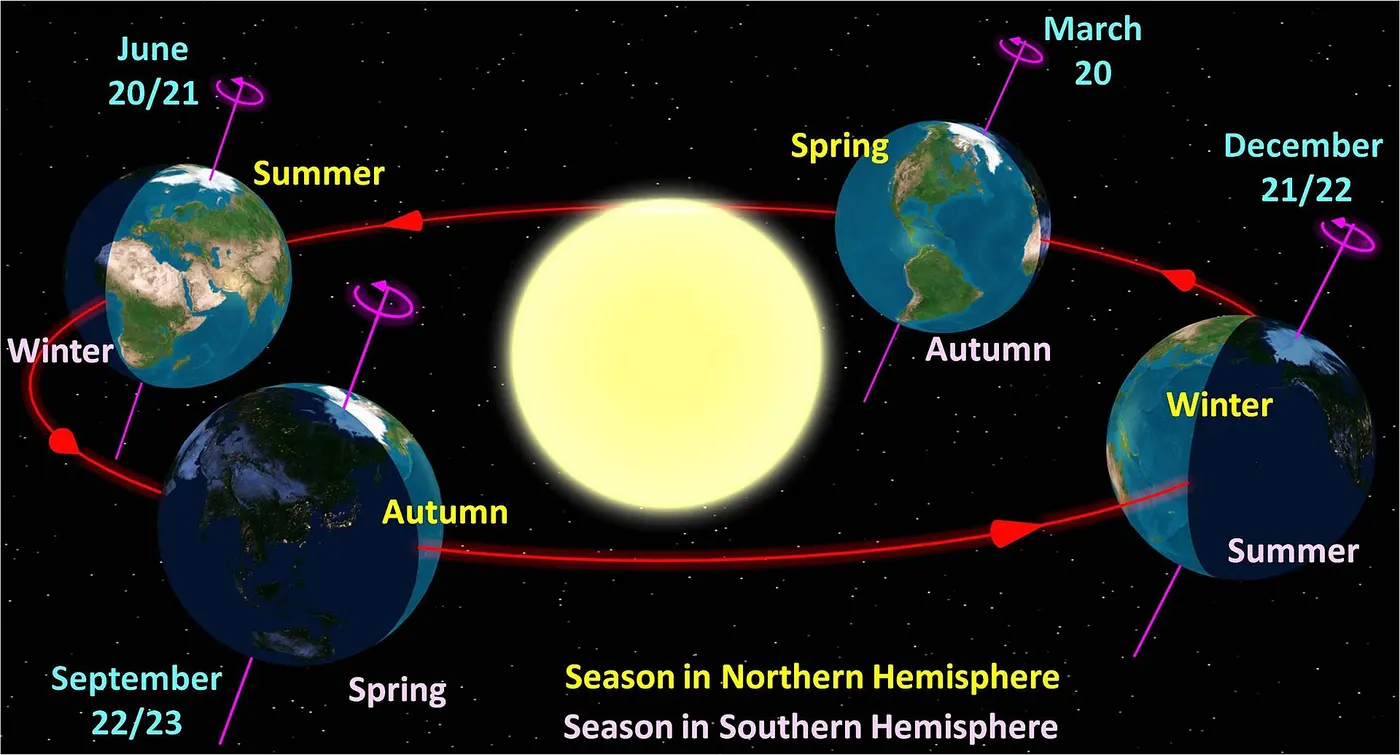

In the Southern Hemisphere it works the other way around: perihelion falls in summer. Yet for the planet as a whole, the hottest month of the year is July. According to the US National Oceanic and Atmospheric Administration (NOAA), the 20th-century average global temperature for July was 15.8°C (60.4°F). Land heats up more readily than ocean, and most of the land is in the Northern Hemisphere, so northern summer is thought to win out.
Northern winter is a little shorter
Where the changing distance does show up is in the length of the seasons. As the 17th-century astronomer Johannes Kepler discovered, a planet moves faster the closer it is to the Sun. Earth travels at about 30.3 kilometers per second near perihelion and about 29.3 kilometers per second near aphelion.
That means northern winter, which straddles perihelion, is the quickest season to pass. Using the National Astronomical Observatory of Japan’s almanac, the stretch from the December 2026 solstice to the March 2027 equinox lasts about 89.0 days, while the June-to-September stretch in 2027 lasts about 93.7 days. The half of the year from the March equinox to the September equinox is about seven days longer than the half from September to March.