Is the Sun actually white?
Yes. Sunlight is a mix of every color, which adds up to white. From the ground it looks yellowish because Earth’s atmosphere scatters away a little of its blue light.
5,500°C
Ask someone to draw the Sun and they will probably reach for a yellow or orange crayon. Think of a sunset, and red comes to mind too.
But the Stanford Solar Center at Stanford University is blunt about it: the Sun is white. Thinking of it as yellow, orange or red, it says, is a common misconception. So what is the yellowish Sun we see every day?
Mix every color and you get white
The person who first worked out what sunlight is made of was Isaac Newton. He let a beam of sunlight in through a small hole in a window shutter, passed it through a glass prism, and spread it into a band of colors from red to violet. In a paper he published in the Royal Society’s journal in 1672, he also showed that if the separated colors are brought back together with a lens, they mingle on a sheet of paper and turn white again. Sunlight, in other words, is a package of all the colors of the rainbow.
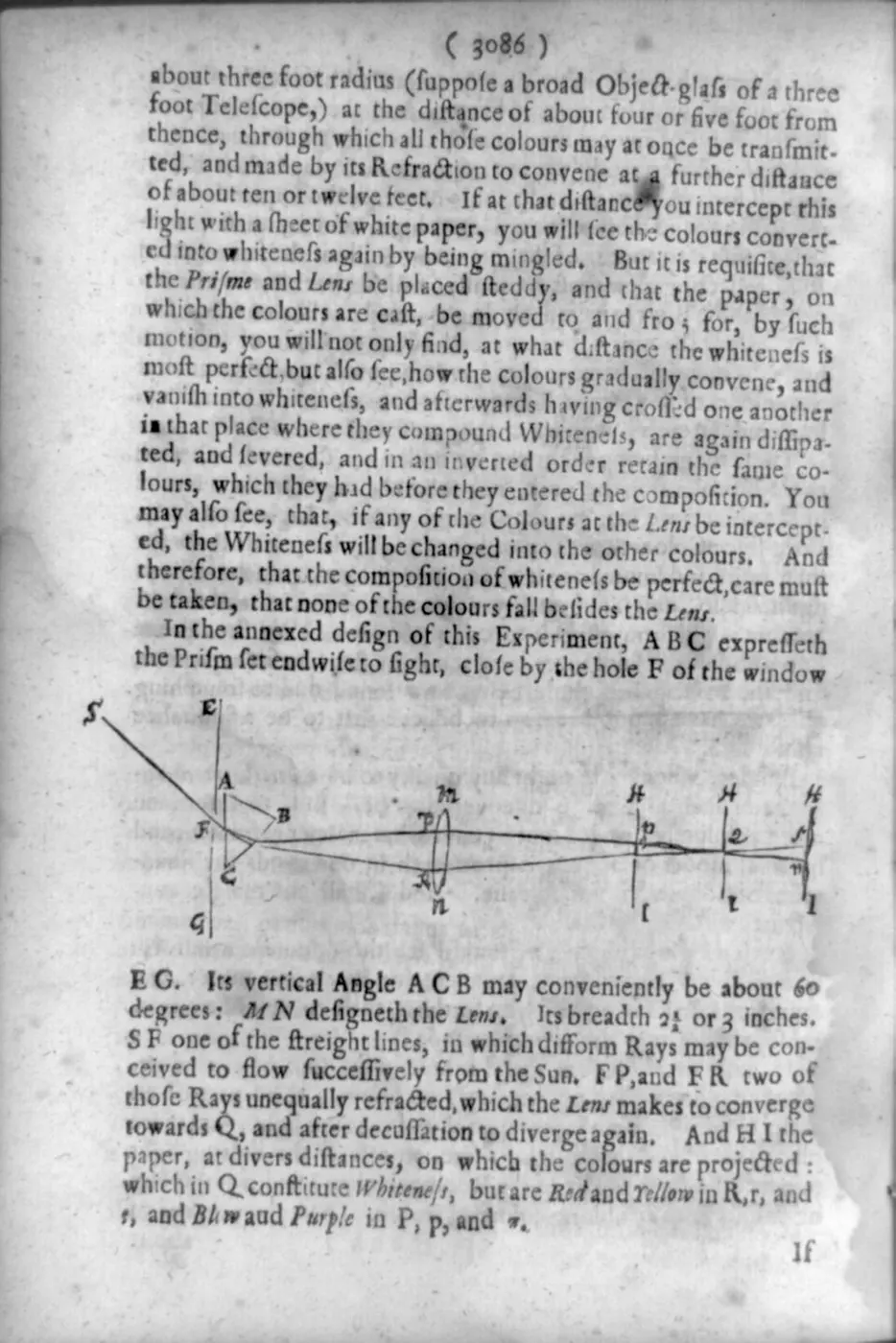

The Stanford Solar Center makes the same point: the Sun’s light is “essentially all colors mixed together, which appear to our eyes as white.” A NASA video explainer adds that the Sun looks white in photos because it gives off all the colors we can see at once.
There is everyday evidence, too. Clouds are white because their water droplets are much larger than the wavelengths of visible light, so they scatter every color about equally. As the UK Met Office puts it, the sunlight bouncing off a cloud stays white, which is why clouds look white against a blue sky. If sunlight itself were yellow, midday clouds would look yellow as well.
The atmosphere adds the yellow
So why does the Sun look yellowish from the ground? Blame the atmosphere. As sunlight travels through the air, the shorter wavelengths, blue and violet, are the most likely to bounce off air molecules and be scattered in all directions. That scattered light is what makes the sky blue, and it means the light coming straight at us from the Sun has lost a little of its blue.
At midday the effect is small, and direct sunlight is still close to white. But when the Sun is low in the morning or evening, its light has to cross much more air. Blue and green are stripped away, and the Sun turns yellow, then orange, then red. The “Sun color” we remember may well be its look at dawn and dusk, when the glare softens. (Never look straight at the Sun in the middle of the day: it can damage your eyes.)
From space, a dazzling white
Above the atmosphere, that yellow filter disappears. “Seen from space, this is clear,” the Stanford Solar Center says, pointing to a photo of a white Sun taken from the International Space Station.


Then again, many of the Sun images NASA releases are orange, green or purple. According to NASA, its Solar Dynamics Observatory (SDO) uses special filters to watch the Sun in 10 different wavelengths of light, many of them invisible to human eyes. Scientists convert the data into colors we can see. Those vividly tinted Suns have had their colors added afterward.
Why astronomers still call it a “yellow dwarf”
The confusing part is that astronomers classify the Sun as a “yellow dwarf.” NASA’s own Sun fact page uses the term.
The label comes from comparing stars with one another. A star’s color depends on its surface temperature: hotter stars look bluish white and cooler ones look reddish. According to the International Astronomical Union’s glossary, G-type stars like the Sun have surface temperatures of roughly 5,200 to 6,000 kelvins (about 4,900 to 5,700°C, or 8,900 to 10,300°F), and compared with other stars they look yellow to human eyes. Those still burning hydrogen in their cores, as the Sun is, are called yellow dwarfs. The “yellow” is relative, describing how the Sun looks next to blue-white and red stars.
If you plot the strength of sunlight wavelength by wavelength, the peak falls in the blue-green. The Sun still doesn’t look green because it puts out nearly as much of every other color. As the astronomer Phil Plait explained in Scientific American, there is no temperature at which a star would look green to our eyes, which is why we don’t see any green stars.