What was the first living thing in space?
Among animals, fruit flies. In 1947 they rode an American V-2 rocket to about 109 kilometers (68 miles) and came back alive.
109km
In November 1957, a dog named Laika circled Earth aboard the Soviet satellite Sputnik 2. A Romanian stamp issued that year hailed her as “the first traveler into the cosmos,” and many people still believe Laika was the first animal in space.
She was the first to orbit Earth, but other animals had reached space before her. The very first were insects just 2 or 3 millimeters long: fruit flies.
Riding a missile to the edge of space
After World War II, the United States took home V-2 rockets that Germany had developed as weapons and began firing them from White Sands in New Mexico to study the upper atmosphere. Each launch was written up in a report listing its instruments and results.
According to those records, V-2 No. 20, launched on February 20, 1947, carried rye seeds, cotton seeds and fruit flies. The rocket climbed to 68 miles (about 109 kilometers), above the 100-kilometer (62-mile) line that is widely used as the boundary of space.
On the way down, a canister was ejected from the rocket and lowered by parachute. The record notes: “Seeds recovered and flies still alive.” The rocket itself exploded when it hit the ground, but the insects were safe. They were the first animals to go to space and come back alive.
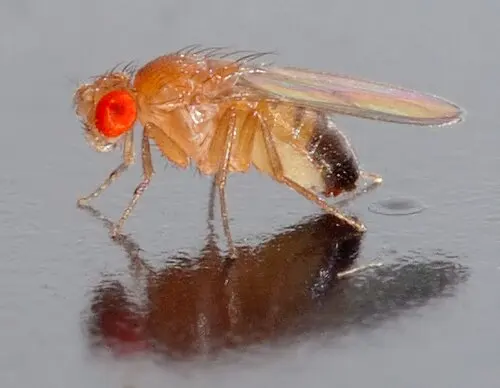

By then, the fruit fly was already a workhorse of genetics. The American geneticist Thomas Hunt Morgan had used it to show that genes are carried on chromosomes, work that won him the 1933 Nobel Prize in Physiology or Medicine. Fruit flies are small, breed quickly and run through generations fast, which also made them well suited to checking what radiation from space might do to offspring.
Seeds and spores went even earlier
Take “living thing” in its broadest sense, though, and something beat the flies. According to the same records, V-2 No. 7, launched on July 9, 1946, carried plant seeds supplied by Harvard University to 83.5 miles (about 134 kilometers). But the seeds that were recovered were badly damaged and unusable. In December that year, fungus spores from the National Institutes of Health also went up, and they were never recovered.
Some sources say fruit flies flew as early as July 1946, but the record for that flight lists only seeds. On firm documentary evidence, the first living things known to have gone to space and come back alive were the fruit flies of 1947.
Monkeys, dogs and then Laika
Larger animals came next. According to NASA’s history of animals in space, on June 14, 1949, a V-2 carrying a rhesus monkey named Albert II reached an altitude of 83 miles (about 134 kilometers). The monkey died on impact.
The Soviets chose dogs, reasoning that they would be less fidgety in flight than monkeys. In 1951, two dogs, Dezik and Tsygan, were launched on a rocket and recovered safely.
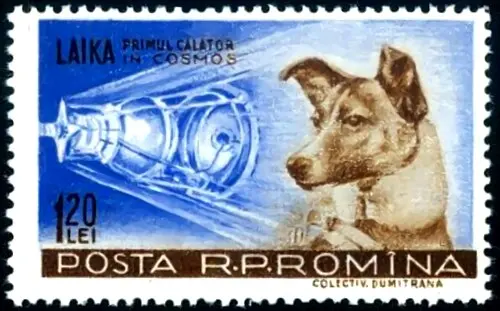

Then, on November 3, 1957, Sputnik 2 carried Laika into orbit, making her the first animal to circle Earth. According to NASA, she was a stray mongrel picked up off the street, and her real name was Kudryavka, “Little Curly.” There had been no time to work out a way to bring her back, and she died within a few hours of launch.
The first animals to orbit Earth and return alive were the dogs Belka and Strelka, launched on Sputnik 5 on August 19, 1960, along with a rabbit, 40 mice, 2 rats, and fruit flies and plants. In January 1961, the United States sent a chimpanzee named Ham on a suborbital flight; he splashed down in the Atlantic in good shape, and NASA credits his mission with paving the way for Alan Shepard, the first American astronaut, that May. By then, the Soviet cosmonaut Yuri Gagarin had already become the first human in space, on April 12, 1961.