What’s on the Voyager Golden Record?
Greetings in 55 languages, sounds of Earth such as surf and thunder, 27 pieces of music from around the world, and 115 images. Japan is represented by a piece for shakuhachi flute.
55languages
Voyager 2 lifted off from Cape Canaveral, Florida, on August 20, 1977, and Voyager 1 followed on September 5. After visiting Jupiter and Saturn, both have now left the bubble of the Sun’s influence and are traveling through interstellar space.
Each carries an identical phonograph record, known as the Golden Record. It was made to tell any intelligent beings who might be out there what Earth is like.
A portrait of Earth, chosen by Sagan’s committee
According to NASA, the contents were selected by a committee chaired by Carl Sagan, the Cornell University astronomer. The core team included the astronomer Frank Drake as technical director, Ann Druyan as creative director, Timothy Ferris as producer, the artist Jon Lomberg as designer, and Linda Salzman, who organized the greetings.
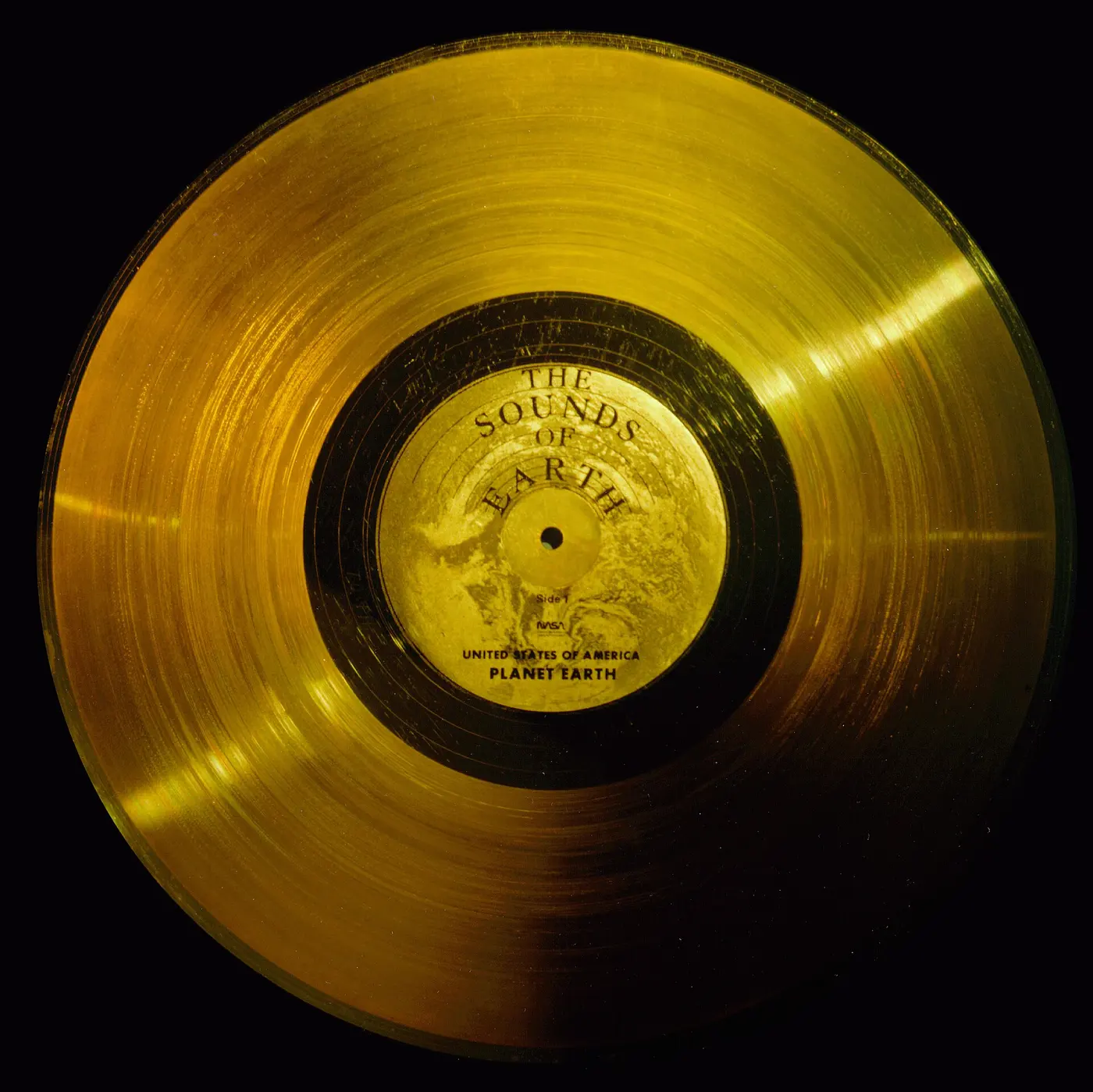

The team assembled 115 images; natural sounds such as surf, wind, thunder, birds and whales; music from different cultures and eras; and spoken greetings in 55 languages. Printed messages from President Jimmy Carter and U.N. Secretary-General Kurt Waldheim were added too.
The record itself is a gold-plated copper disc 12 inches (30 cm) across. According to NASA, the blank records came from a company in France, lacquer masters were cut in Colorado, and a plant in California turned them into eight gold-plated records.
Fifty-five languages and 27 pieces of music
The greetings begin with Akkadian, which NASA describes as spoken in Sumer about 6,000 years ago, and end with Wu, a modern Chinese dialect. Japanese is among them.
The music runs about 90 minutes: 27 pieces, opening with Bach’s Brandenburg Concerto No. 2 and closing with the Cavatina from Beethoven’s String Quartet No. 13. Alongside the Queen of the Night’s aria from Mozart’s The Magic Flute and Stravinsky’s The Rite of Spring are Chuck Berry’s “Johnny B. Goode,” Louis Armstrong’s jazz, a Georgian choral song, and music from Peru and Papua New Guinea.
Japan’s entry is a classical piece for shakuhachi, the Japanese bamboo flute, titled “Sokaku-Reibo,” also known as “Tsuru no Sugomori” (“Cranes in Their Nest”). According to the Japanese encyclopedia Nipponica, it was played by Goro Yamaguchi of the Kinko school of shakuhachi. The piece depicts the love between crane parents and their chicks, from nesting to fledging, and nearly five minutes of it set off into space as “the sound of Japan.” In 1992, Yamaguchi was designated a Living National Treasure.
An instruction manual for aliens
The record sits in an aluminum jacket, together with a cartridge and a needle for playing it. Of course, whoever finds it may never have seen a record player, so the cover is engraved with instructions in pictures.
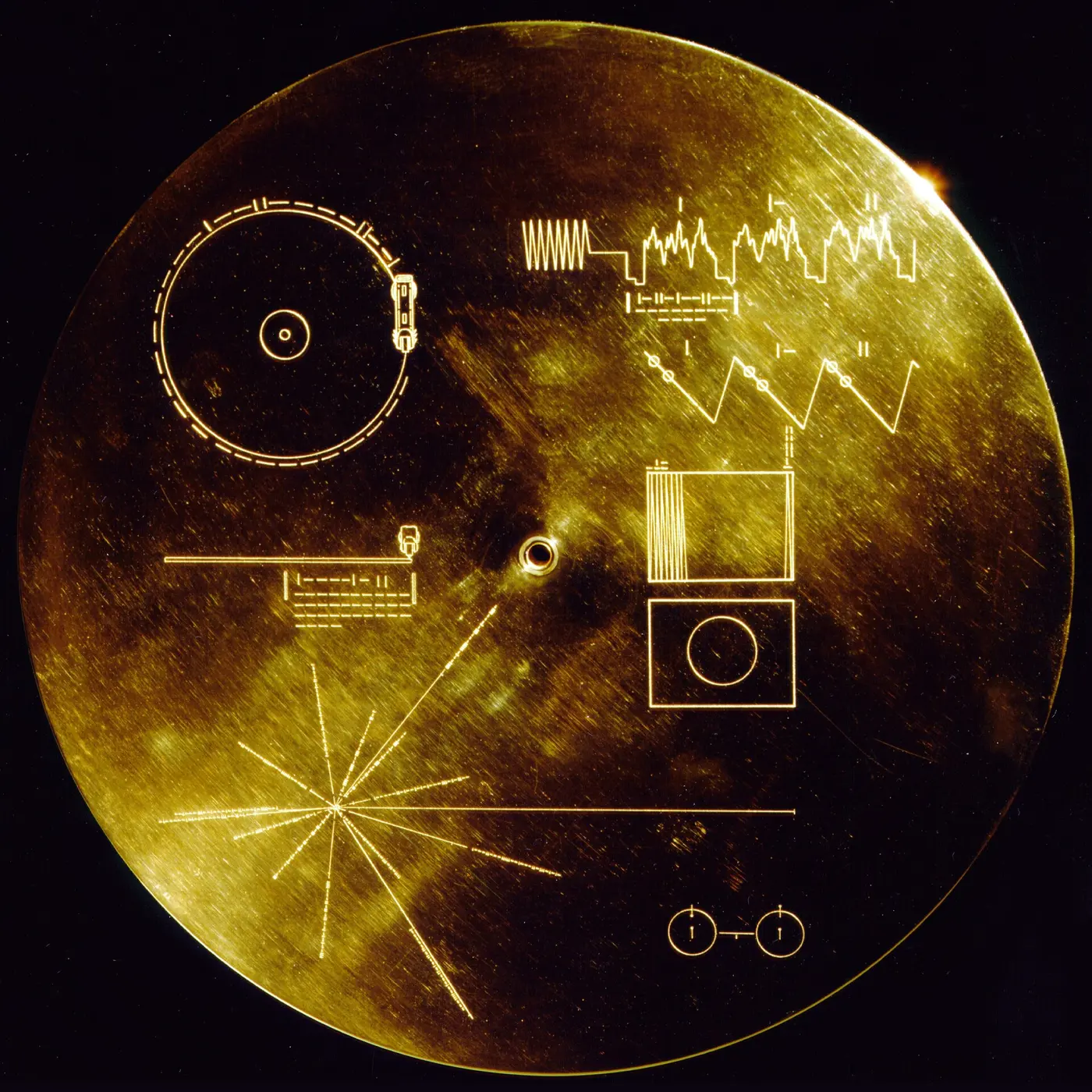

As NASA explains, the drawing at upper left shows the record and stylus and indicates that it should be played from the outside in. Written around it in binary is the time one rotation takes: 3.6 seconds. Since “seconds” mean nothing to an alien, the time is expressed in units of about 0.7 billionths of a second, the period associated with a fundamental transition of the hydrogen atom. The two circles at lower right, a drawing of that atom, define the unit. The record turns at 16⅔ revolutions per minute.
The upper right shows how to turn the signals into pictures: each image is built from vertical lines, 512 of them per picture, and the first picture is a circle. If the finder decodes it and gets a proper circle, they know they are reading the signals correctly.
The starburst at lower left is a map giving the directions and periods of 14 pulsars as seen from the solar system. The cover is also electroplated with ultra-pure uranium-238. About half of it will decay in roughly 4.5 billion years, so by measuring how much remains, a finder could work out how long ago the spacecraft was launched.
A delivery tens of thousands of years away
The odds that anyone will ever play it are slim. According to NASA, it will be about 40,000 years before the Voyagers come close to another planetary system. As Sagan put it, “The spacecraft will be encountered and the record played only if there are advanced spacefaring civilizations in interstellar space. But the launching of this bottle into the cosmic ocean says something very hopeful about life on this planet.”