Is there a secret in how sunflower seeds are arranged?
Yes. The seeds form clockwise and counterclockwise spirals, and their counts tend to be Fibonacci numbers such as 34 and 55.
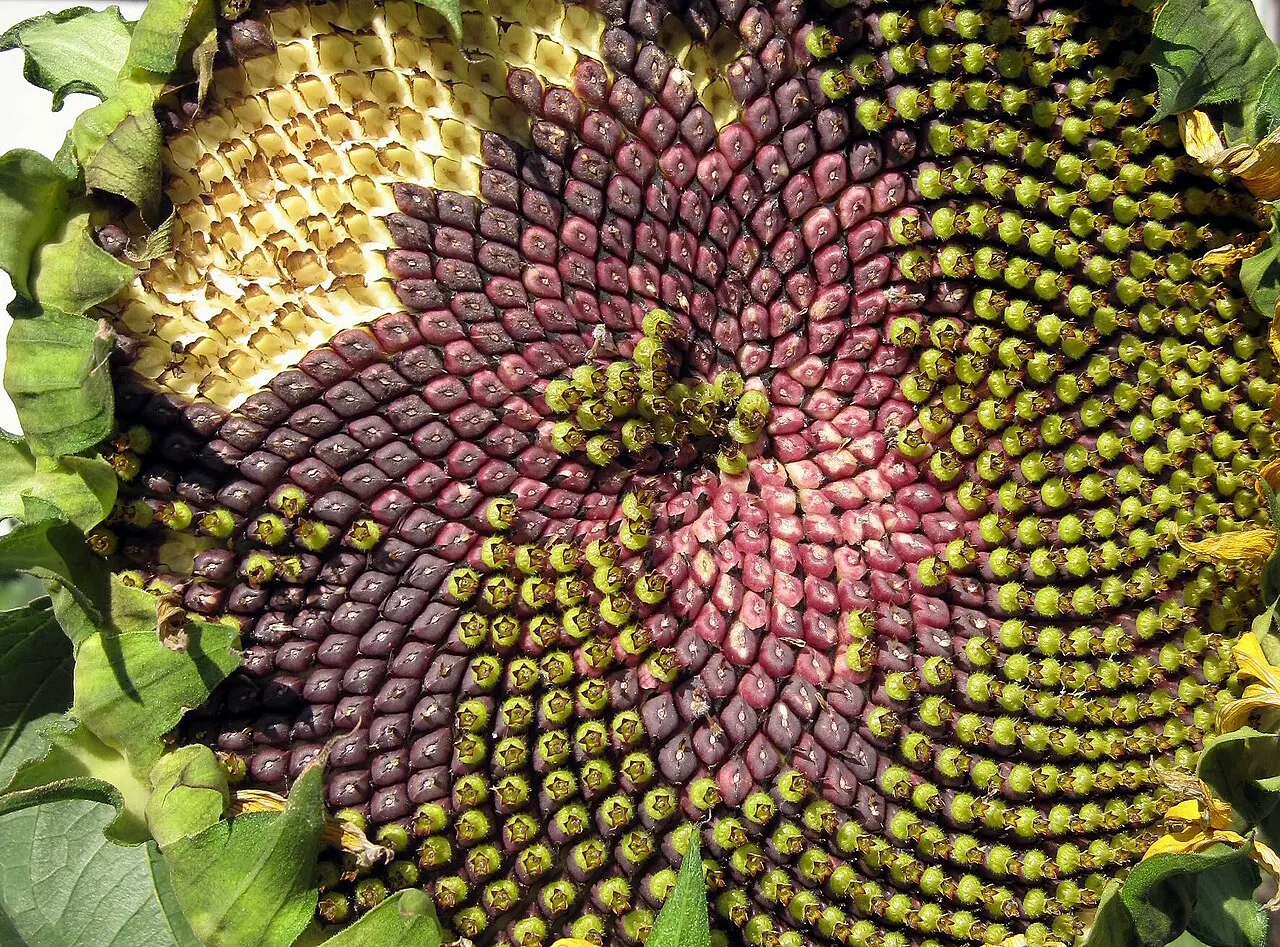
Look into a sunflower after its petals have dropped, and you will see its center crammed with seeds. Stare a little longer and the rows of seeds seem to swirl. And there is not just one set of swirls but two, one turning clockwise and one counterclockwise, laid over each other.
Count those spirals, and some curious numbers turn up.
Counting reveals Fibonacci numbers
1, 1, 2, 3, 5, 8, 13, 21, 34, 55, 89, 144… Each number is the sum of the two before it. This is the Fibonacci sequence. It spread through Europe after the Italian mathematician Fibonacci presented it in his 1202 book Liber Abaci as a puzzle about how pairs of rabbits multiply.
Count the clockwise and counterclockwise spirals of sunflower seeds separately, and you often get a pair of neighbors from the Fibonacci sequence, such as 34 and 55, or 55 and 89. A British study published in 2016 even reported a flower with 89 crisp spirals running clockwise and 55 running counterclockwise.

The key is 137.5 degrees
A sunflower’s big bloom is actually a crowd of tiny flowers, each of which becomes a seed. The secret of the spirals lies in how these tiny flowers are placed.
Each new flower sits about 137.5 degrees around from the one before. This is the smaller of the two angles you get by dividing a circle according to the golden ratio, and it is called the golden angle. In 1979, a researcher named Vogel showed that a very simple formula, turning 137.5 degrees for each new point while moving it slightly farther from the center, draws a pattern just like a sunflower’s.
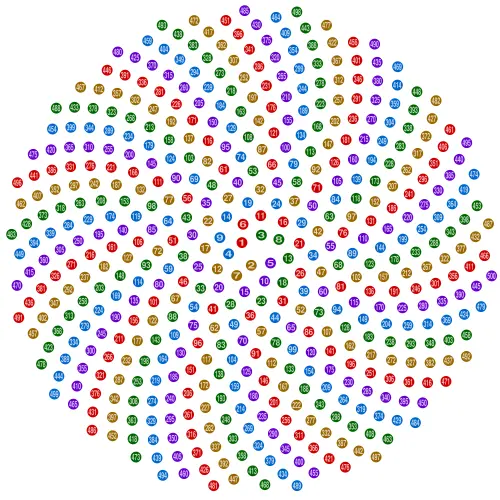

Placed at the golden angle, no point ever lines up in exactly the same direction as an earlier one. Change the angle even slightly and the points fall into radiating spokes, with gaps between them. The golden angle is ideal for packing seeds into a limited space without gaps. And when you follow points arranged this way with your eye, spirals in Fibonacci numbers appear on their own.
Plants do not measure angles
A sunflower, of course, does not carry a protractor. In 1868, the German botanist Wilhelm Hofmeister proposed that each new leaf or flower bud forms in the least crowded spot at the growing tip.
A 2003 study by a team including researchers at the University of Bern in Switzerland explained how, using the plant hormone auxin. Buds that have already formed draw auxin away from their surroundings, so a new bud can only form where auxin builds up, at a certain distance from the existing ones. Simply repeating this rule of “form the next bud away from the last ones” is thought to produce an arrangement close to the golden angle. In 1992, French physicists demonstrated something similar in the lab: they dropped beads of a magnetic liquid at regular intervals onto the center of a dish of oil, and as the beads repelled each other and spread outward, they traced the same kind of spirals.
Turing’s unfinished homework
One of the people drawn to this puzzle was the British mathematician Alan Turing, who laid the theoretical foundations of the modern computer. Until his death in 1954, he was working on the mathematics of how leaves and seeds are arranged in plants.
In 2012, the centenary of his birth, the Museum of Science and Industry in Manchester, England, ran a project called Turing’s Sunflowers, inviting the public to grow sunflowers and count their spirals. Of the 657 flowers collected, the most reliable set of 768 counts showed that 74 percent were Fibonacci numbers, rising to 82 percent when similar number sequences were included. The remaining fifth or so included counts one off from a Fibonacci number and counts that fitted no rule at all, a clear sign that nature’s patterns are not quite as tidy as mathematics.