Does an ear of corn have as many silks as kernels?
To begin with, yes. Each silk leads to one potential kernel, and only the ones that receive pollen grow into kernels.
750–1,000silks
Summer corn piled high at the market. Peel back the husk and a bundle of fine threads spills out from the tip and sticks to your fingers. Most of us pull these “silks” off and toss them before the corn goes into the pot.
You may have heard the claim that an ear of corn has exactly as many silks as kernels. Takii, a major Japanese seed company, lists it among its fun facts about corn. With hundreds of kernels on every ear, is it really one silk per kernel?
Silks are part of the flower
Corn produces separate male and female flowers on the same plant. The male flowers form the tassel at the very top of the stalk. The female flowers form the ear, the part we eat, which grows where a leaf meets the stalk.
An ear is a thick central cob lined with neat rows of female flowers. From each one grows a single long, hair-like style, the stalk-like part of the flower’s female organ. Bundled together and poking out of the end of the husk, these styles are the silk. The name is apt: in Japanese they are called kenshi, “silk thread,” too.
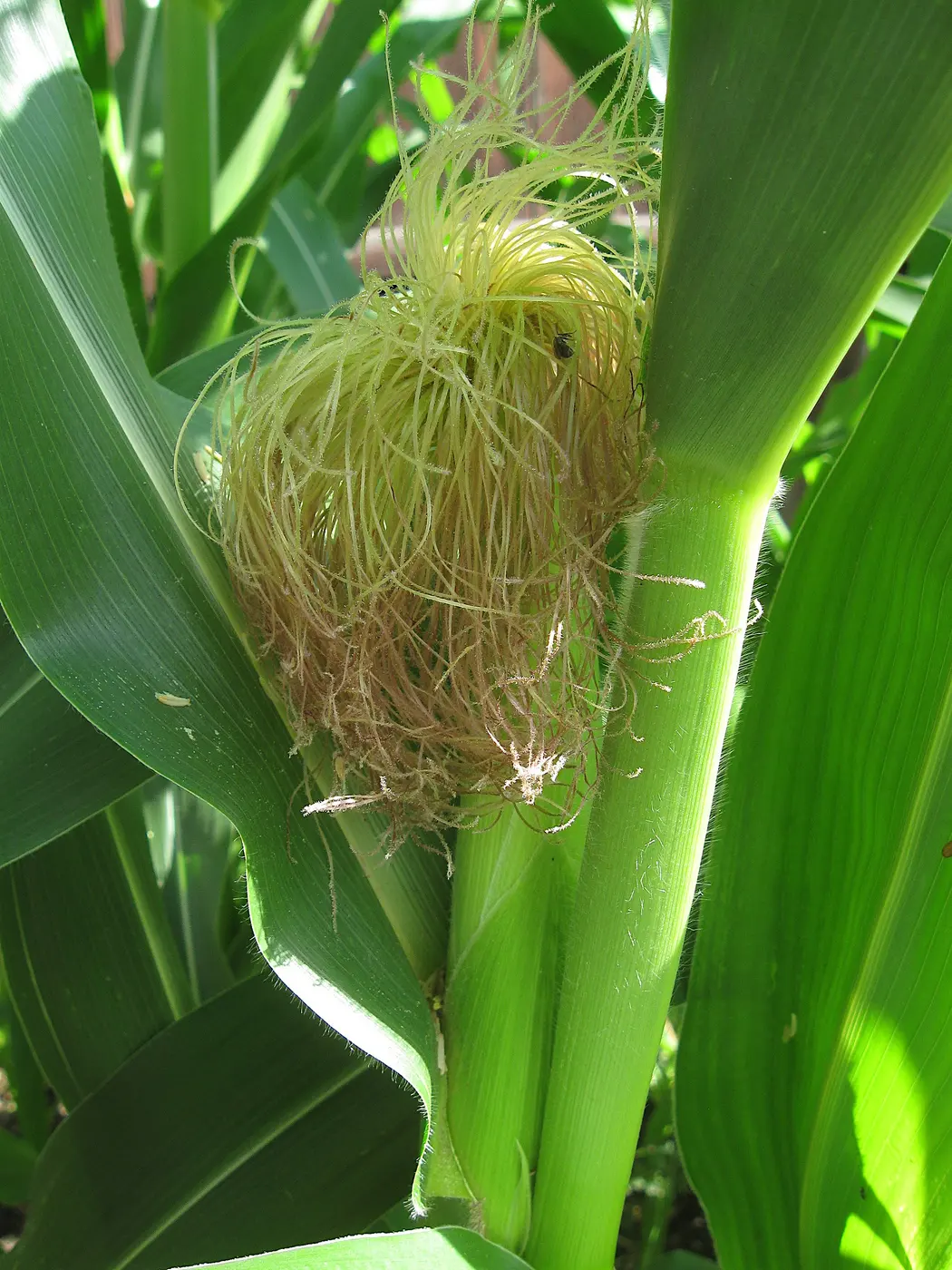

According to agronomists at Purdue University in Indiana, each silk connects to a single ovule, a potential kernel. So the number of silks is exactly the number of places where a kernel could form. For typical US hybrids, that comes to roughly 750 to 1,000 per ear.
One silk, one grain of pollen
Here is how a silk becomes a kernel.
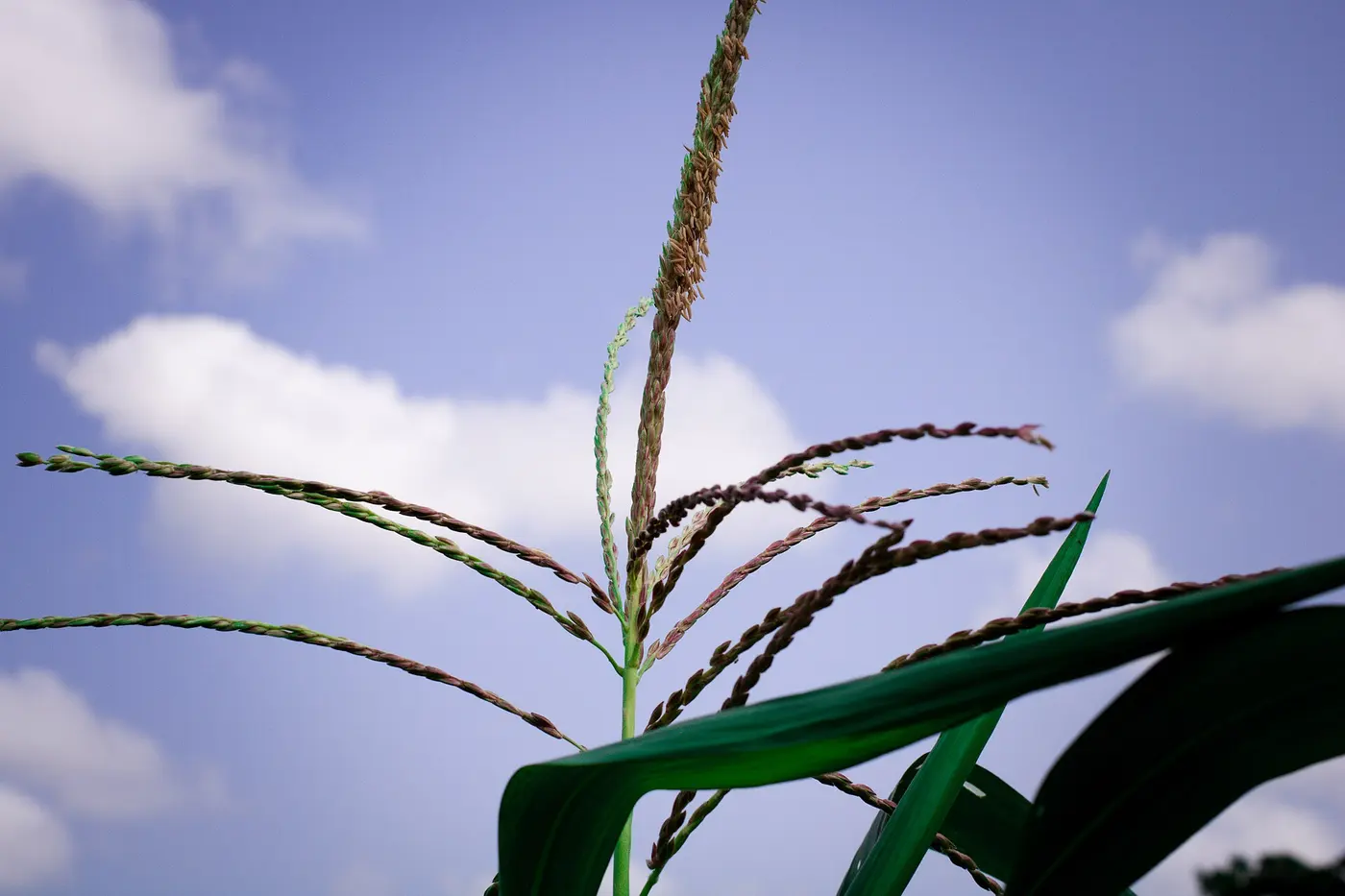
The tassel at the top of the plant is estimated to produce somewhere between 2 million and 25 million pollen grains. The wind carries them off, and some land on silks. A pollen grain germinates within minutes, sending a thin pollen tube down through the inside of the silk toward the cob. Within about 24 hours the tube reaches the ovule and fertilizes it. Several grains may germinate on one silk, but typically only one does the fertilizing.
Once that happens, the silk stops growing, and within two or three days it detaches from the ovule. Only fertilized ovules swell and develop into kernels.

Why kernels can fall short
So could you count the silks and know the number of kernels? Strictly speaking, an ear ends up with as many kernels as silks, or fewer. An ovule whose silk never caught pollen does not become a kernel.
Purdue’s figures for grain corn show how big the gap can be. An ear typically forms up to 1,000 ovules, but only 400 to 600 kernels usually survive to harvest.
Timing plays a part. Silks emerge from the base of the ear first and from the tip last, and it takes four to eight days for all of them to appear. A silk can catch pollen for up to 10 days after it emerges, but most successful fertilization happens in the first four or five. Drought can delay the silks while hurrying the tassel along, so that by the time the silks finally appear, the pollen may be gone. Mismatches like this are one reason ears end up with gaps.
The rows come in even numbers
One more number puzzle: the rows of kernels on an ear come in even numbers.
Japan’s Ministry of Agriculture, Forestry and Fisheries explains it simply for children. As the ear develops, cells split in two, so kernels come in pairs; slice an ear crosswise and you can see two kernels joined at the base. Purdue gives the same picture in more detail. Each row starts as a single ridge of cells that later divides into a pair, so the row count is even unless severe stress disrupts development.
US hybrids usually have 12 to 22 rows, most often 14 to 18. The row number is set very early, soon after the ear begins to form, and depends mainly on the variety.