Why was the stethoscope invented?
In 1816, the French physician René Laennec hesitated to press his ear to a young woman’s chest, so he rolled paper into a tube and listened through that instead.
A doctor presses a stethoscope to your chest, listens, and moves it a little. Slung around the neck, it is almost a uniform in itself. Yet a little over 200 years ago, the instrument did not exist. A physician who wanted to hear a patient’s heart or lungs simply put an ear against the patient’s chest.
The stethoscope was invented by the French physician René Laennec, and it began with a moment of hesitation in front of a young female patient.
An ear that could not be used
Laennec was born in 1781 in Quimper, in Brittany in western France. In 1816 he took up a post as a physician at the Necker Hospital in Paris.
At the time, doctors had few ways of finding out what was happening inside the chest. One was percussion: tapping the chest with the fingers and listening to how it resonated. The Austrian physician Leopold Auenbrugger had published the method in 1761, and Laennec’s own teacher, Jean-Nicolas Corvisart, had done much to spread it. The other was to put an ear directly on the chest.
In a book published in 1819, Laennec described what happened in 1816. He was consulted about a young woman with general symptoms of heart disease. Because she was rather stout, laying a hand on her chest or tapping it told him very little. But her age and sex ruled out the other option of placing his ear against her chest.
A roll of paper
Then Laennec recalled a well-known fact of acoustics. Put your ear to one end of a long wooden beam, and you can hear the scratch of a pin at the other end with surprising clarity.
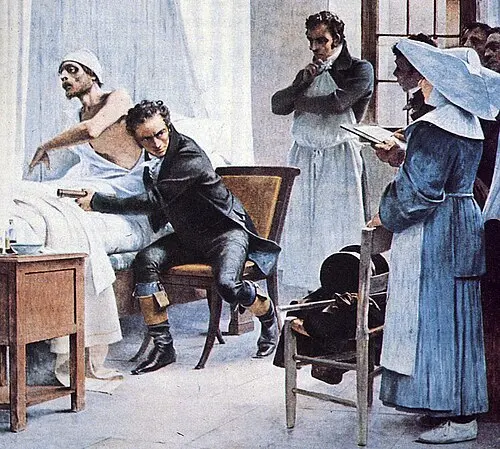
He took a quire of paper, rolled it into a tight cylinder, and placed one end over the patient’s heart and the other at his ear. The heartbeat came through far more clearly and distinctly than it ever had with his ear directly on the chest. Laennec wrote that he was as surprised as he was pleased.

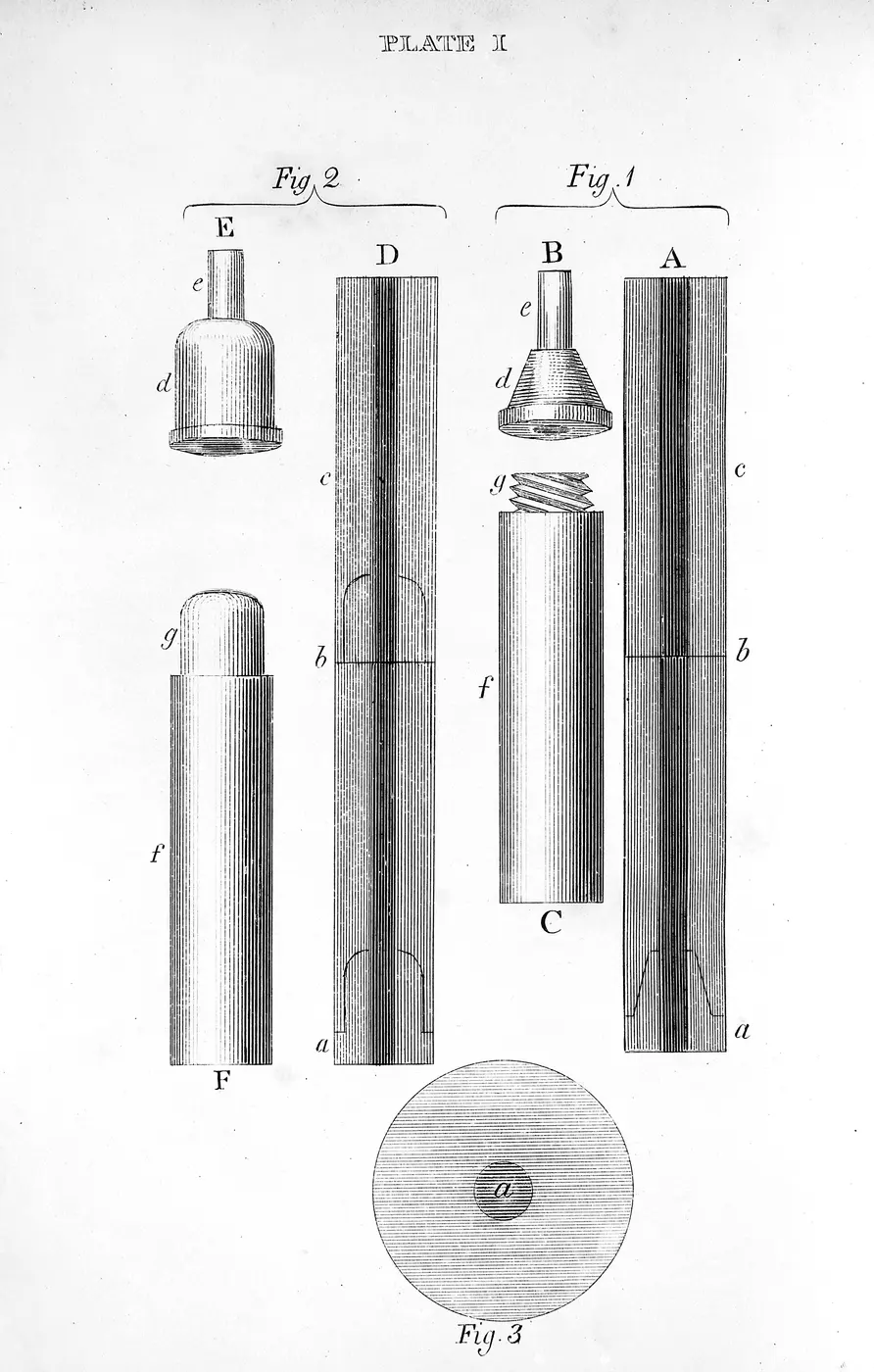
He soon replaced the paper with wood and kept refining the design. According to his book, the instrument was about one French foot long, roughly 30 centimeters (1 foot), and it came apart in the middle so that it could be carried more easily. At first he simply called it le cylindre, “the cylinder.” Later he named it the stethoscope, from the Greek stethos, “chest,” and skopein, “to look at” or “to examine.”
In August 1819 Laennec published his two-volume treatise De l’auscultation médiate (On Mediate Auscultation). It matched the many sounds of the heart and lungs, one by one, with the diseases he later confirmed at autopsy. An English translation followed in 1821, and the stethoscope spread among physicians across Europe.
What about the children at the Louvre?
There is another, more charming version of the story. Walking through the courtyard of the Louvre in Paris, Laennec is said to have seen children playing with a long piece of wood, one scratching an end with a pin while another listened at the far end, and to have had his idea on the spot.
Laennec’s own book, however, mentions no children and no Louvre. It says only that he remembered a well-known acoustic phenomenon. According to the Canadian medical historian Jacalyn Duffin, the scene with the children was told by Laennec’s younger colleague, the physician Le Jumeau de Kergaradec, in a speech given in 1868, more than 40 years after Laennec’s death, when a statue of him was unveiled in his hometown of Quimper. The historian Mirko Grmek later examined how far the account can be trusted.
The wooden beam and the pin come from Laennec himself. The children playing in the courtyard came later, in a story told about him. It is best to keep the two apart.
From one tube to two ears
Laennec’s stethoscope was a single tube that you listened to with one ear. The instrument began to look more like today’s in the 1850s. Around 1852, the New York physician George Cammann designed a binaural stethoscope with flexible tubes that carried sound to both ears, and it became widely available.
Laennec himself died in 1826, at the age of 45. The cause was tuberculosis, one of the diseases he had studied most closely with his stethoscope. In his will, he is reported to have left his stethoscope to his nephew, calling it the best part of his legacy.