Whose voice was the first ever recorded?
The oldest recognizable voice recording yet recovered is a song captured on paper in 1860 by the Frenchman Édouard-Léon Scott de Martinville, 17 years before Edison’s phonograph.
17years
In 1877, the story goes, Thomas Edison shouted “Mary Had a Little Lamb” into his newly invented phonograph, and the machine said it back to him. It is often described as the first time a human voice was ever recorded.
Sound had in fact been recorded in France some 20 years earlier. And in the 21st century, some of those recordings were turned back into sounds you can actually hear.
Edison and “Mary Had a Little Lamb”
According to the IEEE’s engineering history website, Edison sketched the phonograph on November 29, 1877, and a working model was built a few days later. Tinfoil was wrapped around a hand-cranked cylinder, and the vibrations of the voice moved a needle that pressed a groove into the foil. In Edison’s own telling, his machinist John Kruesi thought it absurd when told the machine would talk back. But when Edison shouted “Mary had a little lamb,” the machine repeated it perfectly. “I was never so taken aback in my life,” Edison said. On December 7 he demonstrated it at the New York offices of Scientific American, and on December 24 he applied for a patent.
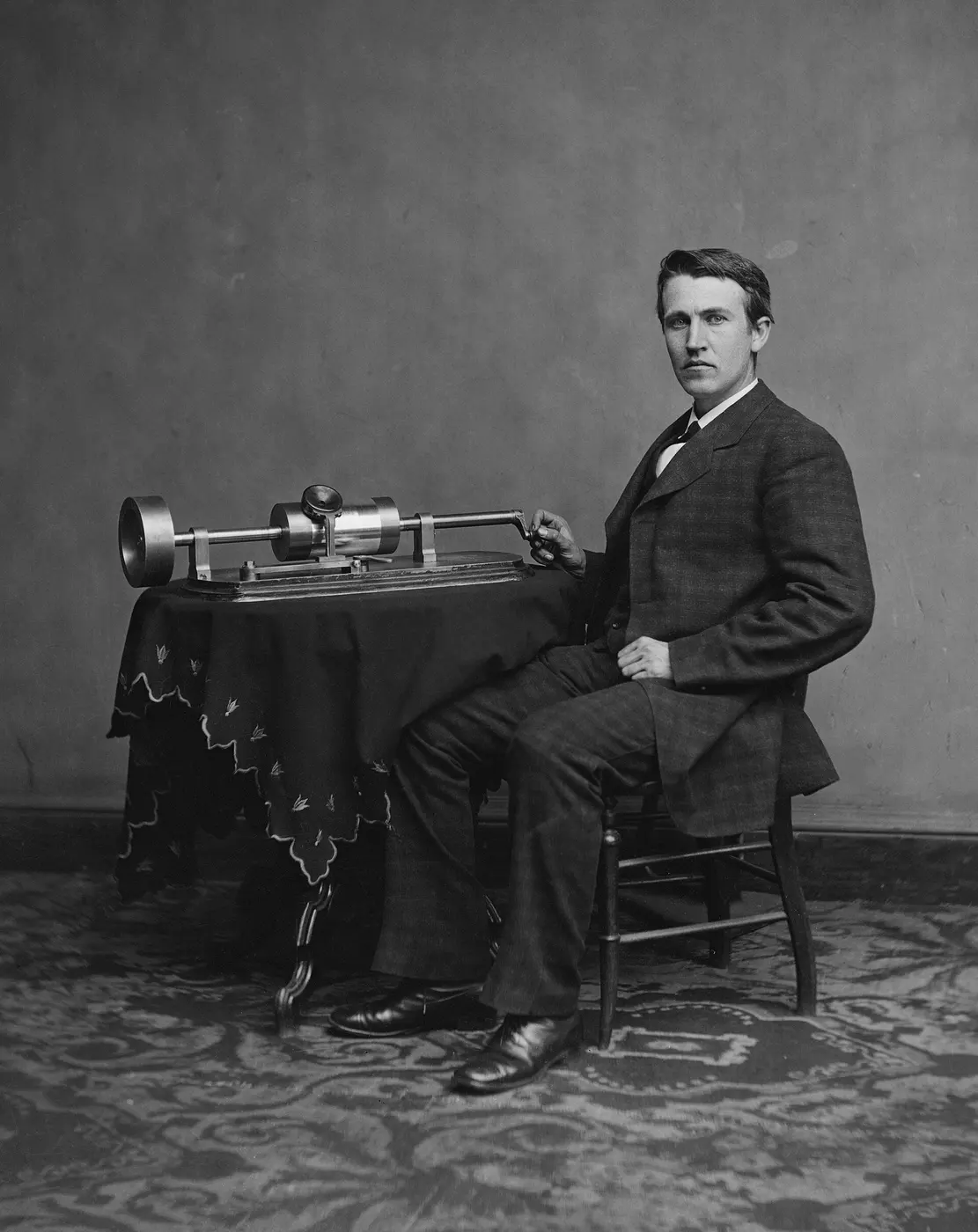

That may not have been the rhyme’s first outing, though. According to the U.S. National Park Service, Edison’s assistant Charles Batchelor recalled an experiment that summer in which sound was embossed onto a strip of paper. Edison recited “Mary had a little lamb,” one of the stock phrases they used when testing telephones, and on playback they got something like “ary ad elll am.” It wasn’t clear speech, Batchelor said, “but the shape of it was there.”
Either way, none of those first recordings survive. According to the IEEE site, the test recordings of 1877 and 1878 were almost all lost, and the few tinfoils that remain have never been played. The Edison “Mary Had a Little Lamb” that people hear today was recorded in 1927, when he recited the rhyme again at a ceremony marking the phonograph’s 50th anniversary.
A machine that wrote sound
The first person to record sound was a Parisian, Édouard-Léon Scott de Martinville (1817–1879). According to the National Park Service, Scott was an editor and typographer at a scientific publishing house. In 1853 or 1854, while reading a text on human physiology, he wondered whether a copy of the ear could capture spoken words the way a camera, with its lens modeled on the eye, captured images. He called it “the imprudent idea of photographing the word.”
His phonautograph collected sound with a horn and made a membrane vibrate. A fine bristle attached to the membrane traced the vibrations as wavy lines on a surface coated with soot. Scott patented it in 1857. The tracings were meant to be studied by eye; no one intended them to be played back.
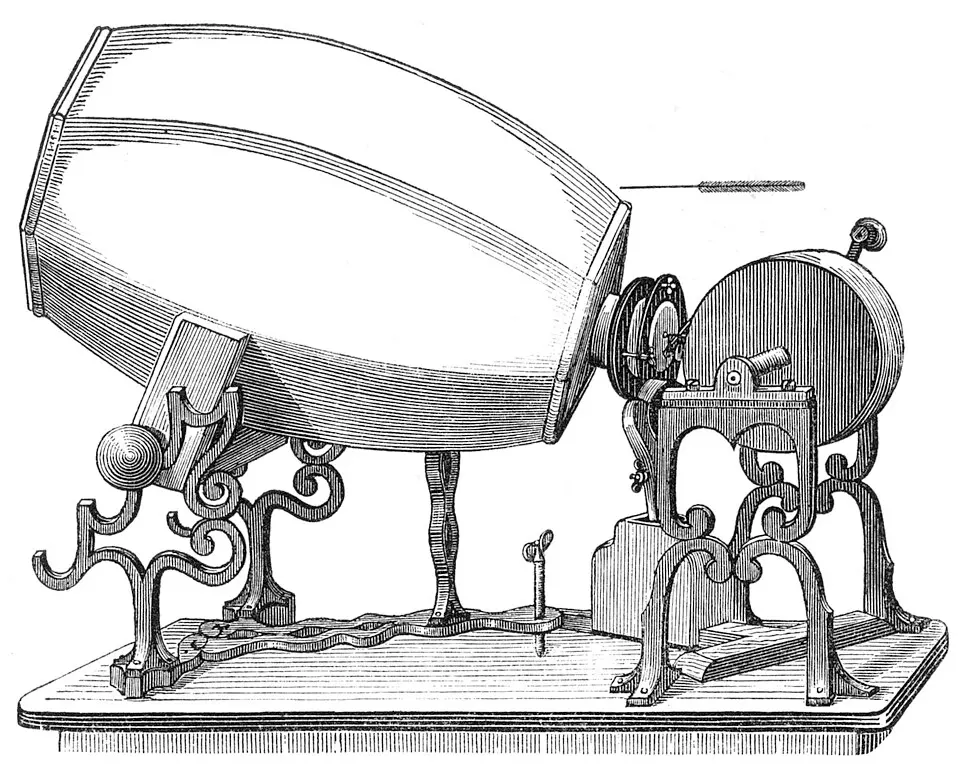

From 1860, Scott also traced the vibrations of a tuning fork alongside his recordings. A tuning fork vibrates at a fixed rate, so its trace shows how fast the hand-cranked cylinder was turning at every moment. That detail would matter enormously 150 years later.
A song brought back
In March 2008, First Sounds, a group of American audio historians, announced that they had played back one of Scott’s recordings preserved at the Academy of Sciences in Paris, using imaging technology from Lawrence Berkeley National Laboratory. It was the French folk song “Au Clair de la Lune,” recorded on April 9, 1860. The New York Times put the story on its front page, and it was soon news around the world.
At first the singer sounded like a young woman or a girl. But in 2009, when the team played a recording of Scott reciting Italian verse at the same speed, it came out sounding like the Chipmunks. They realized they had misread the tuning fork’s frequency, and the correct speed was half as fast. Slowed down, the song turned out to be sung by a man, most likely Scott himself. One clue was a note he had written on the Italian recording: “I was wrong,” followed by the correct word order.
First Sounds describes “Au Clair de la Lune” as the earliest clearly recognizable recording of a human voice yet recovered. Recordings from 1857 have also been found, but the cranking speed varied so wildly that no melody can be made out.
Recording and playback were separate inventions
The National Park Service sums it up this way: Scott was the first to record sound, the Frenchman Charles Cros was among the first to suggest playing it back, and Edison built the first machine that did both. Edison’s phonograph wasn’t the first machine to record sound. It was the first to let people hear a recording.
Late in life, as Edison’s invention made headlines, Scott self-published a collection documenting his own work, trying to set the record straight for future generations. His voice finally reached those generations almost 130 years after his death.