What view does Van Gogh’s The Starry Night show?
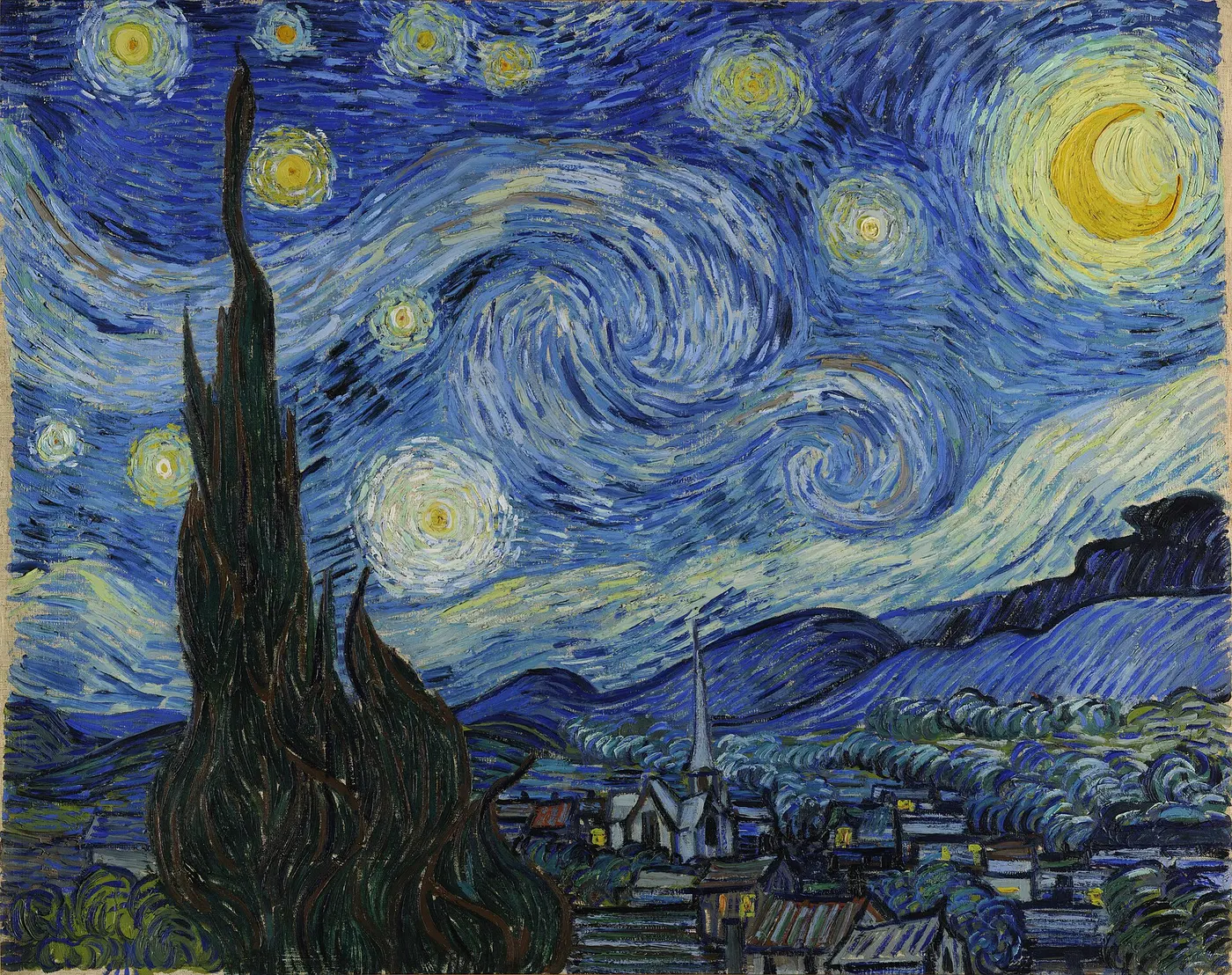
It is based on the predawn view from the east-facing window of his room at an asylum in southern France. The village, however, was added from imagination.
Light whirls across the sky, a cypress rises like a dark flame, and beneath it all a village sleeps. Vincent van Gogh’s The Starry Night, in the collection of the Museum of Modern Art (MoMA) in New York, is one of the most famous paintings in the world.
It is so dreamlike that it might seem to come straight from the artist’s imagination. But behind it there is a real window, and a real predawn sky that Van Gogh saw with his own eyes.
A window with iron bars
In December 1888, in Arles in the south of France, Van Gogh suffered a mental breakdown and injured his own ear. On May 8, 1889, he voluntarily entered the asylum of Saint-Paul-de-Mausole in the nearby town of Saint-Rémy-de-Provence. The asylum occupied a former monastery and had plenty of empty rooms, so besides his bedroom on the upper floor, he was given a room on the ground floor to use as a studio.
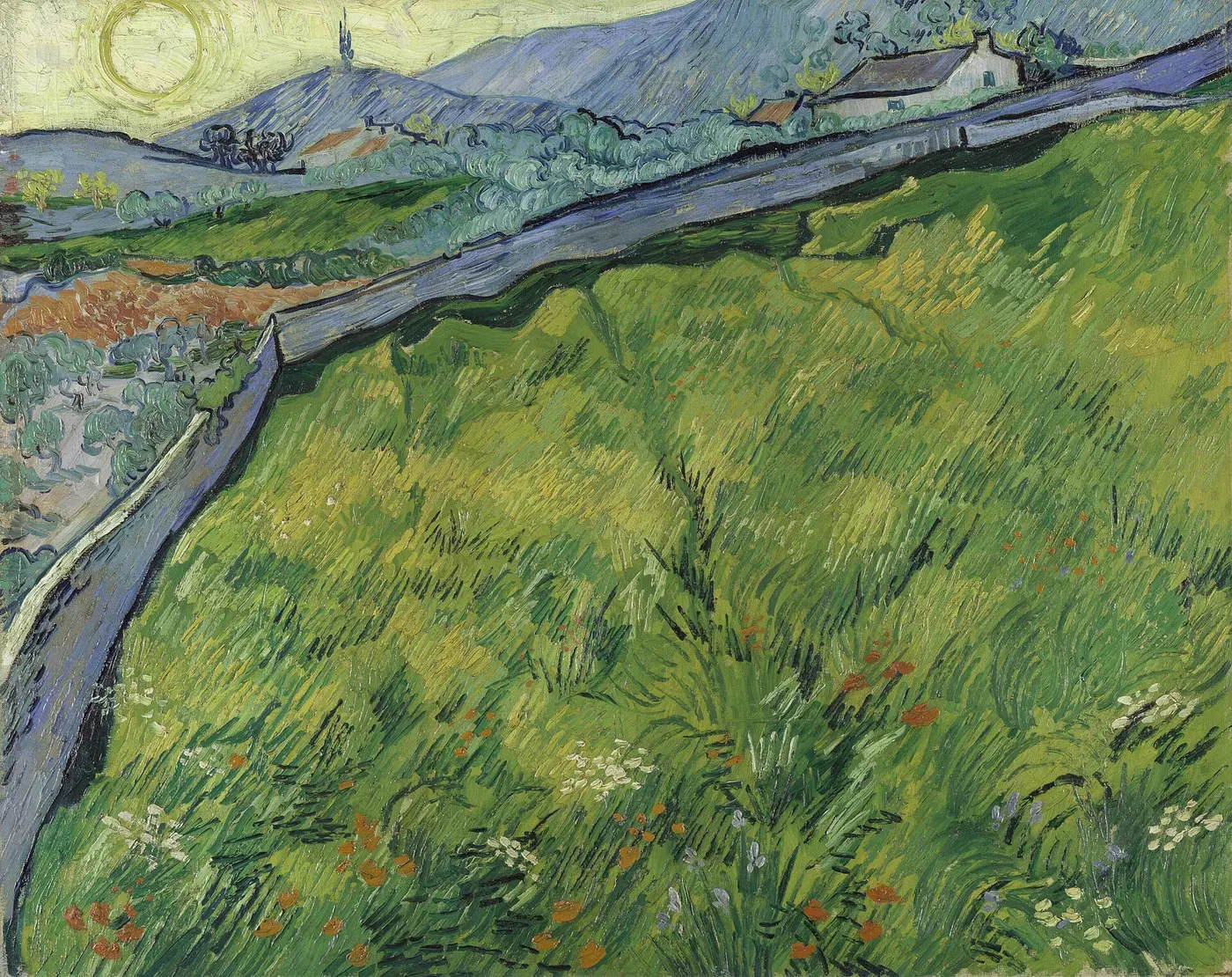
Soon after he arrived, in late May, he wrote to his brother Theo that through the iron-barred window he could see an enclosed field of wheat, above which he watched the sun rise in all its glory in the morning. His bedroom window faced east. Van Gogh painted that view again and again, in the morning and at midday, in sunshine and after a storm. He is thought to have made only drawings in his bedroom and finished his oil paintings in the studio downstairs.
The morning star, looking very big
In a letter to Theo written in early June, there is this line: “This morning I saw the countryside from my window a long time before sunrise, with nothing but the morning star, which looked very big.” Then, around June 18, he reported that he had painted “a new study of a starry sky.” That study is generally taken to be The Starry Night. He did not paint it outdoors at night, but in the studio, from sketches and memory.
The morning star is Venus, shining in the east before dawn. In the 1980s the American art historian Albert Boime and the Harvard astronomer Charles Whitney each studied the painting’s sky independently. Both confirmed that Venus was visible before dawn in Provence in the spring and early summer of 1889, and Boime found that it was then close to its maximum brightness. The especially large star just to the right of the cypress is thought to be Venus.

A moon that doesn’t fit, and a village he couldn’t see
The slim crescent moon at upper right, on the other hand, does not match the real sky. In mid-June 1889 the Moon was just past full and starting to wane, still a large, rounded shape rather than a thin sliver.
There was one more thing he could not see from his window: the village. Boime pointed out that it was the only element of the landscape that was not visible from there. One view holds that it was based on a sketch Van Gogh made looking down on Saint-Rémy from a hillside behind the asylum. Its tall, needle-like steeple has also been said to look more like a church in his native Netherlands than one in Provence. The hills and the cypress come from the view out the window; the village comes from somewhere else, and from memory.

The painter called it a failure
According to Boime, there is one other unrealistic element besides the village: the great swirls across the sky. Boime and Whitney both suggested the influence of telescopic drawings of spiral nebulae (what we now call galaxies), which appeared in popular astronomy books of the day. Whitney added that the swirls might also evoke the mistral, the fierce north wind of Provence.
The Van Gogh brothers themselves were not especially pleased with the picture. In October 1889, Theo wrote that he could sense what absorbed Vincent in new canvases such as “the village in the moonlight,” but that the search for style seemed to take away the real feeling of things. And in November, writing to his fellow painter Émile Bernard, Van Gogh grumbled that he had once again let himself be led astray “into reaching for stars that are too big — another failure.”
Yet this was the painting that would become his signature. According to the Van Gogh Museum in Amsterdam, when MoMA acquired The Starry Night in 1941, it became the first Van Gogh to enter a New York museum collection.