Did cataracts change Monet’s paintings?
Most likely, yes. As his cataracts worsened, his colors turned to reds and browns and his brushwork grew rough; after surgery, softer blues and greens returned.
A pond dotted with water lilies, a green arched footbridge, the sky reflected in the water. The French painter Claude Monet painted the garden he created at his home in Giverny, a village northwest of Paris, until the end of his life.
Yet some of his paintings of that same garden from around 1920 are smothered in reds and browns, and the bridge can barely be made out. That change, it is widely thought, has a great deal to do with the cataracts that were slowly clouding his eyes.
A painter in a fog
A cataract is a clouding of the lens inside the eye, and it becomes common with age. Monet is said to have noticed his eyesight failing around 1908, and in 1912 he was diagnosed with cataracts in both eyes. In 1913 he went to London to consult the German-born ophthalmologist Richard Liebreich, who prescribed new glasses and recommended surgery on the right eye. Monet refused.
According to an article by the ophthalmologist Anna Gruener in the British Journal of General Practice, Monet was frightened by what had happened to fellow artists Honoré Daumier and Mary Cassatt, whose cataract operations had gone badly. Even when his close friend Georges Clemenceau, twice prime minister of France, urged surgery, Monet would not budge. He would rather make the most of his poor sight, he said, and even give up painting if necessary, “but at least be able to see a little of these things that I love.”
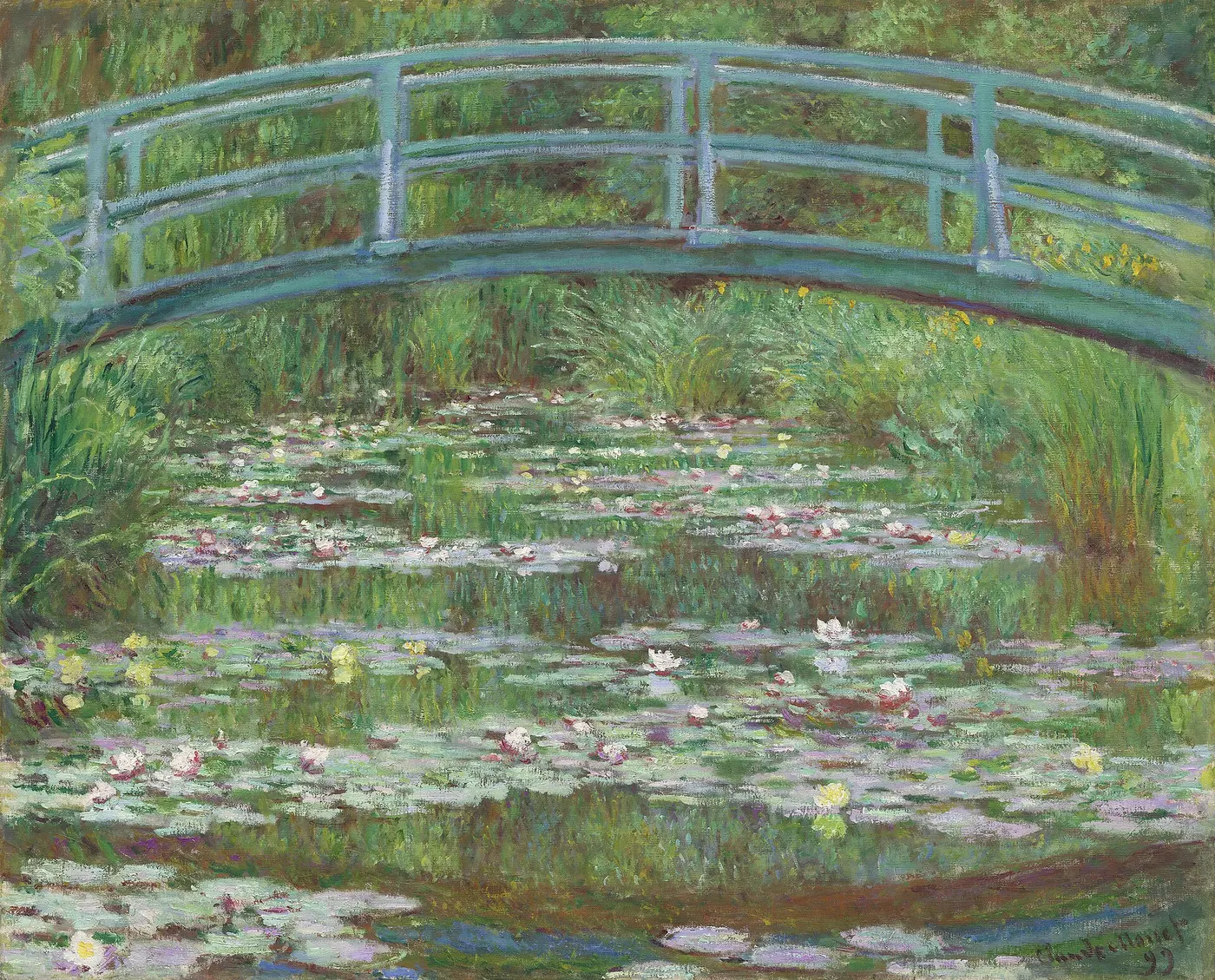

Muddy reds and darkening canvases
As the cataracts advanced, Monet’s sense of color shifted. He complained that colors no longer had the same intensity for him, that reds had begun to look muddy, and that his painting was getting darker and darker. To avoid picking the wrong colors, he labeled his tubes of paint and kept a strict order on his palette. Outdoors, he wore a big straw hat against the glare.
A cataract lens turns yellow or brown and blocks much of the blue and violet light that would otherwise reach the retina. Gruener writes that Monet’s brushstrokes became broader and his paintings, like his cataracts, more brownish. Set his 1899 painting of the footbridge beside one from around 1920, and the difference is plain to see.
The operation of 1923
In 1922 Monet saw another ophthalmologist, Charles Coutela, who found that his right eye could perceive only light and his left eye had about 10 percent of normal sight. Monet still refused surgery, so Coutela first prescribed drops to dilate his pupils and let more light past the clouded lenses. Within a week Monet wrote to him: “It is all simply marvellous. I have not seen so well for a long time.” The effect did not last.
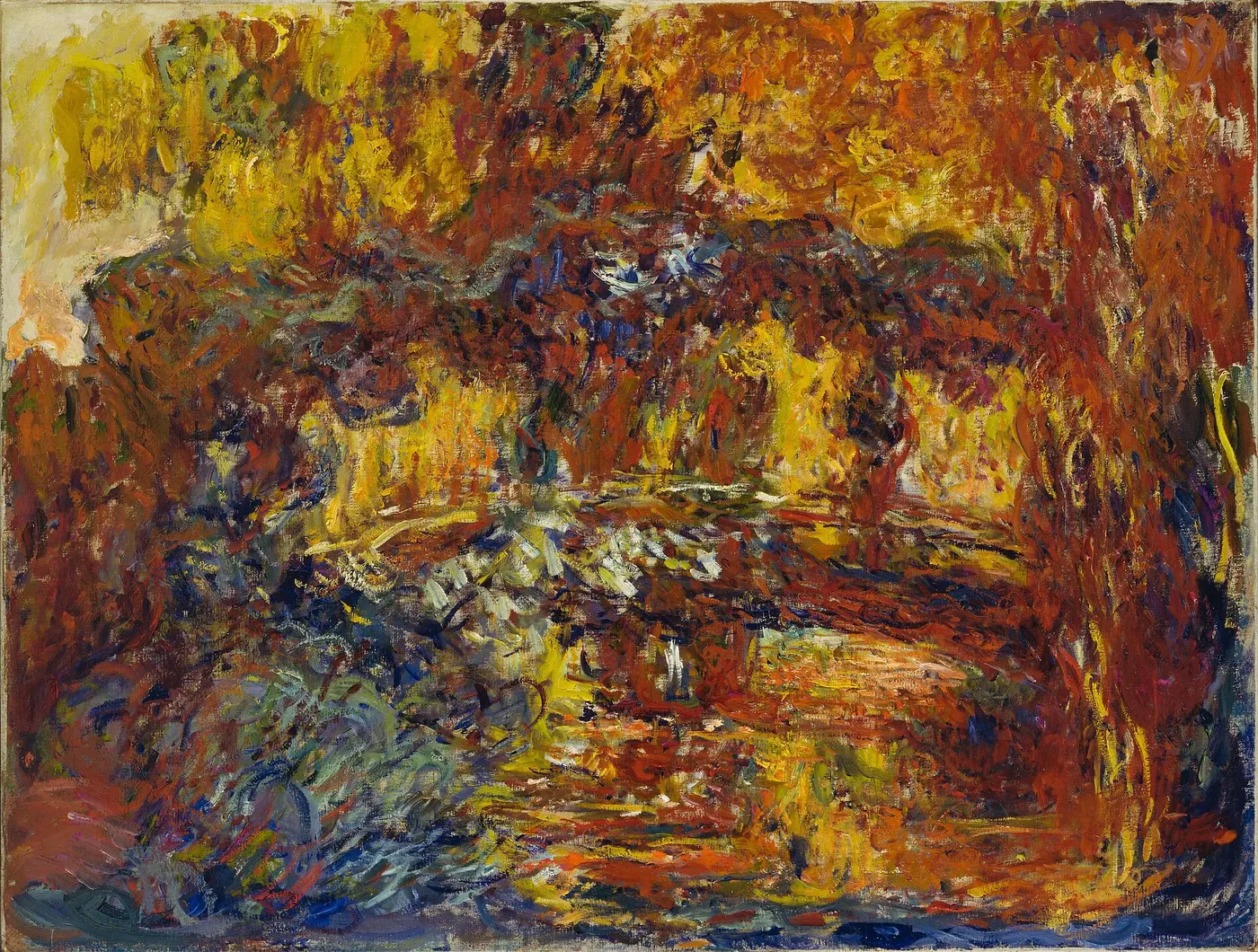

Early in 1923, Monet finally had surgery on his right eye: a two-stage procedure in which part of the iris was removed and then the clouded lens was taken out. Afterward he had to lie flat on his back, with sandbags on either side to keep him still. Impatient and unwilling to follow instructions, he had a miserable time. After a further minor procedure, he wrote to Coutela that he bitterly regretted “having had this fatal operation.”
An eye without its lens needs very strong glasses, and Monet now suffered from cyanopsia, seeing everything with a bluish tint, while objects seemed to curve oddly. Now able to see the real colors of his recent work, he also destroyed some canvases from before the operation. In 1924 another ophthalmologist, Jacques Mawas, fitted him with tinted lenses made by the German firm Zeiss, and in the end his unoperated left eye was covered completely with a black lens.
By 1925 the sight in his right eye, with glasses, had recovered to about 70 percent of normal, and Monet went back to work. His postoperative paintings drop the harsh reds and coarse handling, returning to gentle blues and greens reminiscent of his work before 1914. Gruener concludes that the rough style of his late years was most likely the result of his cataracts rather than a deliberate experiment.
Could he see ultraviolet?
One popular theory holds that after his operation, Monet could see ultraviolet light.
The lens of the human eye absorbs ultraviolet light and keeps it from reaching the retina. According to a 2002 article in The Guardian, some people who have had their lens removed report seeing ultraviolet, normally invisible, as a whitish blue or whitish violet. The article suggested that Monet’s bluer water lilies after surgery might reflect this, since ultraviolet would have given the world a blue cast.
But that is only speculation. There is no way to check whether Monet actually saw ultraviolet light. Cyanopsia is a common symptom in people whose lens has been removed, so the bluer tones of his later work cannot simply be pinned on ultraviolet.