Are very fresh eggs harder to peel when hard-boiled?
Yes. In a freshly laid egg the white is only weakly alkaline, and it sticks to the membrane inside the shell. After a few days, carbon dioxide escapes through the shell and the egg peels much more easily.
5days
You tap a hard-boiled egg on the counter, start peeling, and big chunks of white come away with the shell, leaving the egg as pitted as the surface of the Moon. It may not be your technique. The egg may simply have been too fresh.
Poultry farmers and cooks have long known that the freshest eggs are the hardest to peel. The reason was tracked down by egg scientists in the United States in the 1950s and 1960s.
It comes down to pH
Egg white, or albumen, contains dissolved carbon dioxide. According to the US Department of Agriculture’s egg-grading manual, the albumen of a newly laid egg has a pH between 7 and 8.5, and as carbon dioxide escapes during storage, the pH generally rises. On the pH scale, 7 is neutral and higher numbers are more alkaline. So the white of a fresh egg is only mildly alkaline, and it grows more alkaline by the day.
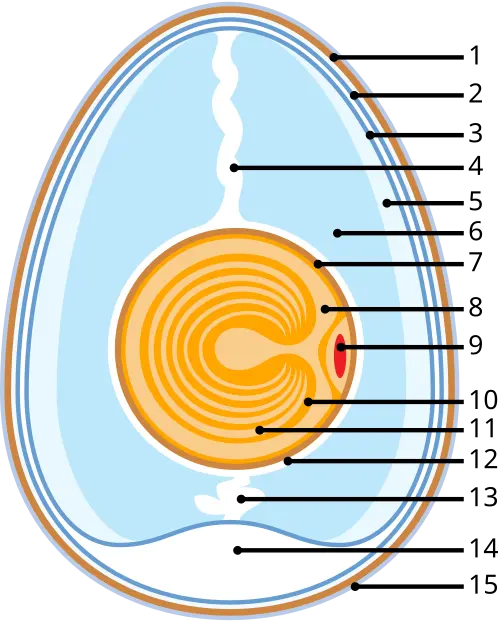
The gas escapes through tiny pores in the shell. An eggshell looks like a solid wall, but it lets gases slowly pass through. Just inside the shell lie two thin membranes, the papery skin that comes off with the shell when you peel a hard-boiled egg. Whether an egg peels cleanly depends on how firmly the white clings to that membrane.

The magic number: 8.7 to 8.9
The link between peeling and albumen pH was pointed out in 1959 by a researcher named Swanson. According to a summary in a 1969 paper in the journal Poultry Science, Swanson put the dividing line between eggs that peel badly and those that peel cleanly at a pH of about 8.7. A 1961 study by Meehan and colleagues put it closer to 8.9, and Reinke and Spencer, in 1964, settled on a range of 8.7 to 8.9.
Later experiments tested whether pH was really the cause. In a study published in the same journal in 1973, Reinke and colleagues placed older, easy-to-peel eggs in an atmosphere of carbon dioxide. The albumen pH dropped, and the eggs became hard to peel. Fresh eggs exposed to ammonia, which raised their pH, became easy to peel. Swapping the contents of fresh and old eggs before cooking them pointed the same way.
The team also looked under the microscope at the boundary between the shell membrane and the white that clings to it, and found it looked different in fresh and old eggs. They concluded that albumen pH acts directly on the membranes and the clinging white to determine how well an egg peels.
How long should you wait?
So how long should eggs sit? In a 1989 American study, also published in Poultry Science, eggs peeled easily once the pH of the raw albumen rose above 8.9. The minimum time to get there was one day at 38°C (100°F), three days at 24°C (75°F), and five days at 4°C (39°F), about refrigerator temperature. The warmer the egg, the faster its carbon dioxide escapes.

Japanese researchers studied the same question in a paper published in 1980 in the journal of the Japan Poultry Science Association. They compared eggs collected within 15 minutes of laying, still warm to the touch, with eggs that had been stored. They estimated that eggs kept at 5°C (41°F) would peel easily and taste good after about nine days. The usual rule of thumb, they noted, was a pH above 8.6 to 8.9 for easy peeling, but eggs that both peeled easily and tasted good probably needed a pH above 9.1.
Taste was part of the study because, at the time, it was said in Japan that the white of a freshly laid egg, once boiled, had a spongy texture and a less pleasant taste. Sure enough, in a taste test, 31 of the 48 panelists preferred the white of eggs kept at room temperature for seven days to that of fresh eggs.
Peeling a fresh egg
What if you keep chickens and all your eggs are fresh? According to a study published in Poultry Science in 1974, fresh eggs peeled easily if, after boiling, they were cooled in ice water for one minute and then dunked back into boiling water for just 10 seconds before peeling. Thirty seconds in liquid nitrogen followed by the same 10-second reheat also worked, though that method is less practical for most kitchens.